Glick
spreads the word about surgery
Pediatric surgeon shows NYC meeting benefits of
minimally invasive surgery via telecast
By LOIS
BAKER
Contributing Editor
Pediatric
surgeon Philip Glick is on a crusade to convince the medical community
worldwide that minimally invasive surgery—which can lessen pain,
hospitalization and recovery time for young patients, as well as lower
health costs—should be the new surgical standard for treating conditions
in children and adolescents.
| |
 |
| |
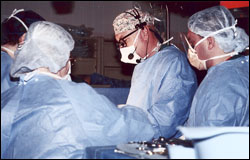
Phillip
Glick (with headset) spreads the word about the benefits of minimally
invasive surgery for children via a telecast of surgery performed
last Friday in Buffalo to a meeting in New York. |
| |
Photo:
Jessica Kourkounis |
| |
|
One
way he is spreading his message is through a 21st-century version of
show-and-tell: the surgical equivalent of teleconferencing. Glick operates
in Buffalo while an audience gathered at a distant site watches in real-time
through the technology of fiberoptics.
Glick,
professor and chair of surgery in the School of Medicine and Biomedical
Sciences and surgeon-in-chief and clinical director of pediatric surgical
services at Children's Hospital of Buffalo, is the visionary behind
a $1.5 million Miniature Access Surgery Center (MASC) at Children's
that has captured the attention of pediatric surgeons worldwide since
its opening in October 2001.
Believed
to be the most sophisticated facility of its kind in the world, the
MASC is devoted to performing, teaching and researching minimally invasive
surgical techniques and adapting them for children and adolescents.
(Glick chose the term "miniature access" rather than "minimally invasive"
in naming the center because it was more understandable to parents.)
Glick's
first telecast was transmitted last October to a meeting of the American
College of Surgeons in New Orleans. Last Friday, he corrected a congenital
chest wall deformity called "funnel chest" in a teen-aged boy in surgery
that was telecast in real-time to attendees at the Eighth World Conference
of Endoscopic Surgery at the New York Hilton. The telecast was viewed
at a demonstration booth sponsored by Stryker Communications Corp.,
which provided a grant to Children's Hospital to help equip the new
surgical center.
As
of press time, a Nissen Fundoplication—surgery to repair the esophagus
in children who have reflux—was scheduled to be broadcast from
Children's to a lecture Glick was to give Tuesday to the Mini Medical
School class meeting in Butler Auditorium in Farber Hall on the South
Campus.
The
procedure performed on Friday, called minimally invasive pectus repair,
involves inserting a removable metal strut into the patient's chest
cavity through small incisions on either side of the chest. The strut
supports the chest while the deformed cartilage is remodeled into a
normal shape. Glick has performed the surgery on more than 50 children
with excellent results.
Compared
to the standard open-chest approach, the minimallly invasive technique
causes significantly less pain to the child, cuts surgical time in half
and hospitalization by 1 1/2 days, and shortens time to complete recovery
by up to seven months, Glick said.
Marc
Levitt, assistant professor of surgery and pediatrics and medical director
of the new surgical center, moderated the procedure in New York City
at the Stryker booth.
Glick,
meanwhile, worked in an operating theater custom-designed for multidisciplinary,
minimally invasive surgeries, including laparo-scopy, thoracoscopy,
endoscopy, arthroscopy and cystoscopy. All equipment, suspended from
ceiling booms, is controlled by voice-activated computer and directed
by the surgeon speaking into a headset. Images from deep in the body
transmitted from cameras embedded in the tips of endoscopes placed at
the surgical site are projected on flat-screen televisions in the surgical
suite.
Situated
unobtrusively in the corner of each room is a communication control
center that allows images captured by these cameras to be telecast to
any location in the world equipped for teleconferencing and provides
the MASC with expansive telesurgery and "telementoring" capabilities.
"One
of the things that is different about our program in Buffalo compared
to others around the country," said Glick, "is that our entire faculty
has embraced the goal of converting over to minimally invasive surgery
as a way to think about every operation."
At
the time they began the transition, surgeons at Children's were applying
minimally invasive surgical techniques to about 5 percent of their cases.
That number is now more than 50 percent; the goal is to reach 100 percent.
Convinced that these proven techniques provide a host of benefits to
patients and their families, as well as savings in health-care costs,
UB surgeons now want to do for other pediatric surgery training programs
in the country what they've done for their own.
"There
are some programs out there that are still at 5 percent, so the children
in those cities are not benefiting from these great techniques," says
Glick. "We'd like to help change that."


