It was a medium-large, vaguely grungy classroom crowded with standard-issue desk-chairs circa 1965, marked by poor acoustics and sight lines so obstructed that some audience members had to crane their necks to see around audio-visual equipment that blocked the center aisle. Despite its shortcomings, however, 301 Crosby Hall has for more than a decade been the principle lecture hall used by the School of Architecture and Planning.
In that capacity, it has hosted multimedia presentations, lectures, debates and discussions by scores of world-class architects, designers and planners-many of them international stars-nearly always to a standing-room-only crowd.
| |
 |
| |
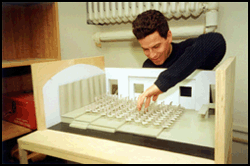
Eric Sutherland shows off a model of a redesigned 301 Crosby, the first project of the Design-Build Program. |
| |
photo: Stephanie Hamberger |
The room will play its traditional role again this weekend during Atelier, the school's annual exposition of student and faculty work, during which it will unveil its accomplishments, welcome new students and celebrate "University at Buffalo School of Architecture and Planning Day" in the City of Buffalo.
This year, however, the 70-year-old 301 Crosby will be one of the projects on display.
Redesigned and reconstructed by graduate students and faculty members in the school's nascent Design-Build Program, the "new" 301 will present its sleek, new-but not yet completed-persona to the public at 7:30 p.m. tomorrow during a reception attended by faculty, administrators, public officials, students and members of the public.
The reception will follow a 5:30 p.m. lecture in 148 Diefendorf Hall by architects Elizabeth Diller and Ricardo Scofidio, special guests of Atelier 2001, the school's annual open house and showcase event.
The transformation of 301 Crosby is taking place under the direction of former Hong Kong architect Eric Sutherland, assistant visiting professor.
"To look at the original room," he says, "you'd think it would be the least likely opportunity to do something creative and instructional with students, but it turned out to be an excellent site for us to design and build a beautiful, functional space.
"The result will be one gesture that has resulted from the work of many minds and the use of many materials and technologies. For the students, this is no simple theoretical narrative but an opportunity to research materials, implement construction techniques and to see a project through from beginning to end," he says.
Sutherland describes the process of tearing off the years of crude, catch-if-catch-can renovations to the room and reducing the space to its bare essentials before beginning with one simple element-a raised, floating, wooden platform for seats.
This was followed by an elegant student-designed acoustical wall that Sutherland calls "very difficult to design-a 28' x 10' "wave" that required each piece of wood to be tapered and called for the development of a special joint to allow for movement.
"The wall is fan-shaped-smaller on the bottom than on the top-a beautiful and functional solution to the acoustical requirements of the hall," he said. A tiny wooden model of the wall is endlessly fascinating to manipulate, as each wave-shaped section slides in and out of those to its left and right.
The front of the room seems to melt and fold into a storage area, also designed by the students, that holds a variety of educational-technology equipment and accommodates a specially designed lectern.
The seats themselves, says Sutherland, "are of a sleek and beautiful 50-year-old modernist design that set the standard for the rest of the hall."
The designers also wanted to include desk space for each chair that would be in keeping with the clean lines they'd established. The solution they arrived at is a sleek desk stand-also student-designed-that curves up from the floor and is made of the same laminated wood construction as the floor. It is topped by a gleaming, pivoting aluminum writing tablet that can slide into a position parallel to the stand when not in use.
The students not only designed, but also built and delivered the items to be installed. The result-a fluid visual field in which curved walls "flow" into a floor whose surfaces merge with those of the desk stands and whose gleaming white chairs are reflected in the soft glow of aluminum tablet surfaces.
The Crosby Hall project is a collaborative effort involving the Department of Architecture, the Methods and Materials Shop, and the Inclusive Design and Environmental Access (IDEA) Center, all in the School of Architecture and Planning, and the Office of Computing and Information Technology.
Another project incorporating ceramic tile and flora into a ramp for use by the disabled is the next Design-Build Project on the drawing board.


