Scientists in the late 1970s and early 1980s were attempting to understand sexual differentiation and reproductive behavior in order to answer important questions about human reproduction.
Hormones held the key, they were sure. "It's the testosterone, stupid!" was the prevailing wisdom.
| |
 |
| |
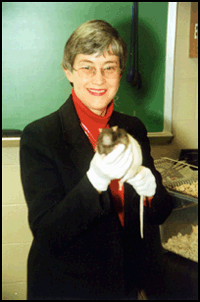
Elaine Hull’s work in the field of sexual differentiation and reproductive behavior has earned her the NIMH’s Independent Scientist Award. |
| |
photo: Stephanie Hamberger |
Not to Elaine Hull. A psychologist who specializes in brain function, she was not convinced and set out to investigate. By the end of the '90s, she and doctoral students in her biobehavioral brain research laboratory at UB had turned the conventional wisdom on sexual function and sex differentiation on its ear.
Hull had proved that although testosterone remains critical, it is possible to affect sex differentiation during fetal developmental, as well as the activation of sexual behavior, without altering the primary male sex hormone. Neurotransmitters, the brain's chemical messengers, play a critical role in neuronal response to testosterone, she found.
That seminal discovery and subsequent accomplishments earned Hull, a professor of psychology, a coveted Independent Scientist Award from the National Institute of Mental Health last September, bringing her total national research funding to more than $4.4 million. Her body of work ultimately could lead to new treatments for sexual dysfunction and may help to explain the variations in sexual orientation.
Hull could have gone to medical school, could have been a neurologist-given her fascination with the brain-but she chose psychology instead.
Why? "I became entranced by psychology in undergraduate school," she says. "My psychology instructor was my pied piper. I'm curious and I was always interested in science," she adds, "and the workings of the brain are about the most interesting area of science I can think of."
Studying the neurochemistry of mammalian copulation, however, was not even a blip on Hull's research radar screen as a graduate student in psychology at Indiana University. Her first serious investigation and the eventual subject of her doctoral dissertation involved studying color vision in macaques.
Arriving at UB in 1967 fresh from graduate school, she attempted to continue this line of research, but had to abandon it up for lack of funds. Searching for a suitable alternative, Hull hit on an intriguing possibility while working on a project with an undergraduate honors student.
"We had tried to develop a rat model to investigate a report that progesterone (one of the sex hormones) administered to pregnant women to prevent miscarriage resulted in better school performance of their children," she said. "We weren't able to find a consistent pattern through those experiments-there is no IQ tests for rats-but we noticed a different effect. Rats exposed to progesterone in the womb were better at getting away from unpleasant stimuli, a task called active avoidance, but performed worse in mazes. And here was the fascinating thing: Only the males were affected."
Hull knew that normally male rats were better at mazes, a task requiring a sense of absolute direction, and worse at learning active avoidance. Now a message flashed on her research radar: Prenatal progesterone didn't make male rats smarter, it made them less male.
Normally, testosterone produced by male fetuses and neonates masculinizes their brains and genitals. The progesterone Hull administered apparently had interfered with testosterone's masculinizing effects. This finding presented another question. All neurons use neurotransmitters for communication. Which neurotransmitters, Hull wanted to know, were used by those neurons affected by pre- and neonatal hormones?
Knowing that L-Dopa treatment for Parkinson's disease frequently increased libido and sexual potency of male patients, dopamine seemed like a reasonable candidate to target. In the next set of experiments, Hull and colleagues administered a dopamine antagonist-a drug that blocks dopamine receptors-which was known to decrease the number of dopamine receptors in adult rats when given prenatally, and to increase dopamine receptors when given postnatally.
Based on previous evidence, she reasoned that fewer dopamine receptors would result in rats with decreased sexual performance in adulthood-an outcome Hull termed "duds"-while more dopamine receptors would produce "studs"-adult rats with increased sexual capability.
To her surprise, the dopamine antagonist made male rats less male no matter when it was administered, and testosterone levels weren't affected. It was a defining moment.
"We had discovered that a dopamine antagonist is a drug that does not alter hormones but can influence sex differentiation," Hull said. "To my knowledge, this was the first report of demasculinization by drugs that don't affect steroid hormones either directly or indirectly."
The respected journal Science published the research results in 1984, but the discovery had little impact on the field. Another six years would pass before researchers began to recognize the influence of biochemicals other than sexual hormones on sex differentiation. Meanwhile, Hull began searching for the site in the brain where dopamine works to influence sexual behavior in adulthood.
Ignoring the main dopamine tracts, Hull once again digressed from conventional wisdom and set her sights on the small, ancient site located behind the eyes at the base of the brain called the medial preoptic area, or MPOA. This area was known to be critical for sexual functioning in all male vertebrates, and brain damage here had been shown to inhibit male copulation. In a series of microinjection studies, she introduced minute amounts of drugs known to enhance or decrease dopamine activity into the MPOA of her male rats via tiny tubes implanted under anesthesia at that brain site, and observed their mating behavior.
The results were revealing. A dopamine-enhancing drug induced multiple erections and the male rats copulated easily. However, when injected with the dopamine receptor antagonist, male rats were less interested in mating, had fewer erections and couldn't copulate effectively.
"This was novel," says Hull. "Nobody had even thought to look in the MPOA for a dopamine effect. We were able to show that dopamine activity in the MPOA specifically focuses attention on sexual behavior and also enhances erectile function."
As a check, the group carried out similar experiments in the mesolimbic tract, which increases motivation for many different goals. They found that shutting down neural activity in the mesolimbic tract slowed the male's general motor activity, but did not affect the percentage of trials on which he chose to be with the female.
"These two brain areas, we learned, are like two essential parts of a car," said Hull. "The mesolimbic system is the motor that gets the male going, but the MPOA is the 'steering wheel' that directs his attention to the receptive female and focuses it on copulation when he gets to her."
Knowing that the MPOA was the seat of this behavior and that the presence or absence of dopamine played a critical role, Hull and company then reversed their research procedure. Instead of injecting drugs that could manipulate dopamine concentrations, they began sampling what already was there, via a process called microdialysis. They devised a series of studies in which they measured existing dopamine concentrations in the MPOA as rats went about their normal mating activities.
These studies could be carried out through a process called "high performance liquid chromatography with electrochemical detection" and required a capillary chromatography system, a sensitive and expensive instrument in use in only a few laboratories in the world at that time. Hull's laboratory was able to acquire one in 1993.
The instrument allowed the researchers to detect the presence and amount of dopamine in tiny droplets of fluid collected from the MPOA and several other sites.
Using microdialysis, Hull was able to show that dopamine must be released in the male rat's MPOA for copulation to occur and must continue for the animal to ejaculate-the test of a "successful" copulation. In other words, all the rats that showed an increase in dopamine were able to copulate; all that showed no increase weren't.
Having shown that testosterone is not the sole arbiter of male sexual behavior, Hull turned her attention back to testosterone to re-examine its role. Subsequent studies showed that the hormone appears to prime the brain to respond to sexual stimuli and to promote the release of dopamine, making copulation possible. The question was, how?
Building on results of earlier work, Hull and colleagues were able to define a complex interplay of hormones and neurotransmitters: testosterone increases production of the enzyme nitric oxide synthase in the MPOA, which produces more nitric oxide, a potent soluble gas, which in turn promotes the release of dopamine, both under normal conditions and in sexual situations. Increased release of dopamine in sexual situations then promotes sexual motivation, genital reflexes and copulation.
In yet another finding, the researchers showed that serotonin, another neurotransmitter and the primary target of the antidepressant Prozac, is released in another area of the brain at ejaculation and dampens sexual interest. Hull's findings eventually could point the way to development of a drug that would restore sexual functioning without interfering with Prozac's antidepressive activity.
Meanwhile, Hull's research had stimulated a rush of interest in the brain's chemical messengers.
"More work has been done on neurotransmitters in the past seven years than on hormones," she said. Hull should know. She has just completed the definitive chapter on male sexual behavior for a three-volume work titled "Hormones, Brain and Behavior," to be published by Academic Press.
Hull is not slowing down. With her Independent Investigator Award and a new five-year, $1.5 million grant from the National Institute of Mental Health, she and colleagues in her lab are aiming to clarify how testosterone and other sex hormones influence the release of neurotransmitters in the MPOA.
"I have a really nice sense," she says, "of having contributed something important to the field."


