
Archives
Contributing to scientific research at summer camp
By JIM BISCO
Reporter Contributor
Forty-seven young researchers presented their findings in typical poster and Powerpoint form before a distinguished panel of scientists who proceeded to question them about their data. They were not, however, typical graduate students or Ph.D. candidates defending their work; they were students about to enter eighth grade.
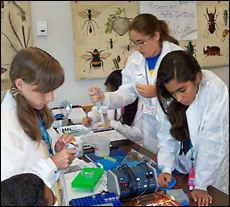
Campers conduct research on
Wolbachia, a genus of bacteria that infects arthropods.
PHOTO: DOUGLAS LEVERE
The Aug. 15 presentation was in the Buffalo Museum of Science, where the students had just completed a two-week, cutting-edge, college-level science camp coordinated by UB’s Center for Educational Collaboration (CEC).
“The presentations they gave were very akin to what you would actually see at a conference,” observed Sarah Burns, a Ph.D. candidate in the Department of Chemistry who, as a program mentor, helped coach some students’ presentation based on her own graduate experience.
Eight groups of students related their research on Wolbachia, a genus of bacteria that infects arthropods—including a high proportion of insects—altering their reproductive capabilities. The Wolbachia focus is currently a hot research topic, “kind of spreading like the infection it is at science conferences across the Northeastern U.S.,” according to Marilou Bebak, one of the teachers of the program at the museum. During the intensive, two-week camp, the students collected insect specimens from the Tifft Nature Preserve—from grasshoppers to damselflies—extracted and analyzed their DNA using a sophisticated Polymerase Chain Reactor (PCR) machine, and, in“CSI” fashion, generated a DNA gel to see if their insects tested positive for the infectious bacterial strain.
“The basic idea is to bring biomedical techniques, diagnostic procedures, advanced science and mathematics to students to prepare them for high school, college and the work force,” said Eric Vosburgh, UB research assistant in science education who prepared the program grant and helped recruit the students for the CEC.
“It’s a brand-new, cutting-edge program, one of the Top 100 science discoveries for 2007,” added Karen Wallace, director of the Center for Science Learning at the museum.
The initial CEC project, in partnership with the Buffalo Public Schools and the museum, attracted some of the brightest seventh-graders in math and science throughout the area for a program of field trips, guest speakers and advanced science exploration.
Guest speaker Michael Clark, Wolbachia expert from the University of Rochester, excited the campers when he told them, “You are doing exactly what we are doing in our laboratories. This is not some kind of mock-type version. You are really contributing to the research.”
Their findings—three of the 24 insect specimens tested positive for the bacteria—indeed contributed to overall Wolbachia research as the students uploaded their results to a national database.
“They learned a lot of different techniques and used expensive equipment that they normally would not see unless they were in college,” added Wallace. “These kids are bright. What blew me away is the type of questions they were asking, which showed they were getting it and being very thoughtful about what they were doing.”
“It was interesting, learning how to separate DNA and being able to look at it and test,” said student Kevin Fling of City Honors School.
“It was surprising that we were doing college work,” observed Nia Brown of the Math, Science and Technology Preparatory School at Seneca. “I learned a lot.”
Parental support was emphatic, according to CEC program manager Teresa Barrett. “We had parents who changed their whole vacation plans for this,” she said. “That was very gratifying to know that they cared enough and that their child wanted to be here.”
The parents of Stephen Valeri of City Honors School cut their New England vacation short to bring their son to camp. “He bonded with kids, made friendships and excitedly told me about the molecule he was studying,” said his mother, Jennifer. Mary Farrell and Mark Detlef, the parents of Alex Detlef of Buffalo Public School 81, said their son became so excited that he is now considering a pursuit in the scientific field.
To qualify for the program, participants had to score highly in math and science from fifth through seventh grades with a 90 or above GPA in the subjects, and have earned 4s (the highest achievement level) in either math or ELA on New York state assessments.
The program, funded through a $100,984 grant from the New York State Education Department’s Excelsior Scholars Program, came together just weeks before the end of the school year. At first, it was directed exclusively to Buffalo Public School students as part of the UB/BPS Partnership but, when slots became available by late June, it was opened to qualified students in Erie and Niagara counties.
The final presentation was made before an audience composed of the students’ families, school officials and a panel consisting of UB scientists Norma Nowak, director of scientific planning at the New York State Center of Excellence in Bioinformatics and Life Sciences; Robert Genco, vice provost and director of the Office of Science, Technology Transfer and Economic Outreach; and Xiufeng Liu, associate professor in the Department of Learning and Instruction, Graduate School of Education, who served as primary investigator for the project.
“These kids know more than when I was in high school and entering college,” said Nowak. “To take their summers to do science, I think, is amazing. Plus, they have great personalities, great communication skills, and what they learned about the insects was really amazing to me. Their enthusiasm is infectious.”
“I think this is a wonderful program,” noted Genco. “I think the age of seventh and eighth graders is a very critical time to develop an interest in science, particularly in females. Obviously, they have similar talents, but for females the expectation to go into science, math and technology is less. I was very impressed with the number of females.”
There were 28 girls and 19 boys in the program, with a total of 30 students from the Buffalo Public Schools. The other schools ranged from Holland to Tonawanda, West Seneca to Newfane.
Robert Bennett, chancellor of the New York State Board of Regents, delivered the keynote address at the presentation. “You are an example of what we have known all along that if you present students with high standards, they will achieve them,” he said. “Of the 3 million in the pre-K-12 system in New York state, you’re exceptional. You need to continue your inquisitiveness and challenge your teachers and leaders in the school. You need to stay here. Everything you need in the academic world is available at the university right here, the largest public university in the State of New York.”
James Williams, superintendent of the Buffalo Public Schools, called the summer camp a model program, indicative of the depth of the UB/BPS Partnership. “I’m very impressed. This is a great partnership to work with the students,” he said. “In our school districts, especially in urban school districts, you have bright kids. Sometimes you have a tendency to forget about them because we focus a lot on those who are struggling. Our goal here is to accelerate our programs and this is a start. We have to build on this.”
Barrett feels that this first collaborative program arranged by the CEC was successful in meeting the criteria and filling the slots. “I saw the growth in the students, not just from an academic standpoint but personal maturity standpoint,” she said. “There’s a lot that we can do with them, their data and the program itself. We’re hoping to use this as a model to leverage other programs.”