
Archives
ECC students assist in earthquake project
By KATHERINE FELSHOW
Reporter Contributor
While many college students are waiting tables or scooping ice cream for the summer, 24 students in Erie Community College's Construction Management Engineering Technology and Civil Engineering Technology programs are busy working with UB faculty and students on a "groundbreaking" research project that will change the way that wood structures are built in seismic regions around the world.
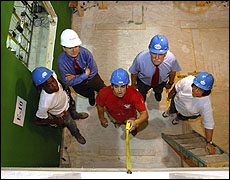
Andre Filiatrault of UB (rear left) and Greg Gillis of ECC (rear right) oversee work by ECC students (from left) Justin Levy, Chris Sardo and April Cockrell. After the drywall is installed, the townhouse walls are painted kelly green so that UB engineers will be able to easily see any cracks that may appear after the townhouse undergoes testing on the shake table.
PHOTO: NANCY J. PARISI
The ECC students are working on the 1,800-square-foot, three-bedroom, two-bathroom townhouse on twin movable shake tables in UB's Structural Engineering and Earthquake Simulation Laboratory (SEESL). The students are installing and repairing gypsum wallboards (drywall) on the walls of the townhouse.
This is the first time ECC students have participated in a project like this with a four-year research institution.
In a series of five experiments, the townhouse has been subjected to increasing levels of shaking, culminating with a final test in November that will mimic the power of an earthquake that occurs once every 2,500 years.
The experiments are all part of NEESWood, a landmark project funded by the National Science Foundation's George E. Brown Jr. Network for Earthquake Engineering Simulation (NEES) that will play a key role in developing an improved design for wood structures in seismic regions so that taller and larger wooden structures can be built.
The ECC students have been helping to record damage and suggesting methods of retrofitting the structure to mitigate further damage. After each test, the house is repaired and prepared for the next round of shaking.
"Through this project, we are helping to save lives," said Gregory Gillis, ECC professor of construction management engineering technology. "We are helping to rewrite the way buildings are built.
"By working together and building a relationship between the two institutions, we can make progress in a lot of different areas of the project, and students from ECC and UB benefit."
While the NEESWood project is unique, so are the students helping to make it a success.
The diverse group of ECC student range in age from 18 to 40 and older.
"The ECC students are doing all the work in this phase of construction on the house," said Andre Filiatrault, professor of civil, structural and environmental engineering, UB School of Engineering and Applied Sciences, and lead investigator on the NEESWood tests at UB. "We are treating them as our drywall contractor."
To illustrate just how dedicated these students are, Gillis said virtually all of the students have full-time jobs for the summer-in addition to their work on the earthquake project.
"The commitment our students have shown is amazing," added Shawn Hill, ECC assistant professor of construction management technology.
ECC student Djuro Stegic works full-time at Safespan Platform System in Tonawanda. Although it means balancing a hectic schedule, Stegic said this project offers him a learning experience that is worth all the hard work.
"From class presentations on the causes of earthquakes to doing hands-on work, such as drywall installation, everything I do benefits me and my future career," said Stegic, who may attend a four-year university after graduating from ECC and pursue a career in construction project management and estimating.
April Cockrell, the only woman from ECC working on the project, took time off from her full-time job to devote herself to the townhouse.
"I made the right choice," Cockrell said. "This project is fantastic and I am honored to be working on it.
"The scale of the house and the size of the shake tables are very impressive, and I've enjoyed learning how the information from the simulated earthquake is gathered and used," she said.