| VOLUME 32, NUMBER 4 | THURSDAY, September 14, 2000 |


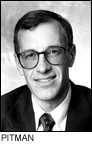
Bruce Pitman is UB's new vice provost for educational technology. A professor in the Department of Mathematics, he joined the UB faculty as an assistant professor in 1989.
There are several parts to the job. I want to help coordinate the several educational-technology initiatives at UB. Perhaps the most important single initiative is the student-access program, iconnect@UB. For iconnect@UB to work, many different parts of the university must work together. Most of CIT is involved in one way or another-academic services provides a great deal of support, while the networking group wires the residence halls and makes sure all that infrastructure is working right. CIT provides support ranging from student training and consulting to email. At the other end of the spine, UBMicro has to get hardware onto campus, set it up and get it into students' hands. Faculty members want training to bring interesting technology into the classroom. Enter the Educational Technology Center (e.t.c.). To make use of those technological tools, we need labs and public-access sites, and wired lecture halls. Moreover, the distributed IT service nodes need to work with faculty members to develop departmental infrastructure so they can develop those course modules and make sure they are available to students as planned. Another significant part of the job is working with departments and the distributed IT service nodes on initiatives in instruction, in building labs and developing technological infrastructure. As senior vice provost for educational technology, Joe Tufariello made great progress in getting departments and individual faculty members involved with using technology in lower-division courses. As we begin to plan for next year, that first Access99 class will be taking upper-division courses and we now need to be prepared for them. Another personal interest is research computing-what technologies are needed in the different settings of research and scholarship across campus.
How will your background as a professor, rather than a strict "techie," affect how you will approach your job as vice provost?
UB's commitment to technology ultimately means faculty commitment. Certainly over the past several years, the university has made a significant investment in technology, in networking, labs and public facilities, desktop equipment. But when it comes down to it, for UB to be among the leaders in using technology in higher education, the faculty must be willing to accept the challenge. And many faculty members are doing just that, creatively integrating technology into undergraduate and graduate courses, into research and scholarship. As a professor in the math department, I tried to do some of those things, maybe with limited success. Although not a "techie," I am pretty comfortable with computers. And although I am not an expert, I have a basic understanding of the strengths and weaknesses of technology. I think that perspective-an instructor and researcher who knows a bit about IT things-will be useful in trying to help in the planning, coordinating and communication of technological initiatives at UB.
What are your priorities for the coming year?
For me, the overriding "near-term" priority is to assist in the building of a curriculum that uses technology in creative ways. In May 2003, the Access99 class will graduate, the first class with the student-access requirement. At that time, we as a university need to have developed a curriculum, ranging from large intro courses to small upper-division seminars and graduate courses, that integrates technology in appropriate ways and challenges students. We won't have the whole thing done by '03. We can't-we'll be learning and revising all along the way. But we do need the basic structure in place. Technology can provide a path of inquiry that students could not experience in any other way. But it is very hard for instructors to develop materials that give students this kind of experience. We don't want to do technology for technology's sake, to "computerize" a class just because we can. It may be that not all courses would benefit from technology. Certainly there are many different kinds of technology that might be used profitably. I would ask the departments to look at the students they teach-the service teaching, the majors, the grad students-and to consider what kinds of curriculum development make sense. Let's build a program that touches each of these groups of students in meaningful ways, that provides a range of uses of technology and helps develop skills and understanding.
What do you see as your main challenges? Funding? Dealing with senior faculty members who have no interest in technology?
Funding is always an issue. The iconnect@UB program implies a responsibility on the part of the university to provide a wide range of services and infrastructure. And, as I said earlier, over the past several years, UB has made a very large investment in technology. But New York State and budget difficulties seem to go hand-in-hand. And that means funding challenges for SUNY and for UB. If you think about the IT infrastructure on campus, the networking, the computer hardware, the need for replacements and upgrades, the needs of instructional and research computing, you see how big a piece of the university budget goes to IT. That is a reality of higher education. I am encouraged that UB is recognizing its commitment to technology and is working to provide resources appropriate to that commitment.
What question do you wish I had asked, and how would you have answered it?
Whether I believe all the hype about technology and its impact on learning. I am an advocate for technology, but I try to retain what I hope is a healthy dose of skepticism. I know how technology can make the acquisition of data much easier. But a data dump of bits and bytes is very different than useful information. And learning some keystrokes to initiate a data dump is far removed from developing an understanding of subject material. Does all the technology "improve education?" I don't know. I'm not even sure I know what the question means. But I am sure that technology provides a different way to learn, a way that can be as enlightening as more traditional approaches to teaching. I have seen technology create a wonderful environment for student discovery. At the same time, technology can also "get in the way" of learning and the introduction of technology into the curriculum can be a big obstacle for some students, especially students who are having a difficult time in a particular course. We hear about the need to train students in using technology because those skills are necessary for getting a job. And there is a valid point in statements like that. But beyond the simple utilitarian argument, I see technology making a fundamental impact on the way we live. Increasingly, to be considered literate and educated requires not only an ability to read and to reason, but also an ability to use computers. Technology allows-or maybe the correct verb should be "makes"-us think differently. Folks of my generation, at least in the sciences and engineering, think about computers and computing in a certain way. The generation of kids now in high school, growing up with Gameboys and PlayStations, think about technological things differently. And, when that generation "comes of age," I expect to see very interesting developments. So whether or not I believe all the tech hype, the impact of technology on the way we think and learn and discover makes me want to understand, to learn, to teach, what it is all about.
Front Page | Top Stories | Photos | Briefly | Q&A | Electronic Highways
 What is your role as vice provost for educational technology?
Exhibits, Jobs, Notices | Sports | The Mail | Events | Current Issue | Comments?
Archives | Search | UB Home | UB News Services | UB Today