| VOLUME 32, NUMBER 28 | THURSDAY, April 19, 2001 |


By JENNIFER LEWANDOWSKI
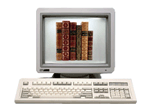
With Internet growth on the rise, the way people are gathering information is shifting away from visiting the local public library. The overwhelming pace at which the Internet is infiltrating the consciousness at large has given way to concern about how, and if, public libraries fit in.
While many Internet services and resources appear to compete with those traditionally offered by public libraries-information gleaned from survey results presented this year by UB faculty in the award-winning research paper, "Impacts of the Internet on Public Library Use"-the good news is that Internet use now appears to co-exist comfortably alongside public library use. And while it also seems, for now, that the public library will be able to hold its own in the "information franchise" market, it most likely will have to build on its strengths as a community institution and adjust its services as consumer preferences change.
"For years now we have been asking, both in our professional press and discussions with public libraries, the persistent question of what is the role of the public library now that we have the Internet," he said. And while the question seems obvious, D'Elia said he and the paper's co-authors could find no published evidence of the relationship between the two.
D'Elia, along with Corinne Jorgensen, UB associate professor of library and information studies, Eleanor Jo Rodger, president of the Urban Libraries Council, and Joseph Woelfel, UB professor of communication, conducted a landmark random telephone survey of 3,097 adults in March and April of last year.
Funded by a grant from the Institute for Museum and Library Services, the results of that survey, carried out by Goldhaber Research Associates, have helped shed light on the direction in which trends in both Internet and public library use are headed, as well as the future of the institution of the public library.
D'Elia, who was recruited by UB in 1995 from the University of Minnesota's School of Management, said consumers wield the greatest influence.
"It's the marketplace that's going to decide where to go for information, and what criteria it will use to evaluate information," he said. "For some people, the accuracy, the reliability, is paramount. For some people, ease of access is paramount."
The public library's "information franchise"-a phrase coined by the investigators-is what's at risk, D'Elia said. Despite the fact that public libraries offer a multitude of services beyond warehousing information-such as specialized services for children, recent immigrants, senior citizens and young adults, literacy and adult education programs, and the like-the Internet challenges the public library to maintain its share of the information franchise. Approximately 45 percent of public library patrons reported that information gathering was their primary reason for using the library.
"A segment of that market is at risk," D'Elia said. "But that leaves 55 percent who will be using other services of the library."
Comparing radio to television, D'Elia points out that radio did indeed survive-but by changing its programming. By the same token, the library, too, can survive, but with emphasis on a different menu of services.
Given that one of the public library's greatest perceived values is the presence of real people, D'Elia found, human interaction will help sustain the public libraries as vital within communities.
Based on the fact that Internet hasn't yet reached what D'Elia called "the Model T Ford stage," predicting how Internet use will impact public libraries is difficult.
For Internet users, its 24-hours-a-day, seven-days-a-week access is appealing, D'Elia found, and users believe that information acquired via the Internet-the immediateness, also a benefit-is more up-to-date than at the library. The convenience of having the Internet at home, as well as the perception of a greater range of resources than at the library, both come out as advantages as well.
As for those who prefer the public library, users say they enjoy its low cost and paper-versus digital-materials, and trust that material to be more accurate. D'Elia also found that public library patrons feel greater privacy at the library than on the Internet, and are more impressed with assistance in the form of a librarian over that of a telephone help line.
And despite the fact that the library serves 65 percent of the population, over the Internet's 50 percent, it is difficult to ignore the latter's pervasiveness into daily life.
What is important to keep in focus, D'Elia reminds, is the distinction between the library function-which is information management-and the library as an institution.
"The future of the library as an institution is in flux," D'Elia said, "but library function is growing by leaps and bounds.
"Everyone now is dealing with information, and the issues related to management of information are pervasive," he said. "And the skills that librarians traditionally have had are in high demand."
The baseline data gathered for the paper-which is scheduled for publication in the Journal of American Society for Information Science and American Libraries-will serve as the foundation for future studies of the Internet-public library relationship, said D'Elia, who hopes to replicate the study in 2003.
Front Page | Top Stories | Briefly | Q&A | Electronic Highways
Survey sheds light on direction both research tools may be headed

Reporter Assistant Editor
 George D'Elia, professor and director of the Center for Applied Research in Library and Information Science at UB, has been conducting research on public library services for more than 20 years. For D'Elia, the principal investigator on the paper-which received the Bohdan Wynar Research Paper of the Year Award at the 2001 Annual Conference of the Association for Library and Information Science Education in Washington, D.C.-the opportunity to conduct a national survey examining public library and Internet use was a natural outgrowth of ongoing research in the field.
Obituaries | The Mail | Sports | Exhibits, Notices, Jobs
Events | Current Issue | Comments?
Archives | Search | UB Home | UB News Services | UB Today