| VOLUME 31, NUMBER 8 | THURSDAY, October 14, 1999 |


By JENNIFER LEWANDOWSKI
Mark Dias helps combat serious illnesses in children every day.
As a pediatric neurosurgeon at Kaleida Health's Children's Hospital of Buffalo, he works with children who suffer from a host of diseases associated with the brain and spinal cord, such as spina bifida, brain and spinal-cord tumors, hydrocephalus-a buildup of fluid on the brain-epilepsy, cerebral palsy, head trauma, cystic fibrosis and abnormalities of the skull.
Last December, Dias began a program to alert parents to the causes of shaken baby syndrome. With the help of a grant from the William B. Hoyt Children's and Family Trust Fund, Dias has been able to get the word out to parents of newborns.
And the effort appears to be paying off.
Of the 20,000 babies who are born each year in the eight-counties of Western New York, seven or eight are brought to Children's suffering from shaken baby syndrome, Dias says. He adds that Children's is the only hospital in the region that treats children with the syndrome.
"If you shake (babies) violently, you can scramble their brain," says Dias, explaining that the shaking causes hemorrhaging in the brain.
"One third (of the children) die as a result of the shaking," he says. And of those who survive, 50 percent experience significant problems, including blindness or eye damage, seizures, a delay in normal development, mental retardation and paralysis.
He points out that the shaking causes such severe damage because in infancy, children's heads are larger in proportion to the rest of their bodies and aren't fully developed.
Dias recalls a personal experience that brought the issue close to home.
Shortly after his son was born in 1997, he found himself awake at 3 a.m. one day, frustrated that his son couldn't sleep. He realized then the potential for parents to take that frustration out on their children, he says, and remembers thinking, "Kids don't deserve this."
"For the first time in my life," Dias says, "(I remember) really, really wanting to do something."
So he began a campaign to inform the community of the dangers of shaken baby syndrome.
Parents of children born in all 17 hospitals in the region are given an informational leaflet and an affidavit that they are asked to return to the hospital in which their child was born. Program coordinators at each hospital collect the affidavits, which are passed on to Dias.
The leaflet cautions parents that children, especially babies, "have very weak neck muscles and do not yet have full support for their heavy heads. When they are shaken, their fragile brains move back and forth within their skulls."
Dias says he worried that in distributing literature and raising awareness about the syndrome, more parents who were unaware would come forward with children who had been shaken. The results, however, have been positive.
Since the program began, Children's Hospital hasn't seen one case of shaken baby syndrome.
"Out of those eight babies, three of them would have died, so we've helped by preventing the problem, not treating it after it occurred," Dias says.
The leaflet focuses on prevention, telling parents: "When your child cries, take a break-don't shake." The leaflet informs parents of steps they can take to cope with a crying child, such as taking a deep breath and counting to 10, letting the baby cry, calling someone for emotional support and calling the child's pediatrician to find out if there's a medical reason as to why the child is crying.
The affidavit seeks the signatures of both the mother and father, and asks parents to respond to several questions: Is this the first time you've heard about shaken baby syndrome? Have you heard it's dangerous? Was this information useful? Would you recommend this to other parents?
Of the affidavits signed by parents, three-quarters have been signed by the fathers as well as the mothers, something Dias says is important since the individual who typically shakes a child is a man.
"It's a guy thing," he says. "Two-thirds of the perpetrators are males."
In addition, Dias says, most perpetrators-male or female-generally deny shaking the baby and are not remorseful.
"If I were being falsely accused, I would be livid," Dias says of those individuals who allegedly have shaken a child. "They're generally not. They seem rather placid, actually. (But) some of them will confess later."
Dias says the occurrence of shaken baby syndrome has no societal boundaries.
"Unlike other forms of child abuse, it does not seem to favor a certain socioeconomic background or race," he says.
"I am just absolutely astounded," Dias says of the program's results. "I just keep pinching myself."
Effort by pediatric neurosurgeon to alert parents to dangers is paying off

Reporter Staff
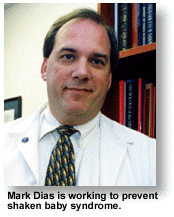 However, Dias, an assistant professor of neurosurgery, is taking steps to insure he doesn't have to treat infants suffering from shaken baby syndrome. He's hoping to prevent the shaking from happening at all.
Front Page |
Top Stories |
Briefly |
Q&A |
Electronic Highways |
Sports |
Kudos |
Transitions |
Exhibits, Jobs, Notices |
Events |
Current Issue |
Comments? |
Archives |
Search
UB Home |
UB News Services | UB Today