| VOLUME 31, NUMBER 25 | THURSDAY, March 30, 2000 |


There seems to be a rash of incidents in the news lately involving police brutality and corruption-Amadou DiAllo, Abner Louima, the Ramparts investigation in Los Angeles, narcotics cops shaking down drug dealers in Buffalo. Are these kinds of incidents on the increase?
Mass media outlets today are high in number and technological advances abound. This makes it difficult to know whether the incidents are on the increase or whether the speed with which we get the information and the detailed nature of the information makes it appear that the number of incidents is on the rise. One thing does seem clear: the nature of the incidents seem more devastating and shocking-sodomy with a wooden handle and a 40-plus shot salvo resulting in 19 wounds and death.
My reaction was more disappointment than surprise. My years as a prosecutor of corruption crimes taught me that it is always difficult to convict police officers, judges and lawyers. Perhaps it has something to do with the jury feeling invested in those groups as a line between lawful behavior and the fear of unbridled lawlessness. Part of it may also be a misinformed fear that crime is rampant. I call it misinformed because there is reason to believe that crime is actually decreasing, but we hear so much about particular crimes that much of society may have the impression that crime is on the rise.
The judge in the DiAllo case has been accused of "slanting" the jury in favor of the police. Is that possible?
As a lawyer for more than 20 years, I have always thought that jury instructions were the most difficult part of a trial to understand. In an effort to give a jury guidance in the application of the law to the facts in the case, we actually may do more to confuse than enlighten. Lawyers on both sides have an opportunity to prepare and suggest a charge to the judge and should always take advantage of that opportunity. The judge may decide to deliver another or different charge he or she feels is superior, more comprehensive, or easier to understand. In the event there is reason to believe a judge has engaged in an effort to slant the charge, it almost certainly would become a matter to be raised on appeal in the case of a conviction. When a case results in an acquittal, like the DiAllo case, there is no opportunity for an appeal. In such a case, I would expect the matter to be reported to the Commission on Judicial Conduct.
Given today's society, are police more inclined to shoot first and ask questions later?
It is true that as a society we have moved from zip guns to machine guns, resulting in a heightened sense of fear that what might have been a matter of some injury years ago might mean death today. We are not, however, better served by accepting the notion of "shoot first and ask questions later." I believe, in the long run, we will be better served as a society if we insist that police adhere to job-description limitations that authorize investigation and apprehension, leaving to another component the job of deciding guilt, determining and executing punishment.
What could possibly cause police officers to brutalize unarmed suspects? How much of this problem is related to drugs, to personality problems among cops themselves, to police fear of the "other"-anyone not like them?
It is impossible to determine how much of our problem of police brutality is attributable to drug laws, as opposed to some personality shortcoming on the part of those who police us. One thing seems clear: our drug policy is a monumental failure. For more than 20 years, we have watched our prison population grow in almost geometric proportions. The overwhelming majority of that growth is a result of drug-law prosecutions. The criminal-justice system is literally reeling from the weight placed on police, courts and corrections facilities. Stiffer sentences have done little to deter people from entering the enterprise of drug crime. It appears that once a dealer or source is arrested, or a drug house is closed, another actor or property is waiting in the wings. Whatever one's spin on where our efforts to become a drug-free society should be headed, we must face the reality that interdiction and incarceration have failed, and failed miserably. Perhaps a switch to treatment and education might provide more productive results. Education and treatment represent a new direction, one we could take without abandoning the desire to promote and become a drug-free society.
How can African Americans ever feel comfortable with police with these kinds of incidents going on?
The truth is that none of us can feel comfortable when there is a sense that law-enforcement behavior is out of control or over the line. It is wrong to think that if we accept the status quo regarding police brutality, it will remain confined to being a minority-community problem. Lawlessness tends to feed on itself and, like a toothache, it is not self-correcting.
How do we prevent police corruption and rogue behavior?
As a start, we need better training and screening of law-enforcement personnel. We must remember that we don't go anyplace special to get police, lawyers or judges. They come to the job with the same human frailties one finds in society at large. Because society has changed so much in terms of the kind and quantity of violence we experience, we may be better served by instituting greater safeguards. There has been talk about rotating police officers out of high-intensity and undercover units after three years. I favor doing more by considering a limitation on the number of years a person is allowed to do police work. It may no longer be the kind of job a person should do for 20-plus years. A system that offered paid leave every three years so an officer could get education or training in a new field should be explored. There is-and should be-considerable resistance to the idea that local police and prosecutors can adequately investigate themselves and one another. There is reason to believe, based on recent incidents, that this effort is unworkable and does little to inspire confidence in the justice system. We need to explore the establishment of independent/special prosecutors to investigate and prosecute corruption crimes. The criminal-justice system should be concerned that citizens have confidence in the process and the people that implement and execute the process.

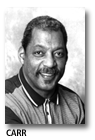 Were you surprised by the DiAllo verdict?
Front Page |
Top Stories |
Briefly |
Q&A |
Electronic Highways
Sports |
Exhibits, Jobs, Notices |
Events |
Current Issue |
Comments? |
Archives
Search |
UB Home |
UB News Services | UB Today