| VOLUME 30, NUMBER 26 | THURSDAY, April 1, 1999 |


What is BRIET?
I understand that teachers also will have to meet new standards, as recommended by the Regents Task Force on Teaching. How will this affect how UB trains teachers?
How has the explosion of technology affected teacher training?
How will the new certification criteria, particularly the requirement that all teachers have master's degrees before they can be certified, affect UB's program?
The current teacher-certification requirements have been assailed for keeping highly educated people-those with advanced degrees in disciplines other than education-from teaching in elementary and secondary schools without additional schooling. How do you answer the criticism that the system requires too many education courses and not enough expertise in a teacher's chosen field?
What's something about yourself that most people don't know, but should?
What question do you wish I had asked, and how would you have answered it?
 Catherine Emihovich is associate professor of counseling and educational psychology in the Graduate School of Education and director of the Buffalo Research Institute on the Education of Teachers (BRIET). Her research interests include children's language use in classrooms and peer relations; sociolinguistic studies of learning and instruction; metacognitive processes in computer instruction; language and literature, and race, class and gender equity in education.
BRIET stands for the Buffalo Research Institute on Education for Teaching. It is both the certification unit for anyone at UB who wants to get certified as a teacher (graduate or undergraduate), and an institute that conducts research on current teaching and learning issues.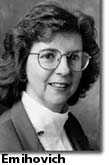 Tell me about the new Regents requirements for K-12 students? Will they really make our students better prepared? Are all students capable of doing Regents-level work?
The new Regents requirement is that all students will have to pass five Regents exams before they can graduate from high school. In addition, the State Education Department has developed the New York State Learning Standards for K-12 students in elementary grades and in all content areas. These new standards do focus more on the kinds of skills and competencies students will need to have to succeed in the next century such as greater use of problem-solving strategies, ability to analyze and synthesize different sources of information, etc. So, in that sense, they will result in better prepared students if they are properly implemented. It's also the case that many more students can do more challenging work than they have been given previously, but whether all students can master these skills is still an open question. Unfortunately, the state decided to implement these new standards and assessments before teachers were sufficiently prepared to cope with these changes, so I believe there will be a period where students' performance will go down before it improves. Helping veteran teachers rethink their teaching practices to help students succeed with the new standards will be one of the major challenges facing both school districts and teacher-education programs in the next few years.
These new standards will have a significant effect on our programs since there will be new certification titles, new requirements for course content that are aligned with the student-learning standards and a new requirement for external accreditation by a recognized educational agency. The time period for acquiring a master's degree in order to continue teaching beyond a transitional period also will be shortened from five years to, most likely, three years (although this still is being debated). Since all teacher-education programs also will have to be re-registered with the state education department by Fall, 2000, to incorporate these new standards, a Teacher Education Work Group has been set up by the dean of the Graduate School of Education to undertake this work. We are developing some exciting new models that will maintain our reputation for quality and that we hope will attract more students into teaching.
Almost all school districts now require new applicants to document that they are proficient in using multiple forms of technology in instruction. The new certificate program in Educational Technology that has been developed is one way for preservice teachers to meet this requirement, as well as veteran teachers who want to upgrade their skills. Many GSE faculty also have begun using more technology in their own teaching to demonstrate how it can be used successfully in the curriculum. A worrisome trend is the development of teacher-education programs that are being offered entirely online, as well as professional-development courses that new teachers will need to take to maintain their certification. At some point we will need to sit down and think about how we will respond to these trends, especially in a era of looming teacher shortages, where the pressure will be very strong to create easy options by which people can get certified to teach.
As I noted above, this requirement is currently under vigorous debate, and one compromise position for the state is to issue a transitional certificate with a master's degree required in three years for initial certification. GSE faculty are designing different paths to certification that take this possibility into account, as well as programs that allow students to complete certification and a master's degree in five-and-a-half years.
I have two responses. One, teaching is a professional field where the knowledge of how to teach is as equally important as the knowledge of what to teach. If an advanced degree were the only prerequisite for good teaching, then college campuses across the country would be filled with great teachers. The data from student evaluations, however, suggest quite a different picture. Second, New York State has long been known for the fact that it requires a minimum of pedagogical courses (six, plus a student-teaching experience), while at the same time requiring a strong content or liberal-arts preparation (36 hours). My own belief is that the two foci-content and pedagogy-need to be perceived as complementary, not oppositional, and that a strong preparation program incorporates a mix of both. The fact that BRIET students pass the Liberal Arts and Studies Test and the Content Specialty Test (the two discipline-based parts) and the Assessment of Teaching Skills (the pedagogical part), at very high rates (95-100 percent) suggests that UB has been able to accomplish that goal.
I majored in drama in college, a major that has absolutely nothing to do with what I do now, except for the fact that I'm rarely uncomfortable speaking in front of any group. Actually, I have given some serious thought to the idea that prospective teachers should have a course in either drama or public speaking, since a part of teaching does involve performance. And unfortunately, with our media-savvy generation of students emerging (the MTV crowd), the ability to be an engaging performer is becoming increasingly important for teachers.
I wish you had asked me about the moral dimensions of teaching, because I believe that teachers should not only be concerned about promoting students' cognitive achievements, but also about helping their students recognize the importance of being productive and engaged citizens (e.g., registering to vote and then doing so), people who are aware of the growing inequities in society, and how they might be redressed to create a more just and equal community in which we all want to live. There is a great quote from a feminist philosopher that sums up my beliefs about teaching: "The question is this: how will you refuse to let the academy separate the dead from the living, and then, yourselves, declare allegiance to life? As teachers, scholars and students, how available will you make your own knowledge to others as tools for their liberation?" While I certainly would agree that it is important for teachers to know their field well, I think it is equally important for them to know why they are teaching, and for what purpose
Front Page |
Top Stories |
Briefly |
Events |
Electronic Highways |
Kudos
Q&A |
Transitions |
Current Issue |
Comments? |
Archives |
Search
UB Home |
UB News Services | UB Today