| VOLUME 29, NUMBER 2 | THURSDAY, SEPTEMBER 4, 1997 |


Bravo, Maestro! Conductor Magnus Martensson seeks the truth in performance
By THOMAS PUTNAM
On the phone is an ailing cellist calling to bow out of rehearsal for the next day's concert by the UBuffalo Symphony.
Later, the conductor will persuade orchestra musicians, not by telling them they can do it, but by telling them what it is they should do. They should observe the dynamic markings. They should listen. They should not rush. Nor should they lag.
"The conductor is a teacher in any circumstances, in any orchestra," Martensson says. "You have to know more, and you have to teach them what you think is the truth."
The Swedish-born conductor came to UB in 1996 from the Cleveland Institute of Music. When he arrived, he was given one orchestra to conductÑthe UBuffalo Symphony, which is composed of students and community musicians. With that orchestra he has had successful concerts. One in December featured faculty pianist Stephen Manes as soloist and included works by Charles Ives and Shostakovich, two very different 20th-century composersÑthe one a Yankee innovator, the other a Russian possessed by history.
New music attracted conductor
Significant in attracting Martensson was UB's history of association with new music. David Felder, chair of the music department, is a composer Martensson admires.
"The musical life in the city, and at the university, as well, has lots of potential," Martensson says. "This university has a tradition of contemporary musicÑthere is a strong composition department here, and an electronic music studio."
Martensson must be doing something right: Now he has two university orchestras to conduct.
This spring, a professional chamber orchestra was formed for himÑthe UB Sinfonietta, about 30-strong.
There is a big difference, Martensson explains, between what he calls the "student-slash-community orchestra," and the Sinfonietta. "A professional orchestra will respond on a more subtle level to your motionsÑthe waving of the stick. A student orchestra often has to be reminded of the same thing several times."
Martensson, who is tall, chooses to conduct without a podium. With his shock of blonde hair, he looks like a kindly Scandinavian bear. He conducts with considerable reach, but does not wave his arms unnecessarily. He does not appear to be reaching for the spotlight. "I think you can achieve what you want with your eyesÑwith other means than large gestures," he says.
Martensson comes from Malmš, in the southern part of Sweden, 45 minutes by boat from Copenhagen. A pianist, violist and composer, as well as conductor, he came to this country to study orchestral conducting at the Cleveland Institute of Music. There he conducted the contemporary music ensemble.
At UB, in addition to conducting the UBuffalo Symphony and the Sinfonietta, Martensson teaches conducting and viola. He has about a dozen conducting students. "I teach them to follow what's written," he says. "Then we can take liberties."
Not all music is true
"True" and "truth" are words Martensson resorts to often when talking about music. Not all music is true, according to his conception. Music that's chiefly commercial probably isn't. For him, audience approval is not necessarily the best measure of what good music is. Ives, one of Martensson's favorite American composers, does fit the bill of truth-teller. One thing Martensson likes about Ives is that he is "daring." The piece by Ives that Martensson conducted with the UBuffalo Symphony in December was a fugue in four keysÑa remarkable piece not for the number of keys, but for their simultaneous presentation.
"A lot of composers write music that is suited to what they think the audience wants," Martensson says. "It doesn't sound true. These composers are stealing from what is old."
Of his own compositions, Martensson says, "I try to look for sonorities, and I try to look for new contrapuntal devices." That puts him very much in the mainstream of postÐWorld War II composition.
An exciting project is an opera he is composing for Gary Burgess's university opera studio, to be staged this fall. Before the Law will have an English libretto based on a story by Franz Kafka (from his novel The Trial). Before the Law is the story of a man who is face-to-face with absolute futility.
What about truth in old musicÑin Beethoven, for example? In a work like the Seventh Symphony, one truth that must be settled is the tempo. The slow movement: How slow should it go? Martensson believes most tempos for this movement are too slow, that they ignore the metronome marking in an attempt to sound "serious." In rehearsal he keeps the pulse moving, to avoid a ponderous feeling.
"Truth in performance is what we as performers, at this very moment, understand, when the performance is taking placeÑthat this is the truth, what I think the composer meant." He thinks about what he has said. "This truth," he continues, "will very probably be something different next time."
Reporter Contributor
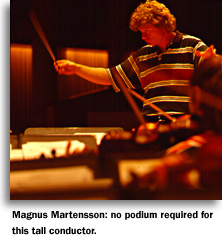 Conductor Magnus Martensson is cajoling. He says into the phone things like, "You can do it, I know you can do it, I really think you should...."
Current Issue | Comments? | Archives | Search
UB Home | UB News Services | UB Today