Artist Gallery
Legendary The Poet

Yes, I have Cerebral Palsy!
Buffalo Born Poet and Spoken Word Artist "Legendary" (Legendary The Poet) specializes in freestyle.
Specializing in freestyle, Legendary The Poet, is a spoken word artist from Buffalo, NY. He has published 10 books of poetry and has been on the poetry scene for 13 years. He has been nominated for three awards, two local and one national, and has been internationally published in the UK. Beyond his artistic work, Legendary also mentors and advocates for disabled people, and teaches about his disability, Cerebral Palsy. Legendary is a fan favorite at the annual disability pride festival. The event celebrates the signing of the Americans with Disabilities Act on July 26, 1990.
On this page
Poems (Selected)
"Song of Rations"
Save and savor carefully!!
We must round and make last to the new day and plot for those coming after,
Keep water as the most reachable thing and food that will not die so easily
Sustenance calls and calls
And so too,
Is the belly calling for it and greed be managed and tamed or we face emptiness again
By this survival,
We must survive some way.
This is the maiden song of our lives and course of these brash ripples.
"The Shared Hour"
The “lost time” we make up for…..
How long was it??
If you could give it an increment would I be there with you in any stretch of it??
Am I close to you?
What is the name of this “lost time” and if it is lost, how daring are we to make it up.
Defining what is destined to run away, none of this time is ever beneath my nails, but I did mourn it.
Of the lost time,
How much of it was the sun, and being onlookers of bursting stars they give a face to the sky such a long way above
To the lost time,
I love your sandy beaches and desires and I never stopped wanting to know you
You have always been something to remember myself by.
"A"
America, land where the abled assure the afflicted the answers align alongside appeasing
all audiences with adoring affirmations at all times
Alternatives to ableism, accessibility and accountability are amenities America apparently
acesses as astronomical and so the afflicted must affirm all is alright.
I won’t pick the meaning of this…..
I just wanted you adjusted to my intelligence to alliteration no thanks to your assistance–
I’m perfectly fine if this hurts your head.
"Untitled"
Um,
Can you love a man with Cerebral Palsy?
Preferably passionately?
Past all the perforations
Pre- determinations and personified
Personalized prejudices, can you promise
To pair me, a man with palsy, with your
Purest passion partridges and
Pear trees to come?
If you can
Then why are your peers your
Brain trust in our partnership?
Why can't you walk with me?
I already know why
Because palsy or not you dread having to
Lend me a hand if I fall.
You're too proud to pace yourself
To be paired passionately with
A person with Palsy......
"Care Is a Blanket"
I care…..
I care for the watering of you that I welcome my own fall.
I care to matter to you as loud as breezes moving the nameless branches and screeching leaves —
I care to let my unyielding brokenness contribute to your belief in strength even through the
unjust stares and eye rolls, like a blanket, care to cover you, bring warmth to your
exhaustion and soreness with nothing shielding my own —
While I fade into your busy afterthoughts trying to remind you, I was given the impression
that you cared.
"Snow Globe"
Once upon a sunrise we would be together over black top with simple games
It was the smell of burning charcoal not opinions that peaked our closeness
Now we are but self righteous circles of mud deciding who is best at dirtying the ground
I thought it was my knees that sunk quickly to the concrete, but it was not myself I heard shatter,
Rather our family portrait,
Outreach is simply the reaching out to tell me, my hand shall be to muzzle my own voice when I am slighted by the crass and shifty
Before I can ask that you listen to know me,
I must sadly discern which is the safer side of your attention.
About the poems on this page
- "'Song of Rations', the poem, appears in my book, Gray Water (2024)."
- "My poem 'The Shared hour' is from my book, Somehow, It's You."
- '"A", the poem,"Th entitled is part of a future book of writing I'm working on!!
- "This untitled poem is from my book Nameless published in 2020!!!"
- "Care is a Blanket" is a poem about care. The new work was created for the Communities of Care project.
Interview (Audio Player)
Michael Rembis interviews Legendary The Poet inside Spot Coffee in downtown Buffalo, NY, on September 1, 2025 (Labor Day).
- Audio: Michael Rembis interviews Legendary The Poet
Use the audio player (above) to listen to the interview (available 24/7).
I would also like to note the income people with disabilities live on. While I’m grateful, people have the impression this money [SSI and SSDI] is a jackpot, and it’s not the case at all. It’s just enough to live.”
—Legendary The Poet, September 27, 2025
My biggest problem is the expectation of people who are disabled to simply be grateful and quiet. I think the notion that I must swallow suffering just so you’re not inconvenienced is b***s***!!!”
—Legendary The Poet, September 27, 2025
Communities of Care
Legendary The Poet
Transcript of Record, approved changes accepted
Interviewee: Legendary The Poet
Interviewer: Michael Rembis
Transcription: AI ; Michael Rembis ; Chase Perkins
Interview Location: Spot Coffee, Buffalo, NY
Interview Date: September 1, 2025
00:00:02 Mike Rembis
So today is September 1st. It's Labor Day. We're at Spot Coffee in downtown Buffalo, New York, doing an interview with Legendary The Poet. We want to talk about his experience of becoming a poet and engaging in spoken word, and also his experience living in the world as a person with a disability. And so I think I'll ask a very open ended question to begin with, just to get you started. What motivates you to do the work that you do, to do the poetry and the speaking in public and the spoken word events and things that you do? What really inspires you or motivates you to do that work?
00:00:56 Legendary The Poet
First I want to say thanks for having me and conducting this interview today. I think my biggest motivation, honestly, is for myself. You mentioned before living as a person with a disability, and sometimes I often feel constricted by it. And when I discovered [that] spoken word could be an outlet for all these feelings and emotions, and it didn't require any physical, brute strength, it was like I found my niche. And so it was something I could pour all of these feelings and emotions into, sort of freeing myself from the cage. I'm not physically free from it, but I can reach the world in one way or another.
00:01:36 Mike Rembis
And what kind of feelings and emotions are you feeling? Do you think it helps you to express or to deal with? What kind of feelings and emotions are behind the work that you do?
00:01:52 Legendary The Poet
I would say self-discovery, self-consciousness. I am very self-conscious because of my condition. Self-worth, all of the self terms that you can think of is really behind that, self-love, self-care, all that good stuff. Because I think at least for me, as a person with a disability, those are a lot of the personal struggles that I have dealt with. And I know that CP causes others to feel that. So I kind of want to be an amplifier, not only of my own story, but to share those feelings with the world. To anyone with CP who can't necessarily express those feelings. So it's always been motivating for me to be able to do that and spoken word, just being able to convey that emotion and people relate to it and they want to hear it. It's empowering, it's motivating. It's like, okay, so I'm not just this broken, busted up body. I'm actually a force of power despite my obstacles. And so it's really about proving to yourself that you have worth in spite of what your physical condition or experiences tell you.
00:03:08 Mike Rembis
Yeah, well that's wonderful. And you've talked a lot about ableism as well. Do you want to say a little bit about that, about how ableism has affected you in your life or where you see it in society, and also how it relates to some of the work that you do?
00:03:30 Legendary The Poet
First of all, for those who may not know what the word means, ableism is basically discrimination against people with disabilities. It's any kind of disrespect or condescension or anything like that. I've dealt with it more prevalently as an adult, and I think one of the driving forces behind my work, especially with ableism, is to open the eyes of a lot of people to the privileges that they had. There are people with CP and other disabilities that can't talk, they can't lift their hands, they can't dress themselves. They can't even talk and say, I love you to their family. So the driving force is to get able bodied people to see the little liberties that they take for granted sometimes. And I think ableism hurts because it's not like if I fall and scrape my knee, I can put some ointment on it and be done with it. But ableism hurts the heart, and all anyone is trying to do is live. So it's a constant battle and it sucks.
00:04:28 Mike Rembis
Yeah, it does suck. That's true. Do you want to talk a little bit about moments when you experienced ableism in your life and whether that has kind of made its way into the work that you do, into the cultural work that you do?
00:04:45 Legendary The Poet
Yeah, most definitely. I believe that there was one instance I was getting some things delivered from an Amazon driver and I asked him if he could help bring the things to the back. There were some pretty heavy packages and I couldn't do the heavy lifting. And he was upset because he starts complaining. Oh, I can't, I could get hurt out here and slip on the ice and I could get hurt out here. You need to have someone here with you and things of that nature. And I just kind of stopped, and I'm like, I have cerebral palsy. I could get hurt here, too. And I'm twice as likely to get hurt as you are. So there was that, people not understanding. Cerebral palsy causes me to have a gait in my walk. Well, most everyone does, but mine is a little off due to the condition. And because people don't see me using mobility devices like a walker or a wheelchair, people have the presumption that I'm drunk or that I'm on drugs. And this has happened everywhere I go. It's happened with people when I go out, if I'm hanging with my friends, if I'm hanging with my family. I'm at bars a lot of the time and people think I'm drunk. Even cops have approached me. And it's just infuriating because it's like all I'm trying to do is live. It's like I'm a criminal for circumstances that are out of my control. So again, spoken word helps to give me a place to put all that. If people won't hear, then I can write it down in one of my books or I can speak it out loud on a stage, that sort of thing.
00:06:25 Mike Rembis
That's really good. So maybe we can talk a little bit more about that. When did you realize that you had a gift for spoken word or poetry? Is that something that's been with you your whole life? Have you worked to cultivate it? Have you studied poetry or is this something you've just kind of worked at on your own? Have you had mentors or tutors or anybody?
00:06:56 Legendary The Poet
My background in the arts just came from home. Poetry for me was that one thing in everyone's life you didn't really plan on making something of it. It was no big deal. But I grew up with that. We watched a lot of comics, a lot of comedians, and we were always into the arts and poetry came along as my mother and I used to watch the Def Jam poetry series together. And when I saw these kids and these people doing these emotional things, it was like, hey, that's the thing, I could do that. It's not about how much I can lift or how much I can move. My literal understanding of it at the time was, all you got to do is be emotional and talk. I can do that, hell. So I really had a simple understanding of it. Writing was always a part of my life, I was always doing it. But again, I didn't set out to be a writer. It's funny how the thing you never really set out to do anything with became the most successful thing. And I would write poems in school and send them around to school. And then, 2012, I did my first open mic, and then I decided to keep it going. And here we are today, 13 years later.
00:08:06 Mike Rembis
That's awesome. 13 years later, you have, what, ten books now? LTP: Yeah. Q: Ten books that you've published of poetry and you've done a number of spoken word events. And I know you do the ADA, the disability pride event every July. LTP: Yes. Q: Do you want to say anything about that, your experiences there and why that's so important?
00:08:31 Legendary The Poet
First of all, I want to shout out any and everyone that's involved with that, all the organizations that come out. I think disability pride is so important. I'm honored to do it every year. I've always had a great time. It's a good way to network, make connections. And again, it helps us to celebrate us and the work that we do. We're not just these broken people that someone else has to take care of. We have made accomplishments, we have made contributions. And even beyond that, we contribute to motivating people to be better as a society as a whole. A lot of my family and friends, I've been able to in a way teach about my disability and other disabilities and what really goes on in our daily lives. And I think the signing of the ADA, as well as the disability pride event itself [has] cultivated a huge community and understanding and bringing awareness. More and more people are listening. Advocacy is a tough job, man. Sometimes when I go through something goofy, I just say I love my job because this is a full time I'm a freaking gig, man. But going to disability pride, my experience has always been great. It's always a lot of fun. And again, it's a chance to network and connect with people and celebrate our accomplishments. So it's been great.
00:10:02 Mike Rembis
Well, good. I go every year as well, it is a very important event. And you're in your 30s, right? Do you feel like things have changed over your lifetime? I mean, because we're celebrating 35 years now of the ADA. And I was just wondering if you noticed in your life, here in Buffalo, whether things have changed or whether things are kind of staying the same?
00:10:34 Legendary The Poet
It's hard to say because as much as the ADA has done, you're not allowed to discriminate against people like myself or yourself. But, I'll say this, I don't want to be insulting, but there's definitely room for improvement because it's not doing a lot to change the people's attitudes. Just because you can't discriminate against me, it doesn't stop people from being ableist. It doesn't stop them from being rude. People with disabilities were still fighting for decent respect. We're still fighting to be treated like human beings. If we want help with anything like living situations or schooling or anything like that, it's still a rat race around the community. It's a wild goose chase. And so I would say that, metaphorically, the ADA is a contract that society still finds loopholes around. And to be quite blunt, we still got to tighten up ADA and everything. Are we really honoring the ADA, or did you just write that so people with disabilities would shut up and go away? Because a lot of the big thing is, oh, realize how blessed you are, you’re a miracle, and yada yada yada. We got work to do when it comes to truly honoring that document.
00:11:54 Mike Rembis
Yeah, no, I couldn't agree more. I think that's a really important statement. And so do you find challenges in your daily life? I mean, with respect to housing and transportation and relationships and friendships and all that sort of stuff. Do you still face challenges in those areas? And all of us, I think generally to disabled people more generally.
00:12:20 Legendary The Poet
Absolutely, I mean, I am loving my independence now. I'm living on my own right now, and I have excellent landlords and they are totally understanding. But before that, it was nine years of bouncing around and couch surfing. And I went to all these organizations, I went to many around the city. I went to OPWDD, I went to People Inc. And that's another thing and I'm sorry to say this, but, it needs to be said, some people with disabilities, their experiences with these services and agencies are not good with this. And I know I haven't always had luck or good experiences working with these agencies. And then there are other people with disabilities who will be like, well, my experience is good. And I'm like, that's great for you that your experience is good. But mine wasn't, and so, relationships. Oh, that's a huge topic. I mean, dating someone with a disability is not for everyone. I like to think of The Dramatics in this. It's a singing group from the 70s. They had this really popular song, Whatcha See Is Whatcha Get. And I think that's the hardest thing about a relationship is like, for me personally, it has me wondering if I'll be a good boyfriend, a good husband, a good dad. Because of my condition, here we go back to that self-consciousness thing again. Because society has a standard of what these things look like. Six foot Hercules looking dude. And then there's frumpy little me walking like, happy feet. It's really funny. And so, it's a challenge. As far as friends, I'm a pretty popular guy. I have a lot of friends in the neighborhood. I'm in a lot of the scenes. The poetry scene, the jazz scene. It's cool. But no, all of these struggles are a huge degree for people with disabilities. And even when you find love, it's like, do you like me for me? Or do you still like me despite the fact that I can't be what you want or do what you like? So the societal standards that people have, for being a man. And then there's a guy like me, it's like extra pressure, I can't count how many times I've been told you're not my type. Like, what am I, a Pokémon? Come on. But, harsh reality, man.
00:14:48 Mike Rembis
Yeah, those societal standards are hard to live up to. I think for anyone and especially for people with disabilities. And so I want to come back to the relationship with the agencies. But you also mentioned the poetry scene and the jazz scene, and you mentioned going out to bars and things. And do you think you found kind of a community there among those groups of people? Do you feel welcome in those settings? And are people respectful to you in those settings?
00:15:20 Legendary The Poet
Absolutely, I can say without a doubt. I want to give a shout out to every bar that I've been to in the city. There's lots of them. But a huge shout out to especially the GypsyParlor on Grant Street. And the biggest reason I say that is not just for the food or the atmosphere, but they are so welcoming to the people with disabilities, to the disability community, and they are welcoming, they're loving. When I say all walks of life, they mean all walks of life. Whether you're able bodied, disabled, LGBTQ, it doesn't matter. You are welcome here. And it was the first place I went and I can say with 100% certainty, from the owners, to the staff, to the security, the nonsense that I deal with on the street, they're not having it in there. So I really salute the GypsyParlor and all bars for being a place that. But definitely them for being a place where people with disabilities can go. We're just kicking it, we're hanging with our families and friends. As far as the jazz scene, that's a lot of fun. I've met a lot of great musicians. It's just good for networking. They don't see a person with a disability. I tell them about my story, and they think it's great. I wanted to get exposed to more things because I think as an artist, I can't grow as an artist if I'm only hanging around people that do what I do. I can't grow if I'm only hanging around poets. I want to be influenced by everything. I want to be around actors, comedians, musicians. So the jazz scene has spent a lot of fun to be a part of. I know quite a few musicians. Alex McArthur, Walter Kemp III, George Caldwell, John Bacon Jr, Ed Croft, just to name a few. All talented guys. And that's only a fraction of what our scene is. So community definitely helps get out there and learn and know these people.
00:17:21 Mike Rembis
Yeah, I think that's a really important point to make is that we can't learn and grow as people or artists or in any way if we're not out there in the community and having new experiences and learning from other people. So that's really good. And I like the positive experiences in the bars and things as well. So you mentioned that the agencies and you don't have to say, of course, anything that you don't want to say, but, I just want to give you an opportunity to maybe provide some more examples or some more thoughts about how, or maybe even why you would have a different experience with agencies, whether it be People Inc. or OPWDD or other agencies. Have you thought about why you may have had negative experiences, or can you give a couple of examples?
00:18:17 Legendary The Poet
I know with OPWDD, I was initially seeking their help in finding housing. And so when I mentioned rat race, it was like I had to do this adapted questionnaire of 30 questions. I had to do a neuropsych evaluation. I had to wake up at seven in the morning to be at a hospital in North Tonawanda. And there was like three hours of testing or some nonsense, and they couldn't help me after all. And then two years later, when I'm literally sitting in my bedroom in my apartment, they call me and say your name, we found your number. Do you still need our help? And it was wild to me. And it's like there are some agencies because I told them I graduated from Hutch Tech or I'm well spoken or whatever the case may be, and quote unquote higher functioning or something like that. I was denied. And it's funny because when I tell people these stories and they're like, you have a disability, they'll help you. I don't believe that. They're so shocked. It's like, okay, your experience was good. That doesn't mean I didn't have a bad one. I know the word no. When I hear it, I know when my attempts are not successful. But I think, to their credit, someone like myself, I'm very adamant, I'm very stubborn, I make people do their job when they're supposed to help me. That's what you're going to do. I'm on your case, I'm on your back, I'm going to call you, you're gonna help me. And so I can be cooperative. Because people can also be condescending towards persons with disabilities. And I am such a person who's not having that whatsoever. You're not going to treat me like I'm unintelligent. You're not gonna treat me like I'm here for you to score brownie points with your personal God or your good conscience or whatever. So it just it's a struggle. You got to know how to work with people. Don't be rude, but also stand for yourself and recognize when they're not treating you like a person. Just because they're not physically harming you doesn't mean they're not degrading you or anything. And my late mother always taught me to fight for your respect and stand for it so I can be pretty much of a bull. But it's been a rocky relationship and I think we have to hold these agencies accountable. Like, hey, tighten up, man. Like your parents when they told you to clean your room. Your grades are slacking, right? No. Your boss tells you at your job. And so it's our job to do that. I have the right to say. You have the right to say, hey, I don't think you're representing me very well. Tighten up the job.
00:20:52 Mike Rembis
Yeah, I think that's a good answer. I think we need to hold those agencies accountable. It's interesting that you said that sometimes maybe you think that it's because you're more, quote, high functioning, that they don't help you or they think they're unable to help you. I've heard that from other disabled people as well, that a lot of the agencies won't help them or think that they can't help them because the people are too independent or too, quote, high functioning.
00:21:27 Legendary The Poet
It's funny, it's kind of like they make the distinction even among disabled people. For them, disabled looks like not being able to do anything for yourself. And with respect to people who have those kind of conditions, I don't mean it like that, but sometimes that's how they define disabled. And that's my problem with CP. There are people with cerebral palsy who aren't in wheelchairs or use walkers or crutches with respect to those who do, but for those who don't, again, myself, I'm always presumed to be drunk, I'm always presumed to be high. People in my life seen this, family has seen this, people I work with at my friends have seen this, my colleagues. And it makes them very angry. I've had cops think I am under the influence of some sort. I can't tell you how many times I've nearly been arrested. And again, it's not so much that. And people like to be like, well, maybe they're uneducated on CP. Now, given respect to that, I can see that being the case in 1940 or 1930, it's 2025. You got Google, you got YouTube, you got chat, you got Siri, you got all these different things. So I don't really want to hear that as an excuse. The only reason you don't know is because you choose not to know. I'm just not giving that. I'm not going to give you that leniency. I'm not going to let you use that crutch if you will. So my mom told me a long time ago about life. She's like, if it doesn't affect them personally, they don't care. And that sucks to hear, but it's kind of the truth when you get older.
00:23:08 Mike Rembis
Yeah, it is true. I think a lot of people feel that way. If they don't encounter something or it doesn't touch them directly, then they don't really care about it. So you mentioned your mom a few times. Has she been really important in your life and important kind of person that you've learned from and has helped you to grow?
00:23:29 Legendary The Poet
Oh, of course man. First of all, I have to say my family's been great. When I was born, I was 2 pounds. That's pretty tiny. I weigh less than a chicken nugget. How crazy is that? My late mother, Johnny Mae. She did foster care growing up, and I was one of the children that she took in, and they told her, oh, he's not going to make it. We just need him to be comfortable. Like I was supposed to be game over the day I got here. Ain't that something? The day I started. So my family's freaking out. And my mom is like, well, no one's dying today, so she closed the door. Fast forward. My mom instilled tough love. She took a tough approach to raising me because her biggest thing was you have three strikes against you. You're young, you're black, and you're handicapped. And the world is going to use those three things against you. This world is going to try to use those things to beat you down. You're already assumed to be unintelligent if you're black or if you're disabled. So now you're a combination of both. So instilling that in me, I didn't get it growing up. But as I have gotten older, what she was trying to do was prepare me. She was trying to leave me the armor and the sword, so to speak. To fight, you got to be a fighter in this world. When you're dealing with something like this, people are going to try to treat you like a charity case, or treat you like you're stupid or like you can't help yourself. And let me be the judge of what I can and can't do. And I've dealt with people where they believed that even though they helped me in a situation, they can just be disrespectful or say mean things to me. I remember an individual told me I had the brain of a, well I overheard the individual say this, he has the brain of a child. He can't live on his own. And that's only one example of the heartless thing that's been said, and, well, karma is real, because look who's living in their own now. My own apartment. I got the keys in my pocket. But that's the thing. So she is very instrumental. She passed away in 2014, unfortunately. But I learned that with me, she took the same approach. Ray Charles took to his. Ray Charles's mother used to tell him all the time, you blind. You ain't stupid. And my mom would tell me the same thing. You handicapped, you ain't stupid and that was important to toughen you up, to give you that armor. As you get older, you learn she wasn't trying to beat you down and break your spirit. She was trying to prepare you for that world. Everyone's not the bad guy. Obviously, I made some awesome friends. But you got to be ready to fight for yourself.
00:26:29 Mike Rembis
Yeah, I think that's a really important point and very well said. How did you find your experience in school. Were teachers supportive, or did you run into teachers that weren't so supportive of you? Were you quote mainstream? Were you with all the other kids, or did you have to go on the short bus to the special school?
00:26:52 Legendary The Poet
Oh man, shout out to the cheese bus man. We call it the cheese bus. We used to make fun of it. Call it the cheese snack. The school I went to is here in Buffalo, School 84. It's a school for people with disabilities. Shout out to all the amazing teachers I had, all the amazing teachers, all the amazing staff. Miss Lauren Motten was my very first teacher there. And so many great teachers over the years. Roz Gaumer, Beth Tolbert, Lauren Motten and just the Palladinos, so many great staff. And they had a physical therapy, occupational therapy, speech. So we didn't have to deal with bullying. I was just the guy that got on everybody's nerves. If I'm being honest, I was. I smiled a lot. I talked a lot. I was a really emotional guy. I was a crier when I was little. It was bad, man. I was kind of a jerk, but, we had fun. It's not that school wasn't hard again. They prepared us with that tough love. I think what school taught us is that you can be somebody despite your disability. I was part of a scout troop when I was there, and we never went into the public or anything. But around school, we held classwork and host assemblies and things like that. I was part of that scout troop. I made the rank of wolf. And it was a great time. And we had fond memories growing up. Shout out to my best buddy, Izzy. Israel Cruz. Man, that guy's like my brother. I've known him since fourth grade. We got some wild stories in there and it was fun.
00:28:30 Mike Rembis
That's really cool. So that was like kindergarten through eighth grade, because then you said you went to Hutch Tech, right? LTP: I went to 84 until about 18, and I had to do an extra year on my senior year. So I went to Hutch Tech and that was the school they found that was handicap accessible. Shout out to Tech. Class of 2010. We're the best class. Hutch Tech was interesting because, not for any reason in particular. I'm a teenage boy. Of course, I was checking out the girls, so I might be disabled. That doesn't stop me from being human, man. Hutch was great. That's actually where I started getting into jazz. We had a jazz band, and a couple of my friends were playing in it, and I was like, wow, this is so cool. And my mom was telling me, you can't say you like music if you only prefer one type. You gotta at least try everything else. So jazz was kind of that sound. That was just it sounded like a lot of fun. People just were having fun and it sounded relatable. A lot of it doesn't have words. It's just a groove. So there's nothing to persuade you to do anything. You're just having fun with it. And I did a lot of growing up. That was fun. It's great experience for me, and I unfortunately didn't have a date, but that's all right. It works. Q: That's good. So I just wanted to clarify. School 84 was just for disabled kids? So you actually didn't go to a, quote, mainstream school when you were in grade school? It was all the students were disabled at 84?
00:30:11 Legendary The Poet
I didn't go to the mainstream school, everyone talks about all the other schools, and I have no idea what they're talking about. I'm just like, I went to school. I'm sure there were other schools. And as far as the students, pretty much everyone had a disability of some kind, whether physical or mental or a learning disability. I'm sure they were able bodied students that went there, but for the most part they were like, mental conditions, learning conditions and all sorts of things. There were people with spina bifida, people with muscular dystrophy, people with multiple sclerosis, cerebral palsy, all kinds of things. So it exposed me to learn that there are all kinds of people out there and all kinds of conditions. And but it also taught us that you can still be someone, despite that so great place to grow up and fond memories. Q: Oh that's good. And I'm glad you had a positive experience and that you met Izzy. And it's just it's curious to me because the legislation to integrate schooling was passed in 1975. And so to think that you, in the 90s or early 2000, you were in a school that sounds like it was almost all disabled kids. I didn't think that would even happen anymore, but apparently it still does happen.
00:31:32 Legendary The Poet
It's there man. School 84. I don't know the exact date it was founded, but I think it's, and I don't want to sound wrong here, but I think School 84 was around, since the 1928 or 1930s or something like that. But in the years that I went there, which was like the 90s. That's when I attended the 90s through the 2000. And it was wild that there was a school just for us. And I think it was good. A lot of people would say that that school was different. I've heard people say we were sheltered there, but at the same time, it's like, I like that school. Because, again, it showed us that we were somebody instead of having to make it work at other schools. And it's not that other schools aren't great. I'm sure there are people with disabilities who went to other schools, but the fact that there was this one, call it divine intervention, if you will. Just knowing what is there and out there and in physical therapists and occupational therapists and speech. It gave us a sense of pride in ourselves and taught us to strive for something. So, yeah, good experiences man.
00:32:41 Mike Rembis
That's good, I'm glad you had a really positive experience there. And you met folks and made good friends. LTP: Yeah. Q: So maybe to shift a little bit. So you went to Hutch Tech and finished there and then did you try to find jobs and things? Did you go on the job market, and did you feel like you faced any discrimination in trying to find work? Or have you always just wanted to be an artist?
00:33:09 Legendary The Poet
I didn't face any discrimination. What I faced was a lack of knowing what I wanted to do with myself because I would look for jobs and they'd be like, oh, well, you must be able to lift 50 pounds or 30 pounds. And we know having CP, I'm not in that category. So it was lack of knowing what I wanted to do with myself. So when I got into the poetry scene it was like, yay! Finally a meaning. And I don't know, I kept it going. I never set out and said, hey, I want to be a writer. It was just like, alright, this seems to be work, so let's keep doing it. Left Hutch Tech, didn't know what I wanted to do. I went to my first open mic in 2012, and it just went from there. It's kind of blown up. I've been a poet ever since. Man. 13 years. 13 years, 200 plus performances.
00:34:04 Mike Rembis
That's really awesome. It's a beautiful gift that you have. You're very, very talented. I've seen you perform. Is there something you do to prepare? Is there a way that you think about your feelings or your emotions or the state of society or is it just kind of spontaneous? You said you like jazz. Do you think it's sort of the verbal equivalent of jazz?
00:34:31 Legendary The Poet
I try to at least think of a direction I want to go with when I get up there, but I think it's me just enjoying the liberation. I think I go up there and I rehearse the energy, at home, I rehearse, it's like, okay, get in that zone. Get excited, get happy. You're going up there, it's kind of like when a football team comes out and everyone's running out there. Or when a wrestler hears their theme music, when the pyrotechnics go off and the crowd is cheering and you're all excited. I just think poetry was that thing that it allows me to be free. My art can go places my body can't. So my art has kind of become my shield and sword and navigating the world. And I think that I really have enjoyed it. To get ready, I try to make sure I get good sleep. I make sure I eat because I get hungry, so I try to make sure I eat before performances, things like that. I do want to mention make sure you have your phone off. My phone went off during an open mic one time. Everyone heard it was up loud too. It was really bad, man. My phone starts going off and I pick it up, answer it, and I'm like, I'm not an Avenger, but I will answer the call. And that was completely off the top of the head. I didn't know what to do. I think it's just being prepared for the spontaneity. It's kind of one of those things. I don't know what to do when the time comes. One of those deals.
00:36:02 Mike Rembis
Yeah, that's important. Being able to improv like that. And I think the way you do spoken word is a lot like jazz, really. There's a lot of improvisation, a lot of freeform. You just need to be inspired with certain words or certain phrases or kind of ideas that people suggest. I suppose the written poetry is a bit different. You work at that longer you craft that more, you spend more time on that.
00:36:34 Legendary The Poet
I would say, and this is my opinion, the key difference between performing a spoken word and my writing spoken word. It's kind of like I go up there, I do my thing and take it or leave it. The writing, it takes a lot more patience because it's just me. It's more intimate. It's you and your thoughts. It's quiet now. Why wasn't it like this when we started? You're just there with your thoughts, and you take a little more time. And I always tell people, if you like some freestyle, imagine what I took the time to write and think about. My most popular book, Nameless, I wrote during the pandemic. That's my third book. I'm up to ten books now, and it's just like, unbelievable. Unbelievable. And it's actually the 10th book I wrote listening to jazz and blues for some reason. I would listen to it on YouTube and I would just write whatever came to my head, whatever I was feeling. So it's all spontaneous and just writing with it because creativity is its own living entity and you just go with it, man. So here's where it led me so far.
00:37:42 Mike Rembis
That's wonderful. I could see how jazz and the blues could be really inspiring or set a certain tone or mood. I really love both jazz and blues. So have you reflected on your ten books and your spoken word performances? Are there themes? Are there sort of things that seem to emerge as really important in your work, or is it mostly all center around things like ableism and disability and the way the world is for people with disabilities. Or are there other themes that come through?
00:38:25 Legendary The Poet
My disability or living as a person with a disability has definitely been a theme throughout my writing. But I think one of the biggest themes in my life is feeling lost and lonely in the world. The world being what it is. And I live alone, so there's nothing but me and my thoughts at home all day. And that's probably why I go out as often as I can. Because it's not good to just be at home stuck in your head. Sometimes you feel separated, you feel out of place. And again, you got to put all that somewhere, you got to put that somewhere. And so that's where writing comes in handy. And so feeling out of place, feeling lonely, all of those things, are the voice of, I like to call it my inner child just crying because CP was a circumstance I didn't have in mind. And I'm the only one that's got to care for it. So it's like even as a grown man, I'm the only one. I don't have a partner to help me through the bad days. I don't have a girlfriend, so there's no one to ride the storms out with me. There's no one to celebrate the good times with. It's just whether it's good or bad, it's just me. And sometimes that gets to you so. And you got to put all that somewhere. Hence the poetry and all of that kind of stuff. So art is a great avenue for people with disabilities. Any creative avenue, whether it be poetry or art or music. I would tell anyone out there, if you've got a disability and you want to pick up that pen or that guitar or those drumsticks, do it, man, because it'll help. It's a big part, the having a disability. The arts can be the greatest ally that we have. And so that works.
00:40:05 Mike Rembis
That's a very powerful statement. Are there places where you've tried to find community? Like, have you tried to talk with other poets or other artists either online or have you tried to reach out to those groups, or do you feel like that's not something you can really do or you want to do.
00:40:30 Legendary The Poet
Oh, I've definitely reached out, I've gotten to it. After I went to my first one, I just kept going to stuff. I've met a whole slew of poets in the Buffalo scene. I met poets from Jamestown, poets from Buffalo, poets from Canada, poets from all over man. And they are just amazing. Even poets with other disabilities like autism and things like that. It is so fun to be out there with those guys. We have a slam team during poetry and they've attended different slam events and done that. And I met with those guys. There's like playwrights, there's poets are everywhere, man. There's a lot of us. So I think a sense of community is great in that sense. You go out there, you build with the poets there, they accept you and they love what you do. And so I think going out and finding because what you don't have, you got to go out into the world and build it or find it. And I was able to do that. So it was really great to talk to them and build the poetry scene. And also, in the arts in general. I mean, I remember I used to visit a boutique owner, Phenominal Xpressions, and the owner, the CEO, Nikita Williams. Nikita Williams, she was the CEO or is the CEO of Phenomenal Expressions. And she would always give a platform to any local talent, musicians, poets and myself in particular. She's been a big proprietor of me having a voice in spite of my disability as of many people. But she's been not only a dear friend, but one of the mentors that I have. She would perform and put on events for Curtain Up, which celebrates the start of theatre season in downtown Buffalo and Maine. She would open her boutique to many events, and we'd have bands and I would do the spoken word. So she's always taken pride in what I do. So it helps to have people who believe in you, because that in turn helps you to believe in yourself. And so it's a domino effect. Q: Yeah, that's wonderful. That's great.
00:42:54 Legendary The Poet
This interview has been great, and I have to say, I think one of the biggest problems with having a disability in general, it's not even the physical symptoms. It's what I call the societal symptoms. I get a lot of this kind of shit like people are. You need to realize how blessed you are. If I had a dollar for every time I've been told that I'd be a filthy rich man. Like I've had people compare me to other people with CP or with other fucking conditions, and they're like, you gotta realize how blessed you are. You gotta like, what kind of fuck? What kind of bullshit is that? Like, that is why. That's what makes the ADA look bad. And that's why I say what I say. Are we truly honoring the ADA, or are you trying to shut us up? Like, don't tell me I gotta realize how blessed I am. It's fucking condescending, it's dismissive, don't insult me like that.
0:43:39 Mike Rembis
Do you think that people are saying you're blessed because of how good people have it. How good disabled people have it in the U.S.? Do you think they have misconceptions about that, or are they saying that you're blessed because you're sort of one of God's special creatures? Because I think disabled people get that as well.
00:44:00 Legendary The Poet
I do want to say that I am definitely blessed by God. I mean a guy that was born 2 pounds and was supposed to die the very day it was born. I got to give it up to the guy upstairs. I mean, I lived to be 33 years old, and knock on wood, 34 this November. But I think they say it just because they don't want to hear it, because it makes them look at it themselves. One of my high school teachers, you talked about my teachers, it was Ross Gaumer who used to. She showed us this one thing and it freaked us out. She would say, point your finger. For every finger you point, there's three fingers pointing back at you. And so people, I think it's more of a silencing tactic. And people don't want to look at themselves because then they're going to look at how snooty and trivial their stupid problems are. We live in a world where people are infatuated with who's cheating, who's creeping, who's divorcing, who's abusing, and all this other stupid shit. And while they're interested in all that, like I said before, there are people with conditions who can't even speak and tell their families that I love you. They literally can't fucking talk. So it's like my approach to advocacy. You're the one who needs to realize how blessed you are, not me. I know you don't know how blessed you fucking are. And yes, my condition compared to others is okay, but I got my own damn struggles. You know what it's like to walk up and down the street and people think you're a drug addict or you're an alcoholic? And you know, girls don't. I've had people physically mock the way I walk, like, ooh.
00:45:50 Mike Rembis
Yeah, I know. Well, that's terrible. So I'm wondering, are there any closing remarks, anything we want to end with that we haven't explored to this point yet. Is there any final words that you would want to leave with the world?
00:46:14 Legendary The Poet
First off, I want to say, people with disabilities. We are not here for you to score brownie points with God. If you're going to help us, then help us from the heart. Don't help us and then constantly remind us that you helped us. Nobody needs that shit. I don't need that shit. But beyond that, I just want to thank everyone who's been so supportive. Family, I want to thank my friends, all the poets and musicians I've met, go Bills, fuck ableism. And just for everybody out there, fuck Trump. And stop asking people [with] disabilities weird ass questions. I know one question that we get a lot, especially having CP, is like, can you have sex? It's like, are you serious? That's a real question that we get like, what the fuck, man? Like, is that an invitation? Learn the do's and dont’s of people with disabilities and people without disabilities need to get more involved because it can't always. If the biggest advocates for people with disabilities are in fact the people with disabilities, that's a fucking problem. Stop telling us how blessed we are. You need to realize how blessed you are. Period.
00:47:16 Mike Rembis
Yeah, well, I think that's a really good statement. And I wonder, we've also been asking folks if they would want to change anything in the world, what would that be? How do you think we could create a better society other than changing the way we view disability and the way we act towards people with disabilities? Are there things in the physical world or politically or socially that that you would want to see changed for a more loving and more welcoming world?
00:47:49 Legendary The Poet
Well, again, it goes back for me socially just people with able bodies speaking up more because when it keeps coming from us, it just sounds like we're whining and complaining. We need able bodied people to realize that I always do this. As an example, I did this with the kids at Elmwood Village charter. I just had them raise their hand. I had them make a fist. I had them look to their left and right. And there are people with disabilities who can't do those things. So again, my approach to advocacy is not trying to make anyone feel guilty, but it's trying to help you to understand the liberties that you take for granted. I am not one of those, I call it the Disney advocates. They just want. Oh, my life is so awesome. And what fucking wonderful. And, oh, everything's good. These are my symptoms, but I'm awesome. No, my life has been great, but it's also fucking sucks, man. I've had people threaten me, I've had people publicly mock me, I've had people follow me. People have threatened to hurt me like this. Reality is real, man. And I haven't done anything except try to fucking live my life. So, yeah, we need just a gratitude. And people who are able bodied, you need to get up, take a look at yourselves and do follow your advice that you give us. Realize how blessed you are and actually take time to help someone you know [who] has a disability or someone you might meet. You need to turn off the TV, stop looking at Beyonce and all these other people who don't know you fucking exist and do some real good in the world. Serve a purpose bigger than your own petty selves.
00:49:41 Mike Rembis
Well that's good. That's very well put, and I think a good place to end. I just wonder, we talked a little bit about or you kind of mentioned a little bit about yourself and your background, and we usually end by just identifying ourselves a bit. And of course, you don't have to identify in any way you don't want to, but you've said that you're 33 now? LTP: Yeah. Q: And you do have CP and you're a black man. Is there anything else you want to say about who you are? You've lived in Buffalo your whole life.
00:50:19 Legendary The Poet
I want to say that, Buffalo. And I want to say that having cerebral palsy. And it's been a journey of discovery, man. I think it's constant discovery. I'm always learning something about myself, and there's always some avenue to explore. And Buffalo being the wild bronco that it can be, the unpredictable weather and the unpredictable people, Buffalo is a nutty town, man. But it's just there's something so endearing about it. We got the best wings anywhere in the world. So I'm just learning again, self, to be proud of who I am. Being out here in the community and doing these things helps me realize that I'm not just this broken body. I can be somebody, I'm worth loving, I'm worth all this good stuff. And I can influence people. I wanted to be a teacher. Growing up, I never went to teachers, so I guess I became that, but just not in a traditional sense. So football season is upon us. Go, Bills. Eat some wings and CP, or no CP, I fucking rock, and so do all of you. Oh, and by the way, a lot of people don't know this. 17 million people. And I say 17 million plus around the world, have disability or have cerebral palsy. And every disability that you can think of numbers in the millions. And I want to end with this, before you think about calling someone cripple, I want to end you with some advice that my mom once said to my brother. One of my brothers called me cripple, and she said this. There's more than one way to be cripple, ain't it? So when you open your mouth to call someone cripple or the R word or whatever you might. Again, like my teacher said, go look in the mirror, have a date in the mirror with yourself. God bless. Love you all. And rock out man. Go Bills.
00:52:15 Mike Rembis
Alright, excellent. Thank you so much. We are at Spot Coffee on Chippewa and Delaware in downtown Buffalo with Legendary The Poet. And it is Labor Day.
00:52:54 – End of interview
Slide Show
To view slide show in full screen: click on any photograph; or click the full screen icon. To advance the photos, use the forward/back arrows.
Authored Books (Selected)


Nameless (2020)
The book, Nameless, by Legendary The Poet is a collection of work that is unique in that it purposely utilizes no title to give the reader the extra task of critical thinking and exploration of their own creative depths.
Nameless (2020) is available via Amazon.
AI review summary: "Customers praise the book's poetry, with one noting it's written from the heart and another describing it as a beautiful collection of honest words. The book receives positive feedback for its authenticity and readability."
Sample Customer Reviews (See all reviews on Amazon)
- Brilliant work from an up and coming new artist
First let me start off by saying the book dedication moved me to tears. The title of the book in and of itself is brilliant. I love how the poem on page 32 explains why the poet choose the title “Nameless”. Tyrone Houston AKA “Legendary The Poet” work in this book is real, raw and from the heart. Some of my favorites to name a few are - p.7 “In the valley...”, p.12 “I don’t...”, p.20 “In the halls of my mind...”, and p.45 “I don’t want to be the greatest...” (keep in mind these are not the titles of the poems). This book is a must read and I encourage everyone to purchase this book and support this awesome artist - trust me, you won’t be disappointed. - Creative poetry
Nameless has brought the art of confessional poetry and creative poetry to life. The best poetry inspires and can be interpreted in many ways. Like the title of the book "nameless" the pages within and poems encourage the readers to find their own meaning within the personal experiences of the writer. This poetry is interactive, inspiring, thought provoking written art. I would definitely recommend buying this book.


Gray Water (2023)
Gray Water by Legendary The Poet is available via Amazon.
Product details
- ASIN : B0CL68B7ZJ
- Publisher : Independently published
- Publication date : October 16, 2023
- Language : English
- Print length : 88 pages
- ISBN-13 : 979-8864566695
- Item Weight : 6.6 ounces
- Dimensions : 6 x 0.2 x 9 inches


Take Your Leave (2023)
Take Your Leave — Dedicated to the memory of friends recently departed the author chronicles grief loneliness and feeling out of place in present times by the best means he knows of, Writing.
Take Your Leave is available via Amazon.
Product details
- ASIN : B0CL68B7ZJ
- Publisher : Independently published
- Publication date : October 16, 2023
- Language : English
- Print length : 88 pages
- ISBN-13 : 979-8864566695
- Item Weight : 6.6 ounces
- Dimensions : 6 x 0.2 x 9 inches
Related Links
Legendary The Poet on Instagram

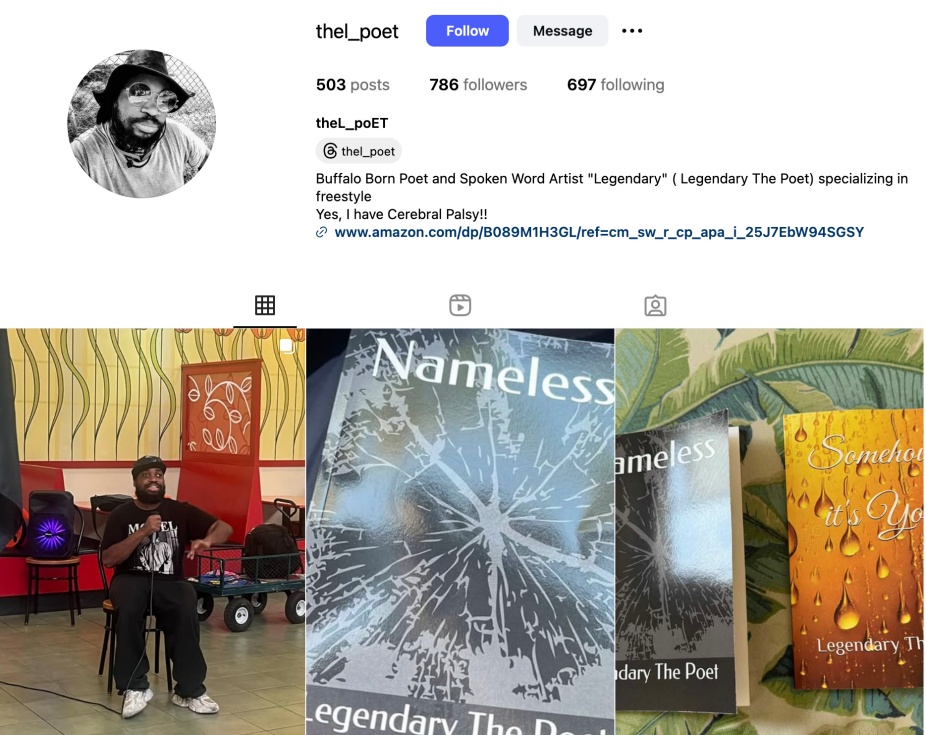
Legandary on Instagram