Artist Gallery
Claire M. Connolly
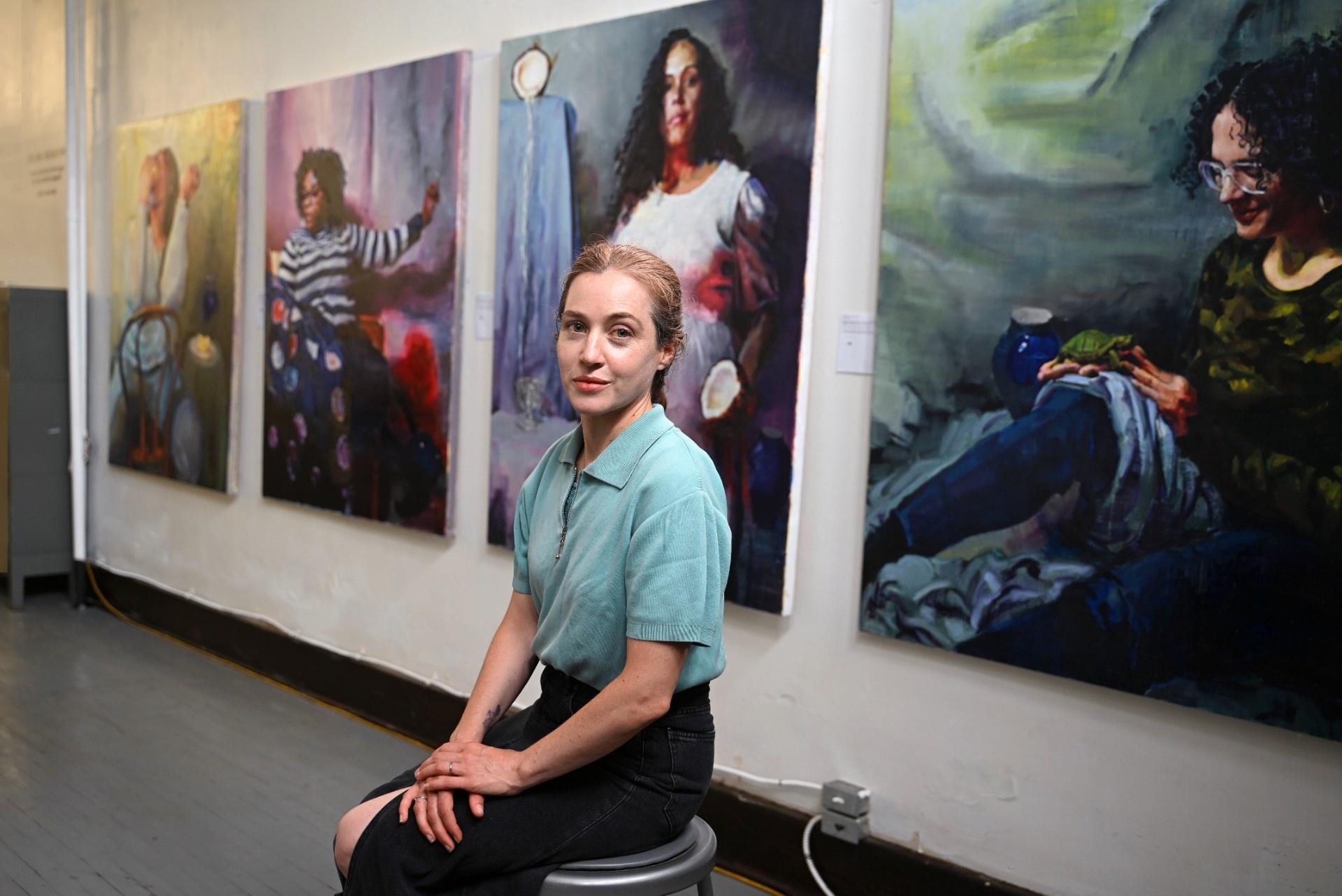
Artist Claire Connolly as seen at the exhibition of her work, See Me Bearing. Photograph by Nancy Parisi, 2025.
SeeMe: Bearing — A new ancient archetype for the people
Claire Connolly is a figurative artist who creates in the spirit of exchange, to express her relationship with anti-patriarchal experiences. She uses art as a living language—one that can complicate our prevailing order, which exclusively values progress, triumph and fixed ideals.
After childbearing precipitated a personal crisis, she became inspired to spend her life exalting the deep mysteries that surround stagnation, defeat and the inevitable chaos of existence. She interweaves oil, gouache or mural paintings with graphic t-shirts. Connolly collaborates with organizations and citizens in her community. Such practices invite her audiences and subjects to ‘speak art’ with her, towards a murkier, richer, truer reality.
Artist's statement: My work invites people to challenge our narrow patriarchal ethos, in small and personal ways. I believe that such piecemeal, spiritual changes can one day add up to a momentous one. I use formal strategies such as figurative painting, ink drawings, and graphic symbolism to express my relationship with anti-patriarchal experiences. I collaborate with community organizations and citizens, and enlist audience involvement using t-shirts; such practices seek in turn to prompt authentic, responsive expression from those around me.
The prevailing order continually enfeebles an expansive spiritual paradigm; it reproduces generic symbols of gender, especially womanhood, in place of specific expressions of personhood, and seems to exclusively value archetypes that express progress, triumph and fixed ideals. I seek to use art as a language to complicate this state of affairs and prompt my viewers to do the same. I create to exalt the deep mysteries around stagnation, defeat, and the inevitable chaos of human existence. I would like to ‘speak art’ with anyone who is willing, to the end of sharing a murkier, richer, truer reality.
On this page
Related Links
Seven Paintings in the series, SeeMe: Bearing
Click on any image to view the series of paintings as a slide show with captions.
Listen to the Interview
Audio Player
- Communities of Care: Claire Connolly Interviewed by Jessica Lowell Mason, July 10, 2025
About the interview
On July 10 2025, Jessica Lowell Mason conducted an interview with Claire Connolly. They discuss the concept for the project, See Me: Bearing, and how it emerged from a personal journey.
Specifically, Connolly’s own mental health crisis revealed to her the ways in which fundamental human truths are both encoded in the childbearing experience, and yet conspicuously absent from the West’s exalted cultural landscape. Connolly observes that this imbalance contributes to injustice for many, not just people with ovaries, but quite urgently for pregnant people of color.

At the exhibition, See Me Bearing, Claire Connolly hugs her daughter. Photo by Nancy Parisi, 2025.
COMMUNITIES OF CARE INTERVIEW
Transcript of Record
Interviewee: Claire Connolly
Interviewer: Jessica Lowell Mason
Transcription: AI; Jessica Lowell Mason
Interview Location: Buffalo, NY
Interview Date: July 10, 2025
00:00:04
JESSICA MASON: This is Jessica Lowell Mason. Today is Thursday, July 10th 2025, and I'm speaking in Buffalo, New York with Claire Connolly about her project, “See Me Bearing: A New Ancient Archetype for the People.” I wanted to begin our conversation by saying how much I admire the project that you and your co-creators have brought to life. I had the pleasure of attending the launch of the installation of your work, which has many dimensions and components at Fitz Books and Waffles, and to be part of the panel and community conversation that you led. It was such a rich and important moment of public conversation that allowed you and us to touch on many topics that I hope we will have a chance to dig a little deeper into today. Since you evoked the term ancient in your title, and I noticed that was in parentheses, I wonder if we might begin by talking about origin stories and origins, the origin of this project, your own origins for this project, as in your personal story and how the project came about, as well as maybe some of the historical origins that you were drawing from. And, in terms of thinking about that our experiences aren't necessarily new, that these are continuing experiences, things that influence the project as it came about.
00:01:37
CLAIRE CONNOLLY: Well, well. Thank you. You know, that's a wonderful question. I'm excited to dig into it. And I also want to just thank you for your contribution to the panel. I feel like you immediately responded to it, personally, and you were generous in your willingness to share that with everybody, right in the room, right on the spot. I appreciated that deeply at the time that the panel was going on. Yeah, it's interesting, you pulling this question from the word ancient because there's a level on which even my personal origin story for this project, which was only nine years ago, feels ancient, and the reason for that is tied to some of the themes that I discovered reading about actual ancient civilizations. So, when I was pregnant, I had a lot of mysterious sort of symptoms that I didn't feel were being listened to. I became increasingly anxious and terrified, and felt that I was slipping further and further from the world, that I was becoming more and more invisible and more and more imperiled as the pregnancy went on. And in this really quiet, anticlimactic way, the day that my daughter was born played out in such a way that an ordinary morning turned into this afternoon where I was kind of realized without having ever gone into labor or feeling anything that I was in a place of maybe dying and that my daughter was also in a place of maybe dying. My emotions were very private and everything was very quiet. There wasn't there wasn't really any drama; it just sort of quietly played out that way throughout the day.
And then I found myself realizing this is a situation I was in. So I had all these internal thoughts, and one of them was, “You know what? If I just hadn't gotten pregnant nine months ago, maybe I could just be living my life and I wouldn't be right here, right now, with nothing to show for it and maybe just dying.” And that that was a thought that was lodged in my head moments before I met my daughter. And everything turned out fine on paper. I was alive and healthy. She had to be in the NICU for six days, but she was alive and healthy. But when she was placed into my arms, everyone was sort of like, “Look, everything turned out great. You know, it's fine.” And I looked at her and I saw her mortality. I saw her future death. I was just in this place of realizing how close we can be. I was in this this sort of, now, I would call it - after reading all this stuff, like liminal place. But all this was, like, secret. All this felt like something I shouldn't tell anybody. The regret that I'd gotten myself into that situation, that I felt very ashamed, that I had valued my own life. I felt that if anybody knew that my first thought of seeing my daughter was about my death and her death and feeling very broken up about that, that they would take her away from me because they would say there was something wrong with my brain. Something had gone wrong with my hormones, and I wasn't safe to be around my baby.
So I started my journey feeling like I was on hostile terrain all around me. And I coped with that by saying, “Were there other worlds? Where is there any, is there any corner of this earth where my experience fits?” And I started looking to ancient civilizations, ancient belief systems, other indigenous belief systems that are still going on and vibrant today. And, I started to learn about different paradigms. I started to feel mirrored and validated by them. One of the really validating things was that the fertility goddess, the earth goddess, sometimes just the supreme being of ancient cultures like Mesopotamia and just in more subtle ways, even filtering through as cultures became more patriarchal. But, you know, ancient Greece, even in those cultures where, where their religions are more image based and less based in text, where phonetic alphabets hadn't been invented yet. And so things are more story-based and image-based and experiential. Those fertility figures, those mother figures were also death figures. That was incredibly validating to me that I had actually gone through a real human door, that door of life and death. And that that wasn't a mistake. That wasn't something that went wrong. That was something beautiful. I found beauty in that. The other really validating thing was this idea that time is not always linear in this other paradigm. It's a whole other can of worms to say where I went down the road with thinking about patriarchy and everything, but these are just emotionally sort of validating things.
00:08:17
I realized that, in my personal story, I was overlapping onto my own past and also the past of my mother and also the past of my grandmothers. I wrote poems about my maternal grandmother having half of me in her body, as one being one of the eggs in her, in my mom's ovaries when my mom was a fetus in her body. I just was thinking about that a lot. And I started to experience my mental health crisis as feeling like a ghost, and looking at my daughter and seeing her as a ghost, and living as if I had died or she had died. And I had very much in my bones at that time, my paternal grandmother, who had very severe mental health issues that impacted her life to the point that she had electroshock therapy. She had to be restrained in straitjackets. She was institutionalized against her, without her; you know, she wasn't deemed competent to give consent over whether or not she should be institutionalized. And, my father's life was never the same after this started to happen. I realized during that time, I felt it in my bones. I had known it, but it clicked in my bones that this mental health change in her happened when she lost a baby who was one day old, and she baptized her baby daughter in the kitchen sink. And then, she had to say goodbye to her. And after that, that's around the time that this change happened. I think I was experiencing that when I was looking at Vivian after having gone through that. I love that you brought up that word ancient because it's ancient in the sense of how I looked so far back into time to get really fundamental and elemental with the human experience, and find where I was fitting within that because it wasn't in our current culture. And also, realizing how my own sense of experience and my own actual life is echoing back further, even in even in the present moment through past generations.
00:11:10
Q: Wow, I could listen to you talk about this all day. I was definitely thinking about discovering, after I had been institutionalized, that my great-great-grandmother and great -great grandfather had been put in asylums, and they were Irish immigrants. And what you're sharing about this idea that our experiences can lead us to uncover hidden pasts or things that have been silent, especially because in your story about birth, you described a lot of silence around that moment and feeling invisible and feeling this shame or this fear that what you were experiencing could not be named, that it was like, you know, “What is that?” And yet that was the place, that liminality, that liminal space of being like, “oh, I'm, I'm just me here. And I can't share this with community outside of me, or bad things will happen” is the very thing that connects you with deeper things within you. And I think that's a beautiful way of describing one of the origins of this project. I'm also curious about the more tangible, everyday aspects, of how you how you found out about communities of care. What that process was like, where you were like, “oh, I really want to be part of this project. This speaks to me. And what can I do with that? And how do I get from being this person with all of this beautiful experience and incredible insights –and I hear psychoanalytic feminism in some of what you're describing— to creating this sense of direction?
00:12:59
CC: Yeah. Well, I'm thinking about my grandmother a lot, and it does kind of pull kind from that. I also, just as an aside, want to say, my lineage is also Irish immigrants, and, the Indigenous belief systems is a big theme with that, because Irish Catholicism is like this mash up of pre-Christian Irish. I grew up in Boston, where there was Irish nationalism and racism. But there's also the other side to it where there's this funny combination of access through the English language into European culture while there's still these Indigenous foundations at play. So I became interested in that, and I realized that every time I was being very triggered by water, every time I would hear running water in the tap or anything, I would be to a point where I would say, what is going on with that? And then I was reading and listening to stuff about, you know, the Irish Indigenous. We still know about it. And water is this big theme where it's the connection to the other world, and I think that those kinds of things, that curiosity and starting to lodge on symbols like that, like something concrete like water, and realizing somehow that was in my body. And who knows if that's anything to do with my bloodline or the experiences of my ancestors. But it felt like maybe there's more magic in the world than I had given credit for. I started to feel like it actually made a lot of sense give meaning to experiential, concrete, almost visual symbolic things. That's something that I hadn't really learned to do in in the world. I feel like our world has a hierarchical thing where we really prize abstract reasoning and abstract concepts over things like that. I started to realize that it doesn't need to be like magical thinking. There's a logic, there's a language to physical things and symbolic things. And that started to loosen up a little bit of creativity and a little bit of fun and a little bit of energy and a little bit of hope for the future.
00:16:04
Going back to my grandmother, so my grandmother was artistic. She was very talented at drawing. She always wanted to do it. I think she didn't really get to do it as much as she wanted. I think she even wanted to go to art school, but wasn't able to. I had been ambivalent about making art my whole life because of that. There was a concern within myself and even within my family of the correlation between artistic inclination and mental health issues, so there was a little bit of fear around my ability. And, my dad is talented, too, at drawing and making art. And he still loves to make things, and I think he may have felt a little bit weary of that in himself too, because it's scary and there's so much pain around it.
00:17:23
So this time where I'm kind of pushed to the edge, I'm miserable. I'm pushed to the dge and it's like I've been cast out of all the games that I was trying to play and all the ways I was trying to succeed my whole life because I was so completely down in the dirt that I’m finding hope in these things that I never would have allowed myself to find hope in. Like, water is a portal to the underworld, and I'm actually speaking that language, I'm taking it seriously. So then that I think that was part of a chain of events where I realized that I'm sort of in this narrative of the past and of these intergenerational things, and I'm working through this ghost business of this life and death issue with childbearing. And I realized that making art was not the scary part. It was the way through it. I can't really articulate exactly how, but all those things sort of came together to make me realize that, this this was the way through, was sort of just digging into all the juiciness and the weirdness that I'd always tried to keep at bay within myself. And that meant I needed to develop my visual language and I needed to develop my weirdness; I needed to give it form and I needed to I needed to make things about it. I needed to commit to my faith in the beauty of it. And then I started to yearn to create a world where everyone would be mirrored and I started to see it. This isn't just about women with ovaries. This isn't just about childbearing. This is about these old civilizations where the mother figure is a life-death goddess that wasn't just for women, that was for everybody, that was an expression of the of the human experience.
So I started to want us to just basically tell the world and make the world a little different. I had this idea that I wanted to use symbols, use visual language. Iin our society, we kind of think, if you want to be an artist, like, what's your career going to be? What are you going to say? What are you if you don't have any kind of thing? Why do you think you're going to be an artist or is your skill level good enough that you could command something on the market? And that was another reason why I just thought I can't. But then this whole thing changed me into thinking it's not about me so much. It's not really my business why I want to do this or why I have this ability. And it doesn't have to be about what I have to say. I just need to do this and use it like it's not a fixed thing. It's a living and breathing thing. And I need to live it and use it, and it needs to start moving in the world. So somehow that all just clicked together, that I wanted to do this thing about childbearing that used symbols and that used other people's voices, and where their perspective and my perspective would be like melding. I had that idea and I was developing the grant for it. And then I found out about the Communities of Care call for art. And I read the description, and it really challenged me, in its way of framing, how do you define care? And, how would you define communities of care in terms of disability and gender and all this stuff, and I think that really helped. I really welcomed that sort of framework because it helped me expand my language in a rigorous way. It helped me really examine.
00:22:03
I sat down and did like fifteen mind maps and did different outlines, and I had different pieces of the outline that were really hard. They were like puzzle pieces that I was trying to fit together, because it really helped me ask myself, how do you make this really gendered personal, specific topic that's childbearing, which has so much baggage around it that is not inclusive or that is very gendered. I learned in researching; this grant proposal prompted me to do that. It's been called the ‘third rail of feminism,’ because it's like this tricky terrain between gender and biology, that there's all different reasons why people want to stay away from it. Because of that tricky confluence. And also the concern about, you know, I think it's maybe second wave feminists concerned about the gender essentialism and we're going to start getting into gender roles. And it prompted me to tackle that, thinking critically, and actually reading research about it and reading articles about people discussing this. One thing that came across was globally, a women's rights issue, just as a fact of policy and reality, around the world, women’s quality of life increase when you provide childcare. That's just a fact. And if we don't want to face that because of these kind of ideological issues that we haven't unraveled yet, then we're not meeting the needs of just humans in the world who are disadvantaged because of one aspect of gender, which is, you know, their childbearing status. So it prompted me to really think about the difference between how feminism can include people, how those issues of biology, gender, childbearing, gender roles, and all these things can just exist in diversity within the umbrella of feminism. And that I could find a language to talk about that, it really helped me refine how this mirroring of the childbearing experience as a paradigm for half of the human experience that our society tries to avoid is an act of care because how much it healed me to be mirrored by the depths of the human experience that this project would be representing the beginning of a change like that.
00:25:32
Q: You've said so much, and I take notes while I'm listening so my little maps are forming here with everything that you're talking about. And there's so much to say and explore. One of the things I was thinking about was how you talked about how in going into these deep places, you began to let certain parts of you rise to the surface. I was thinking about reception, like in the birth situation where you were aware of these things rising to the surface within yourself, but you were like, ‘oh, those would not be received well by others.’ However, the art and embracing the art, despite some of the fears that you were experiencing about what it might mean and where it might place you and the boxes that others might place you in, and where you might become stuck. I was curious about, in the project, how reception might have changed when you really did let these things rise to the surface. And if the project was like this mechanism for having a safer, brave space for you to let it rise to the surface, and then how others receive that maybe differently than what we know institutionally could have happened had it risen to the surface in that context.
00:26:49
CC: I think one thought that question brings up is the fact that there are weirder and harder edged places that I want to go in my work around reception. But this was where I wanted to start. One rationale is that I became convinced I had anger. I wouldn't say rage. Anger was a big part of what was driving the courage that I had. The ability to be curious and have hope was driven by an anger. Childbearing, I felt, was ground zero for misogyny. Ground zero, because it represents chaos and death and obscurity and bewilderment and all these things that men and women alike would rather do without. And women became the scapegoat for that because people with ovaries would get pregnant, and it would just be this… Even a soldier who goes off to war, you can understand how he died. If he dies, he goes off and imperils himself. But childbearing is so bewildering, and it doesn't feel like as much of a choice: like you don't you don't say, ‘okay, I'm going now. I'm going to the danger.’ It comes, comes upon you and you find yourself in it, and your life just goes in this other direction where it suddenly becomes on the edge. I'm trying to find my way back to the origin, I think.
00:29:10
So with this project, I wanted to find that anger. One of the things was, I want a different world. I want it not to be that we are scapegoated because of the fear around childbearing. So that's why I wanted to start with childbearing, because I felt that it was the pith of everything. And, I think it was almost selfishly, I was like, I want solidarity where it's solidarity around other people who have had postpartum health crises. It was solidarity around 'it's not a Pampers ad; it's deeper than that. It's richer than that. It's weirder than that.’ I know that there's been feminist art about motherhood, that has been it's not a Pampers ad; but that has been a little more confrontational, a little more a lot more hard-edged. A lot of times, almost the whole point of it is that it's meant to sort of repel people and confront people with their own disgust around it and, and all that, I respect. I have always been very interested in that kind of art, but I'm thinking of these cultures where this darkness and this richness and this ambiguity… In ancient Mesopotamia, there's this goddess Inanna, who goes down in a cave and all that happens to her down there is she goes down in this cave underground, and her body gets ripped up and she gets hung upside down from the ceiling and she bleeds and all this stuff, and then she comes out and that's it. She doesn't like triumph; it's this mystery that this is what she does. And there's this sense that she is a goddess because she does that. She she's in this liminal zone with really raw imagery, mentally. But I imagine it existing in this culture in a way, a little more diffused and within people's consciousness, where it actually added a kind of beauty and richness to the human experience.
So, I'm more chasing after that than trying to confront people with their own sort of prejudices or assumptions or to confront people with their own disgust around women or something like that. I wanted to invite people into the weirdness and into the richness, and have solidarity with other people who have gone through it, too, to do that. I wanted it to be not just about me. I wanted it to be about the world that I thought could exist, and I wouldn't know exactly what that would look like. So it's almost a research thing or an investigation thing— if I could find other people who are willing to express childbearing in this richer, stranger way, I could find out what that world could be like, and I could feel it and I could experience it. So there's a lot of just me, wanting. I think that's just how human connection works.
00:33:15
Q: Everything you're saying is like exploding in my mind. One of the things you touched on was the way that childbearing is framed in our present moments, in mass media culture. What you said about the Pampers ad, that being this really reductive, problematic kind of thing that we become locked into. But you're also saying childbearing isn't framed as a danger in our culture, but it is a danger; it is always a danger. And it's especially a danger for those whose identities further imperil them, whether it's racial identity, gender identity, and so on. I also hear you talking about, through the process and through the project, how you were centering in this vulnerability rather than confrontation. But there is a politics to that vulnerability. Vulnerability doesn't feel confrontational in the sense that it's not going to repel people, perhaps in the same way as drawing the feminist criticisms that you referred to. People have pointed out that this Pampers ad kind of way where everything's happy and hunky dory when you have a baby, it falls short, and criticisms are needed, like you said. However, what you're doing is something different, and I really love that about the project. I felt that in what you created in the space that I was in: like this sort of mysteriousness and this deep place of life and death that you invited us into. Not to move us away from this, but I'm curious about after you decided you were going to do the project and you're making all these maps and you're thinking about things, did you know who you wanted to create with? Because this was a process of co-creation. You were always creating with your ancestors and creating with your grandmother, but in terms of how the project manifested in your local community, I'm thinking about how this formed, not just in a more esoteric way but like, in place and time. Did you know who you would be working with? Where did you meet people along the way? Did you reach out to certain people in certain communities right away? How did your community form?
00:35:45
CC: So, one positive thing I learned about myself is that, adversity actually, rather than shutting down your empathy and your curiosity about other people and almost wanting to view yourself as like a victim and that other people who are affected; I was pleasantly surprised, surprised to learn that what I actually wanted was to learn more about what things were like for other people because I realized I never knew it was going to be like this for me. So now I want to know what was it like for women back then, and what is it like for other women right now. If I walk down the street and I see somebody with a baby, I'm looking at her like, what is it like for you? Really? Could we talk? Like, I wanted to talk real with everybody. I keep referencing the esoteric stuff. I think because I was vacuuming the stuff up, with my eyes and with my soul. I was reading some stuff that was kind of dry, but it didn't even feel dry. I was worried at one point that I was going to be diagnosed with bipolar or something because it almost felt like a mania, like it felt like I couldn't stop reading this stuff. It was so vivid to me. And one of the things that really hit me was this ancient comparison between the child bearer and the soldier, which I alluded to. I forget what culture it's in, and it may have been in more than one, but I think it was in the Hellenistic sort of span of things that that child birth was actually considered and almost referred to in terms of a battlefield. It was kind of understood that when the soldier goes off to war, there's a question: is he going to come back? When a woman falls pregnant, there's a question of whether she's going to, come back from that battle when the when child birth starts, and I understood it in terms of courage. We have these two sides of courage and we only in our society see one. Now, we only see the soldier side. Everything that the soldier represents, we he's the hero in all our stories. In some, whether he's literally a hero or not, he goes on an adventure. Time is linear. He conquers obstacles. He comes home with something. The child bearer. corresponds. The common thing is that they're both courageous. They put their lives on the line for the greater good.
But as I said before, the battle comes to your body, if you're a child bearing person, you don't go and choose it actively by moving your body towards it. Time, as I said, is not experienced in this linear way. You don't overcome your obstacles, you're navigating your obstacles like your child. You're keeping your child alive; that's your challenge. That's not something you conquer or overcome. It's something that you submit to, really, and you submit to repetitive days, days and days, and psychological effects. Your time is going in a circle. And there's this whole deep paradigm that has this amazing symmetry with our archetype. And as I was reading that, I'm curious who in today's world is living that and people who are still dying. In that battle ground of childbirth, are the people who are still dying to a degree that they shouldn't be; they should have the same access to care. That was another way that the prompt of the Communities of Care Grant helped me is thinking about not just what the care of my project could be, but what would care mean outside of myself, what structurally, in the systems that we're looking at, and what women and people of color, childbearing people of color, are facing.
00:40:49
I did face that peril in the medical system, but I came out okay. And I feel that that corresponds with the fact that I'm a white, cisgender woman. But I do know what it was like to feel scared, and that makes me more curious about people who felt that, who experienced that, too, and who have to feel even more effects of it, beyond just the psychological damage, which I did have. But to actually have that loss of life, and to have that in your family, to know that that could really happen, to live with that. And so I knew that I wanted to invite people of color to be in my project because it felt the whole basis of it and the whole spirituality of it. For me, that is just so important and so relevant. And also, if I'm doing a community project, I need to include the people in my community in an authentic way, but I didn't really know how to go about it.
And I did take this grant workshop, with this woman; she's the current poet laureate of Buffalo. She put on this free grant workshop, back in March of 2024. And you basically had to stand up and speak out loud your idea, which was very a huge leap for me. It took me from a place of feeling a little bit unsure, a little bit daunted, to… it was my turn. My heart is like pounding and I read out loud my little thing of what I want to do and why I want to do it. And she just looked at me and she was like, ‘let's go.’ It was like, this is happening. And it then it became like, we can like talk through some of these logistics. And then, that's when I was just kind of saying how do I, where do I start finding people? And then, just talking with the group, it was like, you can start with some doula services, like start thinking about what nonprofits and organizations are in your city. Once I did that, it basically I knew I wanted to do seven and the seven spots filled up faster than I even expected. Everybody who I sat with about it and talked to about it, I met with two, three different organizations, they gave me names and phone numbers of people who they thought would benefit from it, be interested in it. And I started off each conversation with something that felt not too intimidating and not too heavy and not too deep, but I felt still referred to everything that we've kind of covered, which is I said “I felt both invisible and conspicuous going through my postpartum experience and I wonder if you relate to that.”
That was one way that I really started the conversation and then just kind of explaining “this is what I want to do. I want to do this portrait. I want to do t-shirts. There's this symbol, and this is how we're going to share the experience. And I'm not asking you for details about your circumstances, about your mental health, about anything. I'm asking you for your symbol.” You know, you can you can share the deepest thing without having to disclose private information. So it's like a different type of conversation. Every single person was just like, “that is exactly what I would like to do. I would absolutely love to do that.” It was a really kind of joyful. The whole thing just felt like, this is happening. I just knew it was happening because everyone I spoke it out loud to absolutely liked it. There was a natural sense that this was a good thing to do.
00:45:32
Q: So you're kind of starting to describe a bit of your artistic process, but I had a question that I don't really need to ask, but I'm just going to mention it as I'm forming a new question, which was about co-creation, what co-creation really means to you. I think you're already speaking to that and have throughout this entire discussion. But I was thinking also about the deliberate aspects of co-creation and then the symbiotic or spontaneous aspects of co-creation. And I have more specific questions kind of about your process of creating the portraits versus the t shirts and so on. You've spoken to the symbols and how you created community, but I wondered about maybe some of the unplanned, spontaneous moments of or within co-creation that happened throughout any of this.
00:46:33
CC: Yeah, I think the symbol was kind of the anchor. It was really interesting; I got a sense of what each collaboration would look like through the discussion of how we would develop the symbol for each person because I've had like a couple careers and one of them was teaching art to children, which I absolutely loved. So that's a big part of my passion that, as I develop my artistic practice, it's like really important that like that the early childhood art education spirit be in it because that, especially early childhood, it's sort of like you're getting really fundamental on: why does art exist? Why do humans do it? Why should you do it? Why should we do it? So I made like little history of different types of symbolism in art and kind of created this little resource for people and presented it as like, ‘this isn't like assuming you don't know, but it's just if you feel daunted, I'm offering this to you as a place to kind of enter into it and talk, a jumping off point to talk about it,’ and discovering how different each person is, like with where they're starting from, and how they process things and how they think about things. That's one of the joys of teaching all people.
Part of it is that you could tell right away. One person, the one who had the shy plant, she basically was waiting for somebody to come and ask her what symbol she would have for childbearing. Like she had it. She was already thinking about it before I ever met her. She sat patiently while I explained the whole project. And she was like, ‘I know what my symbol is. I've been living with this symbol in my mind, my mind's eye, for ever since my baby was born. It's this plant.’ And again, that overlapping time thing. It's from her childhood, and it expresses that time is one other theme, that things are not fixed, things are always changing. The more patriarchal, hierarchical side is that we have these fixed, eternal concepts and that those that's sort of like up here in the sky and the childbearing paradigm challenges that; things are always in flux and things are not always what they seem. And so she was already thinking about all those things. And then there's other people who don't really think of themselves as creative or do think of themselves as very creative, but they also have like almost like a lava lamp kind of internal emotional process where there's many different things filtering through all the time. And, um, the process of sort of clarifying one of those things and distilling it; they need to kind of have somebody to talk to and kind of go back and forth and bounce things off, and feel their way around it with somebody. It was really cool.
And then another person. Um, Keira, with the lemon, she's very faith-based, she's Christian. But I don't just mean that. I mean, she moves through life, um, in a posture of faith. So she was like, ‘I believe in this project, and I believe in this challenge to come up with this symbol. And what I'm going to do is I'm going to show up to the photo shoot without knowing what my symbol is, with the faith that something is going to happen. And that's what she did and that's she came up with. We were just talking and she was telling me her story about her. She had twins, and one of her babies passed away at age of one from a bacterial infection that she didn't get antibiotics for, despite having promptly sought medical aid. And she's spoken about this in the community and advocacy, because it is one of those instances that Black women and Black mothers, Black families are subject to, more so, than white women. She was just sharing that and sharing the way that she moves through that and sharing the joy she feels in her baby who is still alive and the joy that she feels in her baby who’s gone. She still feels joy around her baby who has passed away. Actually, I shouldn't say gone. She doesn't think of her as gone. She lives with her child, in her experience, she lives with both of them still, every day. When she came, we were talking about that. I think there was a lemon on my table, and she looked at it and she started realizing that the lemon expressed all the duality that she was sharing with me. And so then we just went on a walk and we got a lemon at the store, and we cut it up so that she could… then she got the idea, I think on the way back from walking there, she was talking about it more and she got the idea that she could bite into it, and that that would show what she does, how she moves through, that she doesn't try to save herself from the puckering and the sourness of it. She smells it and she smells how beautiful it is. And then she started talking about how she loves to cook with lemons, and she loves when the bitter rind is in there. It's that not fixed pure concept that she's in; she's moving through this beautiful place where things are paradoxical and murky all the time.
It was really cool to see people's individual way, and it was really rewarding to be able to act as a, it's a very creative practice to be a teacher and to be able to move through it as a teacher, where you get to enjoy and feel like you're validating or just supporting other people's ways of being creative. To kind of umbrella out from just the childbearing, I think one thing that came out of this is that I realized that this whole paradigm thing of creativity is sort of challenging to like this very ordered, hierarchical, abstract reasoning, logical kind of system. And we isolate it into institutions or into disciplines or we have to tame it under a career. And I want everyone speaking creativity as an ordinary language; in a way I want to be very like profligate with creativity and not precious with it. I became very inspired by that throughout the process and I even started to ask people to consider, ‘what do you want to wear when you come to the photo shoot? And I'm not asking you to wear something special. I'm asking you to consider that,’ even just almost flagging out there that something as simple as the choices you make are you, are your voice coming through. And, um, so I had like some props. I had my parameters where I had my photo studio set up in my daughter's playroom, where I had the same backdrop for everybody. And I had this system where I had these different gel plates that I would put on the lights to show different colors. And, my parameters were that we would choose some colors, and that we would have those same kind of uniform backdrops, and there were selection of furniture they could choose from. And I also wanted that blue jug, which will maybe talk about another question, but the blue jug, I wanted in there and everything else where they sat, whether they land or sit on the floor, in a chair, wherever they want, however they want to interact with the symbol, where they want it placed. I wouldn't just completely say I'm not going to contribute to that or I'm not going to weigh in on that. But I very much wanted it to be that we're conscious that those decisions are also creative choices, and I am not going to monopolize them so that we're aware of all the different aspects of visual language and that the collaboration is going into all those details as well so that people feel at the end that this isn't just they've said this symbol and where like they've actually come across in a way that they've chosen to come across.
00:56:44
Q: Would you mind talking about the blue jug right now? Because I'm just thinking, where we might go might take us away from the actual tangible process that we're in. What did that mean to you or others?
CC: Yeah, one of my big ambitions for this was that it would resonate, not only with childbearing people, not only with people who deal with the effects of misogyny or patriarchy in their personal lives who feel palpably disadvantaged by it. My big wild thing was what if this resonated with people who don't think of themselves as affected by these things? What if this spoke to the soul of someone, just say, like a cisgender, heterosexual white guy? Like, what if this called to something in someone's soul who is not going to be affected in their own body by childbearing or not going to have to undergo postpartum issues?
That, to me, was an important part of being inclusive. It was an important part of it being an act of care. To circle back to your origin question, to give a more succinct and concrete answer to that question is I started reading Frankenstein because I couldn't find any other book, even when I read books that were about eastern philosophy and stuff. And no matter where I went, it was this untethered, unencumbered, independent figure who could sort of go on this journey by himself, and enlightenment meant sort of overcoming grief and overcoming darkness. I was like, what about the hero who lives in the darkness? Who picks up those pieces? Who does grieve? Who does need, who does need the flesh, like I need my baby's flesh to keep going. I am tied to the flesh. I am tied to these low, quote, “low things.” And why is that considered not virtuous? Why isn't there a hero who's standing in that gap, in our canon? So I thought if I could make something that spoke to people's soul in a beautiful way, in an inspiring way, in a way that made them kind of want to, you know, emulate it, or embody it, I'd feel like I was really hitting on something that I really was trying to do. I wanted to symbolize childbearing in a way that was completely outside of gender, that spoke to the human experience of it. The water bearer is an ancient symbol. And, even I think even just from really basic archaeological finds of prehistoric societies, there's this idea that the container is the feminine because of this whole image of the child bearer holding a baby in her belly. And then I got into alchemy at one point thinking about these this idea that alchemy is this precursor to chemistry. So it's almost like the chemistry side is like the post-enlightenment: very hierarchical, logical, Cartesian sort of thought. And then the alchemy is this lower, more make believe, magical, sort of irrational precursor to it.
But, actually, I was like, what truths and what ancient sort of wisdom? And I just became interested in it as this way of looking at the natural world from this other, richer, more experiential paradigm. The vessel was this pretty big symbol within alchemy where you can't see inside of it. And that's another thing that comes up a lot in these dualities between the feminine and masculine principles. Like in antiquity, one aspect of the feminine principle is opacity, where you can't see inside of it, and you don't have clarity about what's happening. The alchemical vessel, you can't see inside of it, but the idea is that there's transformation happening within it, and that, to me, symbolized just being human and having experiences. It doesn't have to be a baby; it could just be like your experiences existing inside of you as a vessel, just like your whole torso could be a vessel for experiences. And you can't always be in control of what that means or you can't just use your prefrontal cortex to pilot all of that. You need to surrender and submit to the experience of being human. So I thought it got to a lot of the ways I wanted to be inclusive, and it got to a lot of the ambition that I wanted it to have, and I liked that. It was really simple, fundamentally human. It went all the way back to like Venus of Willendorf sort of days. And it really speaks to this whole idea of it being a human experience, speaks to my ambition of how far reaching I'd like it to be. And it also reminds people we're not looking at the people in these paintings as mothers only; I didn't want to put any babies in the pictures because it's like the minute we see woman and baby, we're going to go, you know, Virgin Mary, or we're just going to go to a place where we stop thinking about them as a person. And you're not going to get there's stuff about childbearing in here, but none of it is through the typical vehicle iconography. There's a subjective human experience happening here.
01:04:07
Q: Wow. I'm just thinking, with everything that you just said, about the word care and how similar it is to carrying. And I just hadn't thought about that, although I think phonetically about language often, but what you just spoke about is in connection to something I was going to ask about later, but let's talk about it now, which is the books that were important to you. You mentioned Frankenstein. You mentioned, there is a book, I believe the title was on alchemy in your collection that you have in the installation. I also took note of The Invention of Hysteria, the mystery cults of the ancient world, which we've already kind of talked about. I wanted to check in with you and see if there was anything, especially in relation to the invention of hysteria, that you wanted to say about your own experiences and how these how these works shaped this thinking or shaped what you co-created.
01:05:14
CC: Let me see. I think I have a photo here of from The Invention of Hysteria because that was a very dense read, and I was fascinated by it. I sort of had to surf along it, and it was about the mental institution. It was a horrific travesty— to even say it was a prison. It was worse than a prison. It was the Salpêtrière. I don't know, something about gunpowder. Mostly women were institutionalized and examined and observed as curiosities. It got me thinking about the gaze, and I was very interested in the whole idea of hysteria in relation to gender. And let me see, I have this mind map here. Do you mind if I try to pull it up for you? All the way over on the right, there's this little white cloud around the word ‘loveliness.’ And I had this idea. I think that's what I was trying to chase, it's this place where the death and the life and all the darkness and the light are, are actually beautiful. I had this idea that I could reinterpret the creation myth for myself, where the apple, the sin that Eve committed was having the knowledge from the tree of knowledge that that apple is this moment of ripeness between the bud, the beautiful flower, and just like a pile rotted mush because it's like the ripeness is sort of this moment at the top of that; that was her knowledge, that she was her transgression. Was that part of that sustaining beautiful, nutritious thing? Is it this tempting thing is the truth of rot and death and that it's not just that beautiful flower. That's not all it is. That's only a piece of it.
And to think that you can only have that is to turn your back on the truth. That was this loveliness I was trying to chase. And then you can see I've got muse art, femme enfante, femme sorcier, surrealism, sleep, dreams, the unconscious, death above, below, the underworld, otherworld liminality, illusion, the veil, and then related to surrealism, I had insanity, hysteria, trance, hypnotic state, irreverence, madness, wildness, ecstasy, intoxication. And then I'm connecting it to dirt, muck, wandering, suffering, crisis, maternal ambivalence, postpartum depression, anxiety, empiric reality, time, space, causality, the material plane. I'm trying to get all this in one place.
01:09:16
Q: It's so brilliant. I'm so excited that you pulled this up. And to be able to look at this to myself is beautiful because one of the questions I was going to ask you about and maybe while we have this up, it's a good time to ask, is if you wanted to say anything more specifically about the relationship of your work, your project, you to disability and madness or disability or madness, since you're starting to speak to it a little bit in terms of the madness aspect here. I think you've spoken to it already, but if there was anything that you wanted to say additionally or more deliberately about it.
01:09:55
CC: Yeah, I think I started to realize that a that we have plenty of mental health issues in our society, like anxiety and anxiety is almost like a mental health issue for like a, quote, “sane person.” It's almost like going too far into sanity. What we call sanity gives you anxiety because you're living in your head. You're living in your abstract reasoning, and that's where the problems start. I have that. I suffer from that; this is something I'm trying to heal myself or inoculate myself against, or have at least some rebellion within me against, and realizing that there is sanity in this end of things that the trance, the hypnotic state, hysteria, surrealism, the unconscious, the wildness, suffering, the obscurity of dirt, muck and mud, kind of playing and dancing with illusion and with a veil, kind of like surrendering yourself to the dangers of liminality. All these things that can keep you sane, they're vital parts of the human. I interrupt myself with so many tangents, but I realized that I have a name for God, which I don't believe in like a literal kind of magical way. I did start to feel that there was a pattern to the human landscape that I could see over and over and over again.
And I think it came from alchemy. The word is the world's soul and this idea that there's this character, there's this very specific character to the world, to the soul, and you can see it in nature, you can see it in human experience. It exists in all these belief systems, all the mythologies and belief systems of many different indigenous societies and many ancient societies. And that part of it is this, what we would call irrationality, and to get back to the, I forget the name of the Didi-Huberman of the Salpêtrière. The Salpêtrière book, that that was me trying to think about…. So this is the male gaze. What is my gaze? And what does it mean for me to look upon the loveliness? And how do I see madness and the madness that I'm subject to that I've been afraid I would inherit from my grandmother. And I think I was reclaiming it. I think I was making myself feel I was orienting myself within it so that I could feel safe. I read a quote somewhere that was, “if you never go out into the woods, nothing will ever happen to you and your life will never begin.” And I think maybe I was trying to collect everything I needed to go out in the woods and not lose my way.
And that recognition that this rebelliousness, this willingness to intelligently and willingly and with self-possession, go into a place of bewilderment and abandon. Irrationality was something that I needed if I was going to survive. It's not just something that's okay or fine, or that I can accept about myself, even though it's not ideal. It's actually an invitation for my life to actually begin. And it kind of brought a lot of clarity about the legacy of my grandmother, that rather than keeping this stuff at bay, it's an invite in to the whole big picture of what it means to be human. And realizing it hasn't always been. It's a consensus reality that we've labeled it as wrong and it hasn't always been so rejected, right? How much of people's suffering and inability to function comes from the fact that it's rejected rather than absorbed into as a rich part of the belief system that could enrich other people? Even though there's this world soul that I can recognize very distinctly, there's also so much diversity that it takes people on all ends of all these spectrums to fully enrich and bring the world to life for each other.
01:15:19
Q: We've spoken about so much and we kind of may be coming to the end of our discussion, but I did want to ask you about some of the experiences of the painting itself, the internal but also communal experience of painting the portraits, what that felt like for you. And then I'd love to talk about the opening for the installation and that event because there were so many interlocutors, there were so many people who shared and spoke, and it was a reception of the work, but it was a reception of something more. And I’m really curious about your experience of the community's reception of the work. So if you want to start maybe talking about anything that you wanted to say about the painting experience or the creation of the t shirts and what the role of the t shirts were.
01:16:25
CC: Yeah, I think I can get them all. So, the paintings… my goals with them were I had this vision of like one of the famous Napoleon portraits in mind, you know, these old paintings of these heroes, and just the idea of how oil painting came on the scene is almost like it was like an Instagram filter. It was this huge leap in what you could depict. Specifically, you can depict silk and fur and shiny things, all of which are wealth, and you could do it quickly. It doesn't seem that way now; painting doesn't feel like a quick thing now, but at the time, you know it was instead of egg tempera or like wax, you could put that color on there and it would just be vivid, right away. And you could get all these effects. So people used it to signal their own importance, their own gravitas, and it advanced their influence, whether it be political or economical. I wanted the paintings to have weight, but also to subvert that, and I wasn't sure how I was going to do that. I knew making them big and making them well executed would bring the authority to them, but I wasn't sure about how I was going to subvert it, so that was kind of an adventure.
01:18:28
I painted in my garage for logistical reasons. The paintings are big, and I didn't have room in my house, so I'm out in my garage all through the winter. I don't have heating out there. It was very austere, I kept the garage door open to let light in, and people would come by. And so there was even a community aspect to the way that I was actually painting them. When I got started, I was out there and I think even just the weight of the collaboration that I had already done with each person up to that point was upon me, as I'm facing the first painting and realizing this is really interesting because up to now, the context in which you sit down to do a piece of work and create something is, I hope this is good, I hope people like it, I hope this is up to a certain spec of quality that I've got in my mind. But this was different. It was like, ‘I hope that I make good on whatever it is that I have started with this person, I hope I'm doing right by what this person has shared with me, the vision that they've gone to the trouble to begin, and now it's in my hands, and I hope that I'm a trustworthy kind of steward of, guardian of seeing this vision through. That was daunting, but in a way that felt really good. It felt like my ego is left out of it, so it was actually a really refreshing place to be challenged.
There was community within that, where I had to start from, and I found myself realizing that I could just trust myself and just went from that interpersonal space, from the kind of relationship and interactions I'd already started with my subjects, and I started doing these bright colors as underpaintings. I just sort of came up with this playful, vibrant way of doing things. And then, as it as it went on, people who would come by would make comments and sometimes the comments didn't resonate and sometimes they would. I think anyone who produced stuff, you can just tell when somebody picks up on something that is part of the DNA of what you're trying to do, and it, it just clicks. So it was actually really helpful to be experimenting and to kind of know what my goals were, and then have spontaneous feedback, not from people in any kind of academic setting or any kind of professional setting, but just people who have no motivation, no selfish reason to be giving me feedback. But just because they're interested. It felt like a great opportunity to get this pure kind of response from people. And when something resonated, I would be like, ‘aha, okay.’ Like that's if somebody would say, ‘I feel like her presence or I feel her power.’ then I would know that was a piece of what I was going for. So I kind of allowed myself to find my way through that, and by the end of it, people were so interested in what I was really struck by the tension between all the unfinished parts and all the highly finished parts. That's how I worked. And I realized that was where the subversion and the playfulness was coming from, that I had achieved enough of the weight and the authority of them and that something rich and murky and beautiful and full of duality and full of tension, all the things in that childbearing paradigm were coming through in this like space between what I had finished and what was raw.
01:23:27
I had not known this at the beginning, but my final stretch, the whole task was how do I resolve the raw parts and the finished parts without erasing that tension? And that brought up a whole lot of surprises. And then the t shirts, they were just like drawings that I did of the black and white symbols. Going back to the origins of oil painting; they often were created so that the people in them could leverage those images for their own status. It's my own little cute thing, this little microcosm of visual culture, as I would have liked it to be or something like that. Or it's like, what if this archetype was there? What would that look like? And so in that scenario, these people should be receiving these paintings. These should be in their homes. Their next generation should see those, like the old English houses where the eyes follow you on the wall. Her eyes are following you and in her home that she has authority in, or maybe somebody puts them in a public facing way, like one of the people in them is a doula who works to close those inequities for maternal health outcomes for Black women on the East side in Buffalo. She wants to use them to do some public-facing events where she invites people in her community to heal. So they're going to be put to use for the people, by the people in them.
However, whatever they're going to mean, they're going to stay in that context of meaning for those people, how they want to leverage them. And then with visual culture, what's available to everybody else is something more graphic and something that's reproduced. So I had the idea that the t shirts and also the idea that you can take this symbol and wear it, you can identify with it physically, you can literally make it a part of your person, I thought would also be like care. That's the way it's kind of saying, you can't acquire this as a collector, but you can have her the voice that the experience, the meaning of this. You can relate to this as a member of this community. And you can take a piece of it that way, but not in a way that's going to bring you status the way that is often the way the art market works, right? That was kind of the meaning of the t shirts. And then that kind of brings me into the event. One thing that happened in the event is … the t shirts were for sale at the event, at the opening, and my big dreams came true. A young man purchased one. A young man purchased a t shirt of her symbol, and he didn't know that she was watching this, but she heard him talk about why he wanted to buy it and why it meant a lot to him, and he was personally connecting with it, knowing this came from the childbearing experience of somebody, and she became very emotional in a very happy way. I was like , well, at least the t shirts did what I wanted them to do. So I was so happy.
01:27:33
Q: That is beautiful. I love the garage as the place of both creation and community. It's open. I don't know how long the period of creating the portraits in the garage was, but I could see that crossing across seasons. You did mention, at times being cold out there and everything. So it's like you were in this changing space and it was also changing in terms of who might walk by, who you might have a conversation with. All of that is part of the effectiveness of the entire project in and of itself. Having been at the event with you, I felt a lot of love and listening in the room, and it felt like a very different space than I am used to being in, in a good way. And I think you're speaking a little bit to that. So I guess, as we wrap up, is there anything more that you want to say about what you took away? Anything surprising that happened that day, or just since then, what you've thought about in the weeks following the beginning of the exhibit? Has anyone reached out to you, anything that you want to archive in this incarnation of this story and moment?
01:29:03
CC: So many things completely blew me away. The panel. First of all, the fact that I thought there would be, I don't know, maybe 30 people. My hope was like 30 people would come up, and they did a headcount and 120 people were there. And that panel, just as a whole, completely surprised me, completely shocked me. Just the potency of your contribution was extremely potent. And I think you probably agree, wasn't every single person's contribution just like, POW? I just felt like each person who I came up with these questions hoping that they would make some kind of sense, that they weren't too in the weeds or they weren't too general. I was just kind of making this up as I go. I came up with these questions, and so we had a doula who was in one of the paintings we had you who had this rich understanding experience and intellectual understanding and curiosity. Just seeing some of the stuff, like Madwomen in the Attic and all this stuff, to this mind map here, which I just can't believe I was able to have on the panel because how do you even find that? And then a curator and then a community health worker who works with childbearing people who don't have easy access to the kinds of things that will that will make them safe as they move through the process of childbearing. And then an OBGYN.
And then the conversation got pretty real. I mean, the questions before the OBGYN had a chance to talk, the medical system was, by these really potent, pure, powerful expressions, being called to task. She was so real and so honest. And she was so generous with herself. She got emotional. And when she got emotional about one of the paintings, I think I got out of my body and I just could not believe that this much emotion and intensity was blasting out of these paintings and out of people's response to them. There was a standing ovation, which I was crushed by. I was just like, ‘what do you do?’ I was just like, ‘I wish someone told me, I'm not prepared for that.’ Not that anyone could have told me, but I wish that I'd known that was going to happen. I was completely overwhelmed by it and overwhelmed by how many people started crying when they were in front of the paintings, overwhelmed by the emotion over people buying T-shirts, just overwhelmed by the amount of genuine emotion.
And I think I maybe not even realizing until now, just speaking to you now, that I think so much of this was in my head. I mean, I planned this, I did it. It was all action with me kind of piloting it and controlling it and doing it. And only now am I kind of realizing, that the yield for me is seeing not just that people intellectually understand it or that they approve of it. I think I think of things in the negative. So my whole time was, ‘I'll be happy if people don't hate it. I'll be happy if people aren't disappointed.’ My big ambition was that somebody who isn't a child bearer might relate to this, but really what happened was there was an experiential thing that was not intellectual, that was not abstract reasoning, that was not within that patriarchal paradigm. There was this huge, almost felt like a critical mass of emotion that came out of what I went through that came flooding back to me. And, I've had, to be perfectly honest, a bit of dysphoria since that night because I think it's like I walked through a portal and I just didn't know. Where am I now? Like, it almost felt like I had to figure out. I felt kind of disoriented and I don't like that. That's a suffering experience for me to be disoriented and be on unfamiliar terrain. I think it's because I actually witnessed like raw emotion on a collective scale around this, this idea that we could share the richness and the beauty of things that are difficult and dark from this child bearing experience, which is… it's such a deep place for me of the most intense experience I've ever had in my life. And to have this response to it is just really wild. It was really wild.
01:34:44
Q: I am so honored to have listened to you today and heard more of these stories. You're so brilliant, I’m so excited for your work to be out there in the archive, in addition to the installation. And I want to also second that while I was in the space, I felt something like what you're talking about from my own place. I came with this script because I didn't know what I was getting into. I sort of knew the themes, I'm looking at the website, there's that. But when I was in the space itself and there was the community, it sort of transformed where I was in my headspace, just sitting at the table. Once people began speaking before me and I was like, oh, what I have planned and what I have come with, it's still meaningful and everything, but it's not for the occasion that we're in. It's not this moment, and I'm going to just have to let something come over me, and whatever happens is going to have to happen. And it can't be wrote, it can't be planned. And so there was sort of this organic production of the co-created space that I had never thought about even. I think I shared about a certain poem and never talked about it in that way. It just spontaneously happened. And I like really credit that to the space. Like you're saying that it was almost out-of-body, like there's something that is needs to be said here, but it's going to come from somewhere that's me, but also not me or not just me. I want to just validate what you said because I felt that, too. It' made me think about how I go forth in doing things in the future. And so I'm really kind of transformed too by experiencing what you created and what everyone created together. I'm so grateful. I'm grateful for your time today.
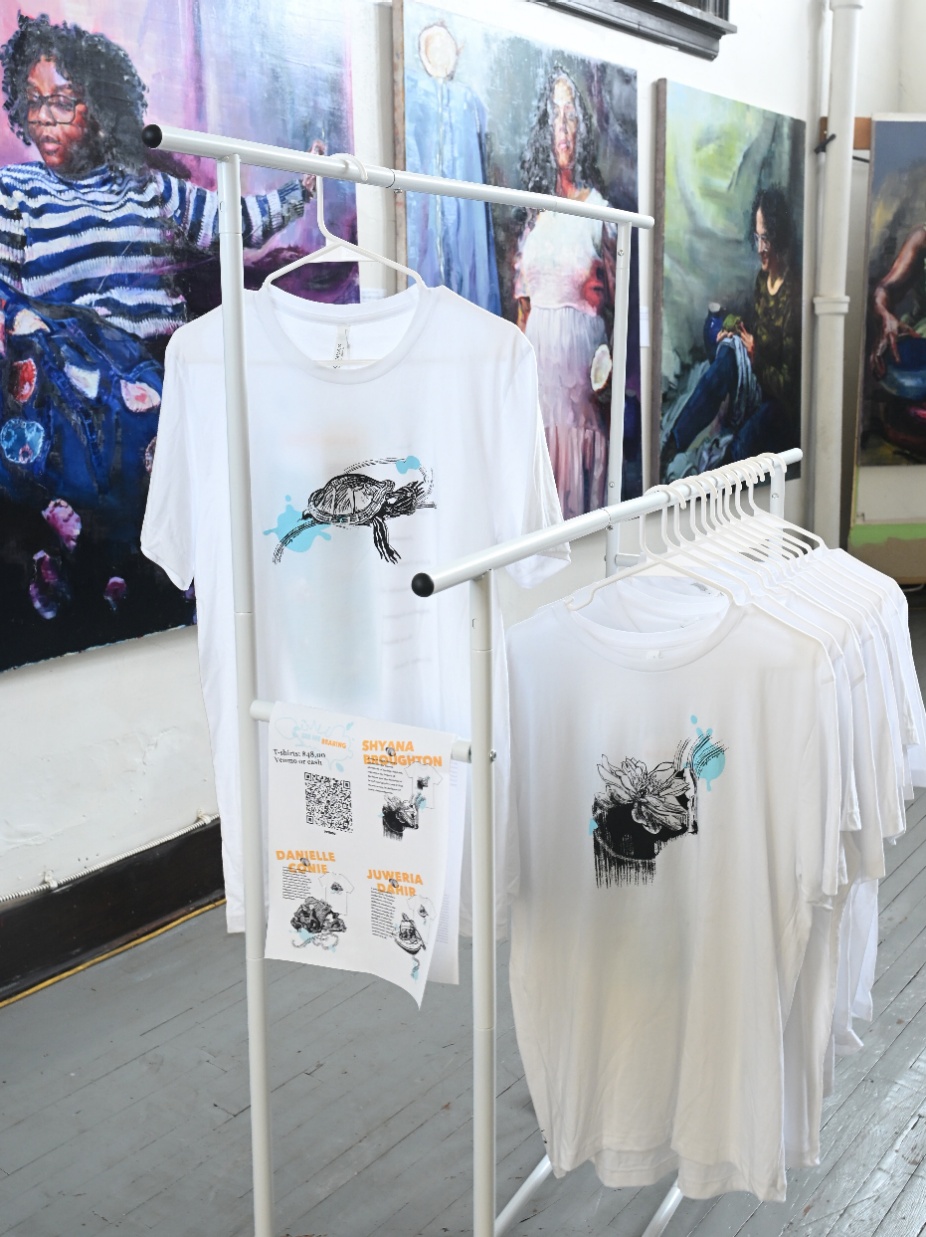
Graphics on T-shirts
The essence of each portrait is conveyed by graphics screen-printed on T-shirts

Project Sketchbooks
Claire Connolly's sketchbooks were displayed at the Fitz Books exhibition, SeeMe: Bearing. Photos by Nancy Parisi, 2025.
Book List
Books serving as resources for Connolly's work include those listed below:
- Mystery Cults of the Ancient World by Hugh Bowden.
ISBN 9780691146386 (ISBN10: 0691146381) - Invention of Hysteria: Charcot and the Photographic Iconography of the Salpêtrière by Georges Didi-Huberman.
ISBN 9780262541800 (ISBN10: 0262541807) - Myth, Religion, and Mother Right by Johann Jakob Bachofen.
ISBN 9780691017976 (ISBN10: 0691017972) - Women Artists and the Surrealist Movement by Whitney Chadwick.
ISBN 9780500276228 (ISBN10: 0500276226) - From Alchemy to Chemistry (Dover Science Books) by John Read.
ISBN 9780486286907 (ISBN10: 0486286908) - A Vindication of the Rights of Woman by Mary Wollstonecraft.
ISBN 9780141441252 (ISBN10: 0141441259)
Press Release
A bitten lemon, a patched jacket, a poured out coconut. Images like these populate artist Claire Connolly’s forthcoming project about the pregnancy experience. Notably absent from her multi-media, social practice series are mother-and-baby scenes and round bellies. Entitled See Me Bearing, Connolly’s rich visual landscape draws from seven local Buffalonians of color, and comprises seven sumptuous, large scale oil portraits alongside as many corresponding graphic t-shirts. On approaching this aspect of motherhood without its conventional imagery, Connolly says, “I want to find new ways of engaging with the physical adventure of bearing children, so that audiences of all genders and lifestyles can see themselves in the heroic childbearer the way we all do with the ubiquitous male warrior hero. Pregnant people, especially those of color, put their lives on the line for the greater good.”
At Fitz Books and Waffles on June 6, 2025, Connolly will debut See Me Bearing and thus ask us to invite ‘the Childbearer’ into our universal collective consciousness. Over the past year, Connolly’s portrait subjects worked with her to create personal symbols reflecting their inner experience of having children. By painting and designing this dual series, she both creates a new visual language of heroic prestige around the archetypal mother and offers this symbolism to audiences. Connolly, the seven portrait subjects, their loved ones, and all interested in attending, will culminate this collaboration with a free opening, panel discussion, and t-shirt sale. The work will remain on display until June 30, 2025.
Each 4-foot x 5-foot oil paintings depicts a childbearer interacting with a symbolic object of their choice. The scale of the scenes is imposing, and Connolly’s rendering of the figures gives them solidity and presence. Her love of wildness and mess bursts through in her use of saturated colors and energetic brushstrokes. In one piece, Keira Grant, who lost one of her twins—a reality faced disproportionately by black mothers— sits backward on a chair, her face thrown back and grimacing, as she bites into a lemon wedge and vivid light bounces off her face and body. On a table beside her lies a plate of more lemon wedges. Grant explains, “a lemon is fragrant. Not only the juice but the bitter rind can be delicious in food. But it’s also sour and intense. I live in a perpetual duality, it’s constantly ‘this and that’ every moment—joy and grief. I bite the lemon and let my face pucker to embrace the beauty of all parts of my world.” Grant’s anguish is revealed here as, not a private pain, but a valorous kind of wisdom.
The concept for this project emerged from a personal journey; Connolly’s own mental health crisis revealed to her the ways in which fundamental human truths are both encoded in the childbearing experience, and conspicuously absent from the West’s exalted cultural landscape. She also saw that this imbalance contributes to injustice for many, not just people with ovaries, and quite pertinently and urgently for pregnant people of color. Social determinants of health such as food and housing insecurity, chronic stress, and systemic inequalities impact outcomes and well-being for black and brown mothers; starkly, the numbers bearing these conditions out reveal their prevalence in the United States, alone among wealthy nations. Not surprisingly, Buffalo is hit hard by this issue. Here, Connolly has partnered with two local organizations that are tackling maternal inequities within Buffalo: Our Mommie Village, and Buffalo Prenatal Perinatal Network.
See Me Bearing references the role traditional oil painting has played in advancing the prestige of heroic male figures, as well as the way such figures influence consumer visuals. While the male hero tends to represent certainty, linear progress, independence, and the glory of a fixed eternity, Connolly sees the childbearing hero as emblematic of murky dualities, cyclical time, interdependence, and a visceral understanding of mortality. “I see all these themes showing up in the symbols people chose, and in the way I’ve made the pieces. They are meant to be epic like Napoleon’s portrait, but in a completely different way—defiant of the refined and tasteful style of traditional oils.”
Connolly repays the generosity of the seven people who have shared their inner experiences, by granting each of them their own oil portrait. Thus, when the show ends, each one will be free to leverage art as wealth however they choose; they may see fit to keep the paintings within their homes as meaningful future family heirlooms, or to display them in their own businesses or other community-facing settings. Each symbol featured in the oil paintings is available as a t-shirt design (adult and kid sizes). A still life ink drawing and a brief statement from the corresponding childbearer comprise each of seven limited-run, affordable pieces of wearable art. These act as graphic instances of visual language, of the kind that allow people to have vibrant relationships with cultural archetypes— in this case, Connolly’s proposed ‘Childbearer’ archetype.
Connolly invites attendees to not only center and honor these seven mothers of color, but through the t-shirts, to also recognize their perspectives as vital collective resources. For example, anyone navigating pain and grief for any reason might gain inner strength from Grant’s wisdom, and get a quiet boost on the days they put on her ‘Bitten Lemon’ shirt.
Artist's Personal Story
When my mind fell apart after having a baby, I discovered spiritual treasures that fuel my art and provide the foundation for this project. My pregnancy was dogged by mysterious medical concerns and ended in a near-death experience for both me and my child, that I felt alone in having foreseen. I embarked on my role as a new mother to a tiny, vulnerable human amid the wreckage of this event, and my perception that I had already failed my daughter before she had a chance to start her life. I wasn’t just depressed and anxious; I had one foot in an exhausted, isolated and overwhelming daily reality, and another in an inside-out, untethered one wherein my baby and I were ghosts. The precious treasures I speak of take their place among the fixtures of my new normal, wherein I continue to be impacted by mental health struggles while carrying out the care work of mothering.
My biggest leap in healing was my recognition that the shapeless terrain on which I found myself was incompatible with the world as I had known it up to pregnancy: a patriarchal ethos of order and control. While the countervailing spirit I work to embrace personally and artistically remains undefined, its bedrock is a hard truth. The spiritual state imposed upon me by the tedium of babycare and the physical perils of childbearing taught me this: death, vulnerability and fallibility cannot be controlled, but must be danced with. This can be a fumbling, wild business, requiring courage and resilience. Thus inspired to research the history of mothering, I found this insight mirrored in the art and mythologies of oral traditions around the world. I went from feeling myself slip away, to being anchored by a drive to creatively multiply this mirroring for everyone in my community; truly, the full human experience is incompatible with our patriarchal paradigm.
Although my concerns were dismissed by the medical establishment despite having repeatedly raised the red flag, I am lucky that now my child and I are physically healthy. I feel the dangerous invisibility I experienced corresponds with my presentation as a woman in our society, but that my overall positive outcome corresponds with my status as a normative white woman. For those subject to institutional sexism, most especially for marginalized BIPOC folks, the pride and insights I speak of come at an unacceptably high cost. Janice P. De- Whyte points this out: “Today, despite advances in healthcare and technology, maternity continues to place women—seeking to bring life into the world—at the threshold of death. Pertinently, the latest research informs us that maternal morbidity and mortality persist at appallingly higher rates for women from historically oppressed and marginalized communities within Western society.”1 Yes, the shapeless terrain lying beyond the bounds of patriarchal order and control may be inevitably harrowing from a spiritual standpoint. However, the care workers who learn to dance upon this ground deserve gratitude, respect and care itself— certainly not neglect, unhealed trauma and loss of life.
This project takes aim at our patriarchal institution’s compulsion to sideline experiences that fail to fit its paradigm. Circumstances that cannot bearably be navigated via neat categories, measurable results, or fixed and eternal abstract principles are subordinated to the realm of the invisible and undesirable. This casts out many childbearing/childrearing people, alongside queer and trans folks, racialized people, impoverished people, unhoused people, those living with disabilities, those with chronic illnesses, the neurodivergent, the elderly, the mentally ill, and many others. In solidarity with everyone thusly disadvantaged, and as an act of community-building around applied and spiritual care, my mission is to honor the universal pith of the postpartum experience: namely, courage and resilience on shapeless terrain. Rather than essentializing or romanticizing the patriarchal institution of motherhood, I will position the respective agencies and lived experiences of postpartum childbearing people both as belonging only to them, and as centrally relevant to the spiritual wellbeing of all humans in their community. To realize this two-fold intent, my project will work with seven postpartum mothers, using oil portraiture and still life graphic t-shirt art, seeking to both provide and reflect forms of care.
I believe it is important to thoughtfully foreground childbearing as a feminist issue, for the following three reasons. Firstly, community around the often-disorienting experience of pregnancy is both crucial to health outcomes for everyone, and frequently either absent or toxic. Secondly, the physical dangers faced by mothers of color over whites in the medical context flags a confluence of racism and sexism acutely in need of reckoning. Lastly, I feel that art-catalyzed conversation about the universal spiritual meaning of the peri/postpartum experience can bring new folks, through relatively untrodden avenues, into feminist resistance at its most powerful and inclusive.
Pregnancy and postpartum are isolating conditions on the level of collective awareness, as well as in everyday life. Concerns about falling into biological determinism or gender essentialism have left it out of much of feminist discourse. In fact, Samira Kawash characterizes motherhood studies as “...under siege and at risk of diminishing into divided encampments.”2 In practice, many going through postpartum mental crises avoid opening up about their struggles for fear of losing their babies; I can attest to this personally. In those days I was wary of and wounded by the dehumanizing judgments and gendered assumptions surrounding me. Writing about the community-building power of black mothers’ voices in the intersectional space, bell hooks says, “by calling attention to the skills and resources of black women... who have essential wisdom to share, who have practical experience that is the breeding ground for all useful theory, we may begin to bond with one another in ways that renew our solidarity.”3 We need to create space to hear each other, and strengthen equity- focused action. A cursory scan of the Western canon reveals that the hero, the physically imperiled warrior, the courageous and resilient figure taking up residence in our shared imagination, is overwhelmingly male.4 I have observed little reservation in our society about universally admiring and identifying with this archetype. Centering pregnancy and mothering—this dancing on shapeless terrain—as embodying the very same heroic qualities, directly challenges the spiritual core of patriarchal value systems. Indeed, Kawash also expresses that motherhood studies are “uniquely poised to have a transformative effect in a broader social context.”5 Thus, a focus on mothers, rather than being destined to compromise feminism, has the power to get at the heart of the matter, for the benefit of everyone. I would like to start with my community, here, in Buffalo.
NOTES
1 De-Whyte, Janice P. “A Matter of Live and Death: Maternity in Antiquity and Beyond” Journal of the Motherhood Initiative for Research and Community Involvement, vol. 14, no. 2, 2024, pp. 153–164.
2 Kawash, Samira. “New Directions in Motherhood Studies.” Signs, vol. 36, no. 4, 2011, pp. 969–1003.
3 hooks, bell. “Homeplace: A Site of Resistance” Maternal Theory: Essential Readings. Ed. Andrea O’Reilly. Demeter Press, 2007, pp. 266-272.
4 Kinsella, E., Ritchie, T., Igou, E. “On the Bravery and Courage of Heroes: Considering Gender” Heroism Science, vol. 2, no. 1, 2017, article 4.
5 Kawash, Samira. “New Directions in Motherhood Studies.” Signs, vol. 36, no. 4, 2011, pp. 969–1003.
Exhibition flyer

Exhibition Flyer courtesy of Claire Connolly.