Advancing Interdisciplinary Legal Scholarship since 1978
FALL 2025
The Baldy Center Podcast

Whitney Taylor discusses constitutions, social rights, and prosecutorial backlash
Published September 12, 2025
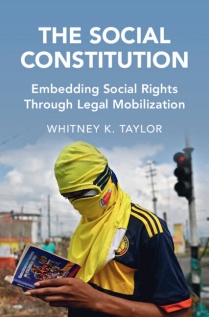
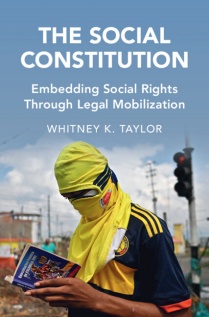
In Episode 49 of The Baldy Center Podcast we welcome Whitney K. Taylor, PhD, Mid-Career Fellow at The Baldy Center. Taylor discusses her award-winning book, The Social Constitution: Embedding Social Rights Through Legal Mobilization. Her work examines how Colombia’s 1991 Constitution and the tutela procedure transformed access to justice, embedding social rights into everyday life. Taylor offers perspective on constitutional reform, the labor of law, and the political backlash that follows experiments in justice. Taylor connects her research in Colombia to ongoing debates in the United States, including the rise of reform-minded prosecutors and the challenges they face.
KEYWORDS: Constitutional Embedding, Tutela, Social Rights, Colombia, South Africa, Access to Justice, Legal Consciousness, Courts and Compliance, Progressive Prosecution, Recall Politics, Backlash, Comparative Law and Politics, Cambridge University Press, The Social Constitution.
HASHTAGS: #ConstitutionalEmbedding #Tutela #AccessToJustice #SocialRights #LawAndSociety #Colombia #ComparativePolitics #BaldyCenter #UBPodcast
Podcast Streaming 24/7
STREAMING AUDIO 24/7
You can stream each episode on PodBean, Spotify, Apple Podcasts, and most any audio app. You can also stream the episode using the audio player on this page.
Podcast Audio Player
- Episode 49. Whitney K. Taylor
Note: Audio Player may not function ideally on small-screen devices.
Meaningful reform is challenging, if we're thinking about constitutions at least. Tthere are different technical amendment requirements. Some places like Mexico, very, very easy to reform the Constitution. The US is kind of on the other end of the spectrum. It's very difficult. There are barriers and challenges, in both cases.
[...]
The two biggest challenges that I would point to are, first, the challenge of getting the reform or amendment through, and then, the second challenge is the more social side of things, whether it's compliance, or buy-in, or however you want to talk about it."
—Whitney K. Taylor, PhD
(The Baldy Center Podcast, Spring 2025)
The Baldy Center for Law and Social Policy at the University at Buffalo
Episode #49
Podcast recording date: 9/4/2025
Host-producer: Tarun Gangadhar Vadaparthi
Speaker: Whitney K. Taylor, Mid-career Fellow at The Baldy Center; Associate Professor of Political Science at San Francisco State University and
Contact information: BaldyCenter@buffalo.edu
Transcription begins.
Tarun:
Hello and welcome to The Baldy Center for Law on Social Policy Podcast produced by the University at Buffalo. I'm your podcast host and producer, Tarun Gangadhar. In today's episode, I'm joined by Dr. Whitney K. Taylor to explore how constitutions, courts, and everyday citizens turn rights on paper into rights in practice. Dr. Taylor is an associate professor of political science at San Francisco State University and mid-career fellow at The Baldy Center this fall. Her award-winning work, including the book The Social Constitution, examines legal mobilization, access to justice and the politics that shape reforms from Colombia to the United States. She also studies reform minded prosecutors and the backlash they encounter. Here is Dr. Taylor. What first inspired you to explore the relationship between constitutions, law, and social rights in your research?
Whitney:
Well, I guess I was a grad student at Cornell thinking about what my dissertation topic would be, and I was having a bit of a crisis trying to figure out what do I want to do for the next five or more years? And I had sort of thought back to what made me curious initially, even back in undergrad. And basically, I wanted to know if there was anything to the sort of aspirational notion of law, that law and rights could make lives, people's lives better. And so that was the sort of springboard. And then I had been exposed to lots of different arguments, of course, in the past, and one of those arguments was coming out of Colombia. There was a Colombian law professor had come to my undergrad institution to give a presentation on the Colombian constitution and a particular legal mechanism that constitution introduced called the tutela. And that was exciting to me, interesting to me because it really lowers basically every barrier there is in terms of access to justice. It's free to file. You don't need formal legal training. You simply have to either turn in some paperwork or make an appointment with the judge and explain a problem in your life. And then the judge has to look into it, and they have 10 days to decide if there was a rights violation or not. So all of these sort of barriers with time and cost and knowledge are lowered. And so that made Colombia seem like an interesting case for me. And that sort of got things rolling. And then the project developed, of course, as I got into it.
Tarun:
That's a fascinating starting point. Let's turn to your 2023 book, The Social Constitution: Embodying Social Rights Through Legal Mobilization introduces the idea of embedding constitutional law. Could you explain what this means and why legal mobilization is central to making rights real?
Whitney:
Sure. Yeah. So the idea behind constitutional embeddedness is I thought we sort of lacked a concept for helping us understand the extent to which constitutional rights impact social and legal life. So that was my attempt to try to put a name to that idea. And yeah, in terms of why legal mobilization is central, I guess the first thing I should say is that it matters for the Colombian case. I don't argue that legal mobilization is the only mechanism that drives constitutional embedding. But in the Colombian case, there was this unique legal procedure, the tutela that I just mentioned, and that was really what shifted people's attitudes, our understandings of law, both everyday folks and lawyers and judges. So people started to experiment with the tutela, they pushed the boundaries of what the constitutional text actually said, and judges picked that up and ran with it. And so without this legal mechanism, without people making claims to their rights through legal mobilization, I argue that the constitution wouldn't have come to take on the meaning that it does in people's lives. But in other places, we can imagine things like civic education or legal education prompting constitutional embedding rather than actually making rights claims.
Tarun:
That makes sense. And it leads me to your case study. You focused on Colombia's 1991 constitution. What made Columbia an ideal case and how did your year of field work-interviews, surveys, and observations- shape your insights?
Whitney:
Yeah, so the original case selection was focused on this idea of social constitutionalism. And this is something that a bunch of different scholars had written about, but basically, and they disagree slightly. But basically the idea is that the constitution outlines a wide range of rights moving beyond just civil and political rights, but to also include things like the right to health, housing, education, even environmental rights. And then beyond that, social constitutions also include provisions that make it possible for people to claim those rights. And often they also empower either new constitutional courts or new chambers within existing supreme courts to hear those rights. So I was looking at that set of countries, typically these countries adopted new constitutions somewhere between the late eighties and into the nineties, maybe into the early two thousands as well. So Colombia was one of those countries, and I had some connections to Columbia through that undergrad experience. And so that made it a little bit more possible. So there's a theoretical reason and then the practical reason that I could actually go do field work in Colombia. So that was the idea there behind why Colombia. I also look at South Africa in one chapter of the book, similar story. They rewrite the constitution in the nineties. It has these features that I just mentioned, and both Colombia and South Africa were understood to be more robust experiments in social constitutionalism. So that's the sort of logic there. In terms of field work, yeah, I mean I went in thinking I would do primarily interviews that I would talk to judges and lawyers. And then the project expanded as I got going, I realized there were other people who I thought were important to speak with, the rights claimants themselves. And so I figured out different ways to do that. I got a little bit of financial support to do surveys and came up with some creative ways to do them cheaply. And then I also had the opportunity in Colombia to do this thing called the Caravan for Peace and Justice. And that was something that essentially a friend of a friend was doing. And so it was a real happenstance that led me to it, but it was an opportunity to go around the country in 2016 following the vote on the peace process with the Farc, get to end this internal armed conflict that had been going on for decades in Colombia. And that vote didn't go the way that the organizers of the peace caravan expected. People voted it down. There's some conversation about why the vote went the way that it did and some irregularities there, but we sort of revamped what the caravan would look like. And we went around to basically every major region in rural areas as well in Colombia and just spoke with community organizers. And that didn't really fit in with my original vision of my dissertation research, but it was an interesting experience. It was a chance to see different parts of the country that I hadn't been exposed to. And ultimately, I met some people who I then ended up interviewing. And those interviews, these community organizers allowed me to interview folks who I wouldn't have had access to, wouldn't have known, wouldn't have met, but who are from marginalized communities who often aren't the focus of at least political science research, but whose lives are really important to the story I wanted to tell, right. If constitutional rights can make a difference in people's lives, it should be those who are most in need. And so that became a key part of the project, but it wasn't something I thought I was going to do initially. It wasn't something I could have even imagined until I got there. And the field work just kind of took off in the way that it did.
Tarun:
Hearing that, I'm curious about everyday impact in practice. How have Colombians used constitutional social rights in everyday life? Could you share an example of a case where ordinary citizens went to the court to claim rights and what roles judges played?
Whitney:
Yeah, so I'll give you a couple different examples. The first will be, I guess more quantitative big picture. So in 2023, Colombians filed that legal procedure that I mentioned earlier. More than 700,000 times. All of these claims went to the constitutional court. They were decided by lower court judges initially, but then they all go to the constitutional court for potential review. So there are bags and bags and bags of these claims filling up the hallways. And so that's a lot, even if we imagine there are some people who might've filed more than one tutela claim in the year, that's still just a big number. Another sort of quantitative take on this question about how these constitutional rights matter for everyday life. Between 1999 and 2023, there were 2,780,000 roughly favorable health tutelas. So people filed tutela claims claiming their right to health. The courts decided in their favor, right, of the applicant. There's one study that we know of right now on the compliance rate with tutela orders. It doesn't look at the whole period, but if we make some assumptions here that the compliance rate is roughly constant. So the compliance rate they found was 72%. We do the math there. It's about 1.6 million claims regarding the right to health that translated into medications, procedures, or treatments. So that's, in my mind, that's meaningful, that matters. There are folks who may be absent, the tutela and this counterfactual situation would've found a way to scrape together the money to get some of the medication they need on the cheaper end of things, maybe they find another solution. I think most of those people probably couldn't afford it. If we think about the astronomical cost of healthcare, many people would've simply tried to deal with the problem. And that sometimes works out and sometimes doesn't. A more, I guess particular example, less sort of big picture, less quantitative. There's a young girl, like a school age girl who played a board game called tutela y juega, which is like tutela and play loosely translated. And this is a game that a law professor designed to teach kids about this legal procedure and about the new constitution. And the way you play the board game is you draw cards. It looks like there's a board that you have to travel around, and the cards introduce a problem to you. And the problem is something relatively easy to understand and the solution is to file a tutela claim. It's essentially like you have a rights violation, here are three options. What should you do if the answer is file a tutela? That's the sort of pedagogical nature of the game. So she played the game and then she filed a tutela claim against her municipalities’ telephone and gas companies, and she won. And this is in the newspapers. This is not the most common story. Most of the time it's not a school age child filing a tutela claim. But this gives you a sense of, I guess just how widespread it's become. Right? There are these ways in which not just lawyers, not just people who are otherwise connected to the legal system, learn about this. And it does matter at least some of the time.
Tarun:
That really shows how widespread it's become. Your book identifies three challenges to embedding a social constitution, limits of legal legibility, the labor of law, and political backlash. Could you unpack these challenges and explain what they reveal about the fragility of rights protections?
Whitney:
Yeah, and I guess I want to say here that these three challenges are not entirely specific to Colombia, but there are three that we saw in the case of Colombia. I can imagine theoretically that there would be other challenges to constitutional embedding in other contexts as well. But these were three that I saw in this case. And so the first, the limits of legal legibility, that really refers to the idea that not all problems neatly fit within a liberal rights framework or even the slightly more robust social rights framework. So in the Colombian case, I was speaking with people who were poor and that created a bunch of problems in their lives. It made their lives really difficult. There wasn't a rights violation, so they couldn't for all of the sort of aspirational language of the constitution, this goal to improve people's lives, they couldn't make claims on the basis of that, unless their lack of employment came from something like a discrimination issue. There were other people who were more diffusely impacted by the internal armed conflict that I mentioned before. So they weren't able to document that they were under the Colombian legal framework considered victims of the armed conflict and people who could document that were able to gain access to a bunch of different kinds of state resources. But people who fled the place that they grew up because there was conflict nearby, but they did so before the conflict actually reached their community. They couldn't claim that status even though they might've left everything and had to start over. And this is not unique to Colombia. This is just a challenge with the law, right? Law can't predict every potential problem and rights can't necessarily provide a remedy for every potential problem in people's lives. So that's one challenge. If the social constitution is actually going to serve everyone, how do you deal with the unexpected problems that come up or more broadly, the limits of liberalism, I should also say. In terms of the labor of law, there are a lot of tutela claims. There are a lot of claims to process, to investigate, and judges have 10 days to decide in the first instance. So it's quick, and I spoke with judges from smaller jurisdictions, from larger ones in different parts of the country. And some said it wasn't that much of a problem. They could handle the tutela claims in addition to their normal work. So if they're in a criminal area, they deal with whatever criminal justice case has come before them. They have their hearings, they write their decisions, they do all of that stuff. And then they also decide tutela claims that could have to do with any constitutional right. So it could have to do with social security, it could have to do with access to gas and telephone lines, like I mentioned earlier. It's all over the place in terms of the subject matter. So some people could handle that relatively easily because they didn't have too many cases at once. Other places, they're busier. And so judges would talk about bringing tutela claims home after work. So they would do them after dinner and they have very long days, or they'd bring them home over the weekend and it creates more work. And there is a limit to the amount of work that a human can do. So that's that challenge. And so far in my, according to my study at least, judges have managed. I don’t how long they can manage, right? At some point there is that limit, but so far, they've been able to manage. And then the third challenge about political backlash or the reaction of other political actors, the new constitutional order empowered some actors largely within the judicial system, but specifically within the constitutional side of things. And it disempowered, relatively speaking, other political actors, not everyone was happy about that. And so the constitutional court had to figure out how to navigate that, how to make sure that they have incentives, they want to have the final say. The argument from the constitutional court is that all matters ultimately, are constitutional questions at the base, if the constitution is the fundamental law of the land. So they should have the final say over these other courts. That was a challenge. And then of course, elected officials didn't necessarily want judges to be able to hold them accountable, let's say that. So there are lots of different kinds of tensions there. And in the Colombian case so far, these tensions have sprung up in different moments, but the constitutional order has endured. People remain committed, especially to the tutela procedure. There've been a number of attempts to reform the tutela, and people get upset with each one, any attempt to limit the tutela. And so those reforms haven't gone through. Doesn't mean that this equilibrium will remain steady forever. That seems unlikely, but right now, it's still steady enough. The constitutional order has endured.
Tarun:
That raises the comparison to the US. Since our constitution doesn't guarantee social rights the way Colombia’s does, what lessons might apply to the American law and social policy?
Whitney:
So I guess we could think about a couple different ways that the Colombian experience might offer some lessons for the US. I guess one is for people who simply want to add amendments to the US Constitution to protect social rights. One lesson is that simply adding those rights in won't be enough. It wasn't enough that the 1991 Constitution outlined a set of new rights in Colombia. Those rights actually had to be adopted, had to become important in people's lives. They had to become embedded, I guess to use the language of my book. And the book details in part how the right to health took off and other rights haven't taken off in the same way in the Colombian case at least. So that's one lesson that there needs to be something beyond simply the amendment process. That amending a constitution doesn't mean that social rights will become real. I guess another lesson that I would draw from the Colombian cases, there are unanticipated expansions or contractions that can occur. So initially, according to the constitutional text in Colombia, the tutela could only be used for civil and political rights. It's one chapter of the Constitution that outlines what they call fundamental rights, but it's a list of civil and political rights. There's another chapter that details social and economic rights, and a third chapter that lists collective and environmental rights. So according to the original text of the Constitution, the tutela could only be used for fundamental rights. Judges responding to claims that citizens had made, I should say. So citizens make claims to all of their constitutional rights, not just fundamental or civil and political rights. And then judges responded positively and created ways for the tutela to expand over time. And that's not something that the designers of the Constitution anticipated. And so in one way, I'm saying that you should expect unexpected consequences, which okay, what are you going to do with that? But I think it is important to note that the constitutional text, once again is not the final say. These things can take on a life of their own over time. And I should also say, I don't think the judges who made these early decisions to expand the tutela really foresaw what would happen. I don't think they knew that there would be hundreds of thousands of these claims just like 25 years later being made each year. So I guess those are kind of two lessons there. One is simply amending. For those who want social rights to be realized, simply amending the constitution is not enough. You need a bunch of other things happening. You need access mechanisms. You also need these rights to become embedded socially, legally. And then the second lesson there is that the text isn't the final say either. And so there, if we're thinking about maybe lessons for policy makers to keep checking in on how things have developed, and that's hard with constitutional amendments or constitutional reform more broadly, we think about these big moments where a constitution is drafted or when the amendment is approved and added. But I think what my book shows is there's a lot more to it than that, and you need to figure out ways to constantly reassess. Is this result that we're seeing right now, is this actually in keeping with what we envisioned as the sort of drafters of the amendment or the constitution itself, or we as citizens, is this what we want our constitution to mean? Is this what it means to be a rights bearer in the US or in Colombia or wherever?
Tarun:
That idea of embedding reform makes me think about your recent project. You also studied reform minded prosecutors in the US. What drew you to that issue and how does it connect to your broader focus on legal reform and resistance?
Whitney:
Yeah, so I guess when you first look at my CV, it maybe seems like a bit of a shift, but I think the, well, let me say first. The thing that got me interested in it is that I was living in East Bay in Berkeley, California, and I was working in San Francisco, and in both San Francisco County and Alameda County where Berkeley is, there was a explicitly progressive prosecutor, elected and then recalled. And so I was having conversations with friends and colleagues and students about this just because it was relevant in my life. And then I realized that there's a lot of scholarship generated by law professors on progressive prosecution or reform prosecution. Some of it is empirical in nature. A lot of it's normative about how those particular scholars think that the criminal justice system ought to be reformed. And that's great. It's useful scholarship, but political science takes a slightly different approach at least much of the time. And I wanted to know more about the politics of it. I have normative commitments myself as an individual, but I was curious about how the backlash to these prosecutors came about. These are folks who were elected, and interestingly in the case of San Francisco, at least Chesa Boudin got more raw votes in the recall than he did initially when he was first elected. But it wasn't a three way or a multi candidate, I should say, split in the recall. It was just an up, down, do you want Boudin, or do you want someone else? And so that's interesting how all of this happened. And then the project expanded over time to not just focus on the Bay Area. As I dug into it, and as my co-author also dug into it a little bit. But then I guess the way I try to sort of draw a through line in my research is that I'm interested in experiments in law and justice. So we can think about social constitutionalism as an experiment and what constitutions can mean about thinking about the relationship between citizens and the state. If the state commits to at least on paper, providing for more than just civil and political rights, but also the social needs of its population, that's an experiment. Other aspects of my research look at sort of related questions though, in thinking about experiments and access to justice and then progressive or reform prosecution is something of an experiment as well. I think the jury's still out. We haven't seen the sort of reform prosecution for all that long. It's a relatively new phenomenon, at least in this iteration. Even if some of the reforms that these prosecutors are putting forth have deeper roots, some diversion programs go back decades. But this idea of reform prosecution is something that really comes about from 2016.
Tarun:
From your interviews with prosecutors, what are they themselves saying about navigating backlash and how does the threat of removal shape the reforms they're willing to try?
Whitney:
Yeah, so I've spoken with, between my co-author and I, we've spoken with about 60 prosecutors, all of whom oversee or talk about reform policies. Not all of them adopt the moniker of reform prosecutor, and I can say more about that if you're curious too. But they have a lot of different views frankly, about this. If I try to sort of group them together, there are three sort of overlapping reactions that folks tend to have. One is some folks try to ignore backlash, and that's easier if you don't face certain kinds of backlash. Not to say that it's always easy, but if the backlash you're receiving is on social media, you stop looking at social media. And that's something that people talked about being very intentional about. If the backlash is something a little bit more overt with direct threats, one prosecutor talked about someone breaking into their backyard and leaving a noose on their patio furniture. That's a little bit harder to just ignore. As you can imagine. So some people try to ignore it. They say, I was elected as a reformer. I didn't hide who I was. The people who voted for me want me to do this, I'm going to do it. I believe it's right. I believe it's working. Or when it's not working, I make adjustments. I collect data. I try to see the effects of different policies. And so I'm committed to doing that regardless of what these threats look like or whatever this backlash looks like. The second reaction is you opt out. So some folks didn't run for reelection, and that's reasonable, very reasonable if you're being threatened, right? And some folks talked about this really weighing on their family life, sending their kids to live with other family members so that they wouldn't see these threats. They wouldn't be exposed to if these threats were actually realized. Some folks who ran but weren't elected, who are just candidates said, I wouldn't run again after this experience. It's not worth it. As much as I believe in the value of these reforms, for me personally, the cost is too high. So there's this sort of opting out, and some folks try to ignore the backlash until they can't and then they opt out. So that's the overlap there. And then the third reaction is to try to more quietly pursue reforms. And this can look like a couple of different things. So if some people said, I've tried to really tamp down on my national profile. Locally, I have good relationships with community groups. People who disagree with me come and they say their piece. And then I explain why I think my approach is the right one, why I think we should try this kind of diversion program or this kind of drug court. And for those folks, those conversations can be productive in a one-on-one or a small group setting, but they can't be productive with all of the noise of national politics. So that's one thing we heard about more quietly pursuing reforms. Another thing we heard in this last category is that folks just said, I just go about my work. I implement the policies that I think are right, and then I just don't talk about them. I'll claim credit later once people see that they're working, but I'm not going to announce that I'm doing this new program because by doing that, I put a target on my back. So those are the three sets of reactions. It varies substantially based on where you are in the country, the party of the prosecutor. So we would talk to folks who are both Democrats and Republicans and a bunch of nonpartisan candidates. And the backlash that they face is a little bit different, sort of depending on the party, but also, again, where they are in the country, what region. The threat of removal is more real for some than others, where recalls are possible, where state legislatures are more focused on prosecutors. Some places the legislature doesn't seem to be doing much. Some places the governor is very active. I think everyone knows about other people being recalled or removed in other ways. A lot of people said that they were worried about it, if not, even if it wasn't necessarily possible for them. It was something that sort of weighed on their mind as something that was happening to prosecutors across the country. And the final thing I'll say here, and I'll stop because this has been a long answer, is that a couple of people who we spoke with said, I'm not worried at all. This is something that there are two explanations there. One, someone said, I'm not worried if it happens to me, it happens to me. I'm not going to change what I'm doing. It's just like it's a risk we take. So that kind of fits in the ignore camp, I suppose. The other thing is some people said, I don't think it would happen to me. It's not something that happens in this area, and I would have to royally screw up. And that, I guess, gives you a sense of how locally specific some of this is, because it's not necessarily people who are doing more or less in terms reform that really predicts backlash.
Tarun:
That's a powerful set of responses. More broadly, in your view, what are the biggest challenges to making constitutional or legal reforms stick, whether in Colombia, the US, or elsewhere?
Whitney:
Yeah, so I guess meaningful reform is challenging, if we're thinking about constitutions at least. On the one hand, because there are different technical amendment requirements. Some places like Mexico, very, very easy to reform the Constitution. The US is kind of on the other end of the spectrum. It's very difficult. So there are barriers there, in both cases. So on the US side of things, it's hard to get an amendment through. And so obviously it's a challenge. But in the Mexican side, if it's easy to amend the Constitution, it's easy to re-amend the Constitution. And so the amendment that you just push through may not actually have a long life. Beyond that, there's often a gulf between the law as it’s written and an everyday life, everyday practice. And enforcement requires resources as well as sort of will or commitment. And depending on the politics of a country, of those who push an amendment through, may not actually be able to get resources to go through whatever relevant body needs to approve those resources. And from the state's perspective, voluntary rather than coerce compliance would be desirable. That lowers the resources that you need to spend. It's cheaper, it's logistically easier to maintain, but it's not a given. And so my book on Colombia talks a little bit about how, at least in Colombia, people began to see the Constitution as meaningful for their lives and something that they should be embracing, they should be on board with. And the book itself isn't really about compliance, but we can think about compliance in that way too. If you see yourself as committed to the Constitution, you also have obligations under it, and so you might comply with it, but there are lots of actors involved, and even what would seem to be the easiest or simplest legal question, whether it's constitutional or otherwise, and those actors are likely to have competing interests, competing preferences. And so that becomes the challenge. It is generating that buy-in. So this is somewhat circular, but I am trying to outline a couple of different problems. One is the challenge of getting the reform or the amendment through in the first place, and then the second is the more social side of things, whether it's compliance or buy-in or however you want to talk about it. So I think those are maybe the two biggest challenges that I would point to.
Tarun:
That brings us to a closing thought. If listeners take away one key message from your work on constitutions and prosecution reform, what would you want that to be?
Whitney:
Yeah, I guess the way I would try to tie these both together and come up with one key message is that I think both of these projects show that people care, that at least some people are deeply committed. They're willing to take on great personal and professional risks to try to make the communities better and safer, to try to improve the conditions under which their neighbors live. And we're likely to disagree, I should say, about some of the nuts and bolts about what changes should be made, whether they're about constitutional rights or criminal justice reform. We might disagree about the specifics there, about what changes should be made, how those changes should be pursued, but I think that commitment is admirable, and that's something that we should keep in mind. So that's the one thing is that people care and they're willing to take on great cost or risk to continue to care. And then the other thing, and this is more about I guess my broader views about political science research is there are people involved in all of these things that we study. And I think it's really important to remember that there are people who are pursuing the reforms, but there are people who are affected by the reforms whether they work or not. And it all comes down to people's lives. And that's just something that I try to remember in all of my projects and all of my research. Sometimes our research takes us away from reality a little bit where we're very much in our computer and there's a disconnect, but that's something that I try to remember there. So those are two somewhat related points, I guess. That there are ultimately people underlying all of this and people who are trying really hard to make things better, whether we agree with their vision or not. But yeah, those are the things I would highlight.
Tarun:
Thank you for your time.
Whitney:
Yeah, thank you so much.
Tarun:
That was Dr. Taylor, and this has been The Baldy Center for Law on Social Policy Podcast produced by the University at Buffalo. Let us know what you think by visiting our X, formally Twitter, @baldycenter or emailing us at baldycenter@buffalo.edu. To learn more about the center, visit our website, buffalo.edu/baldycenter. My name is Tarunand on behalf of The Baldy Center, thank you for listening.
Transcription ends.
Whitney K. Taylor, Mid-Career Fellow, The Baldy Center (Fall 2025); Associate Professor of Political Science (San Francisco State University)
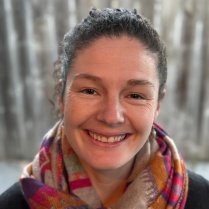
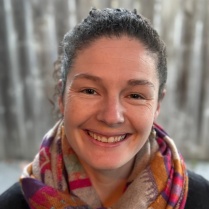
Whitney K. Taylor
RELATED LINKS
BIO
Whitney K. Taylor (PhD, Cornell University) is an Associate Professor of Political Science at San Francisco State University. She teaches courses in comparative politics. Her research focuses on the intersection of rights, law, and contentious politics. She is the author of The Social Constitution: Embedding Social Rights Through Legal Mobilization (2023), Claim-Making in Comparative Perspective (2024, with Gabrielle Kruks-Wisner and Janice Gallagher), and Law, Mobilization, and Social Movements (2024, with Sidney Tarrow).
Taylor's research has also appeared in Comparative Political Studies, Comparative Politics Global Constitutionalism, Government & Opposition, Human Rights Quarterly, Law & Society Review, Law & Social Inquiry, and Sociological Perspectives.
RESEARCH FOCUS
Legal mobilization; social constitutionalism; access to justice; Colombia’s tutela mechanism; constitutional embedding; comparative perspectives (Colombia/South Africa/United States); reform-minded prosecution and political backlash; law and society.
Sometimes our research takes us away from reality a little bit, where we're very much in our computer and there's a disconnect. But there's something that I try to remember: There are ultimately people underlying all of this, and people who are trying really hard to make things better, whether we agree with their vision or not."
— Whitney K. Taylor
(The Baldy Center Podcast, Fall 2025)
Tarun Gangadhar Vadaparthi, Podcast Host/Producer


Tarun Gangadhar
Tarun Gangadhar Vadaparthi is the current host/producer for The Baldy Center Podcast. As a graduate student in Computer Science and Engineering at UB, Vadaparthi's research work lies in machine learning and software development, with a focus on real-time applications and optimization strategies. He holds a bachelor’s degree in electrical engineering from NIT Nagpur and has also completed a summer program on Artificial Intelligence and Machine Learning at the University of Oxford. Vadaparthi's research and projects are rooted in data-driven decision-making, with a strong commitment to practical innovations in technology.
Executive Producers
Matthew Dimick, JD, PhD
Professor, UB School of Law;
Director, The Baldy Center
Amanda M. Benzin
Associate Director
The Baldy Center