Advancing Interdisciplinary Legal Scholarship since 1978
FALL 2025
The Baldy Center Podcast
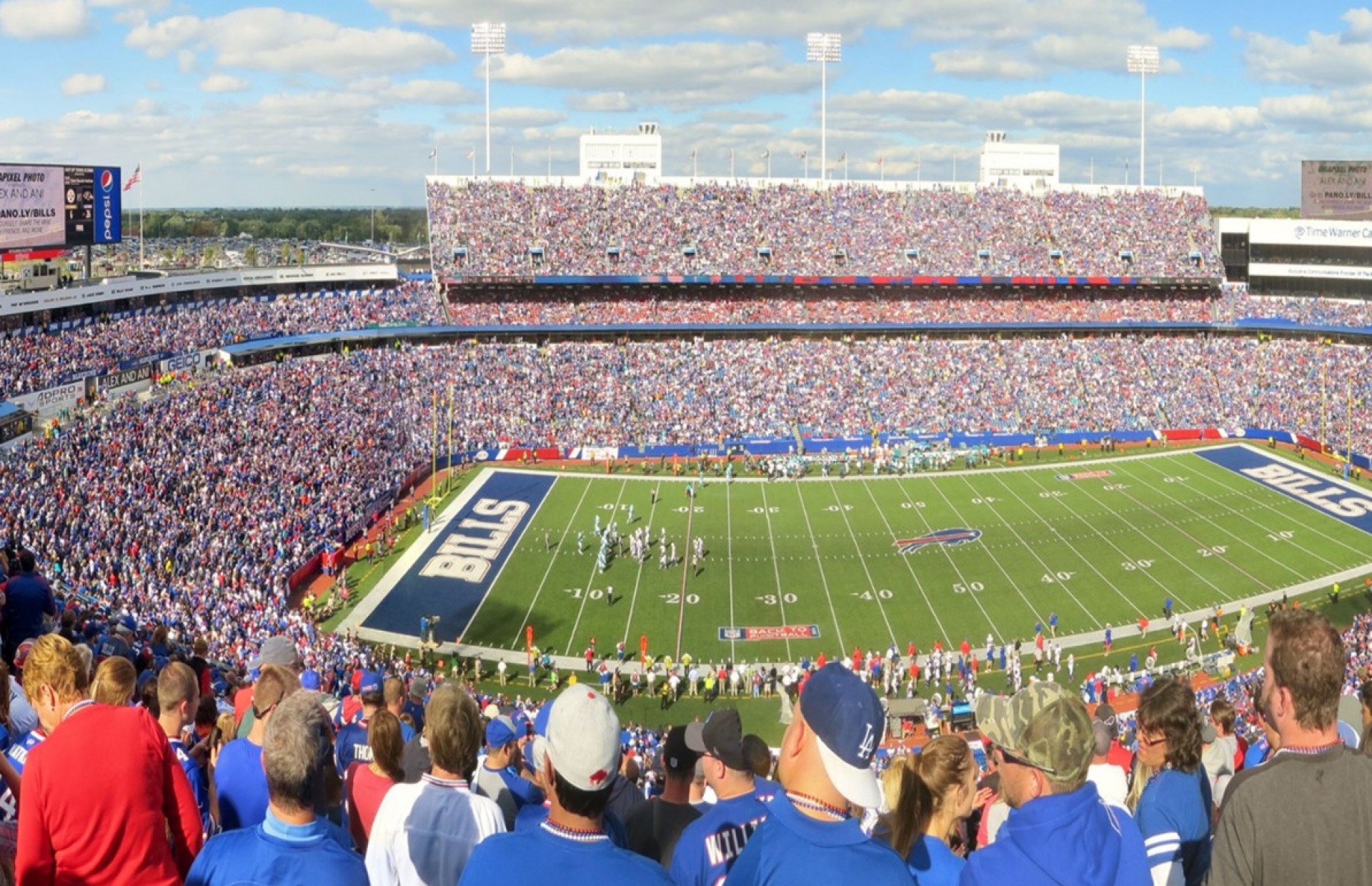
Pictured: Highmark Stadium (then known as Ralph Wilson Stadium) panorama, September 2014. Final score: Buffalo 29, Miami 10. Upper left edge is the skyline of the city of Buffalo. Photo courtesy of Wikimedia.
Episode 50
Helen Drew and Ken Belson discuss stadium financing, public subsidies, and the politics of pro sports
Published October 15, 2025
In Episode 50 of The Baldy Center Podcast, Helen “Nellie” Drew joins Ken Belson to discuss the complex intersections of professional sports, public subsidies, and policy decisions. Drawing from the Buffalo Bills stadium deal and other national examples, they explore how public-private partnerships shape urban economies, political choices, and community identity. Their conversation examines both the economic and ethical dimensions of sports development and what it reveals about how cities invest in their teams and themselves. Nellie Drew, Professor of Practice in Sports Law, is the director of the UB Center for the Advancement of Sport. Ken Belson, long-time New York Times sports business reporter, is the author of the book Every Day Is Sunday: How Jerry Jones, Robert Kraft, and Roger Goodell Turned the NFL into a Cultural & Economic Juggernaut.
KEYWORDS: Sports Law, Stadium Financing, Public Subsidies, NFL Economics, Sports Policy, Public-Private Partnerships, Economic Development, Community Impact, Law and Sports, Media and Sports Business, Political Economy, Legal Accountability, Urban Policy, Fan Culture
HASHTAGS: #SportsLaw #PublicPolicy #StadiumFinancing #NFLEconomics #PublicSubsidies #UBPodcast #BuffaloBills #SportsBusiness #EconomicJustice #UBLaw #TheBaldyCenter
Podcast Streaming 24/7
STREAMING AUDIO 24/7
You can stream each episode on PodBean, Spotify, Apple Podcasts, and most any audio app. You can also stream the episode using the audio player on this page.
Podcast Audio Player
Note: Audio Player may not always function ideally on small-screen and moble devices.
- Episode 50. Helen “Nellie” Drew and Ken Belson
The Baldy Center for Law and Social Policy at the University at Buffalo
Episode #50
Podcast recording date: 9/22/2025
Host-producer: Tarun Gangadhar Vadaparthi
Speakers: Helen “Nellie” Drew and Ken Belson
Contact information: BaldyCenter@buffalo.edu
Transcription begins.
Tarun:
Hello and welcome to The Baldy Center for Law on Social Policy Podcast produced by the University at Buffalo. I'm your host and producer, Tarun Gangadhar. Today we are looking at public investment in professional sports facilities, how legal frameworks, league dynamics, and local politics shape billion dollar stadium decisions and what they mean for communities. The guests are Nellie Drew and Ken Belson. Nellie is professor of practice in sports law at UB and the director of the Center for the Advancement of Sport. A lifelong Western New Yorker, she has worked across the professional sports landscape from negotiating NHL player contracts to advising on stadium and arena matters, bringing a rare blend of legal expertise and industry experience. Ken covers the business of sports for the New York Times reporting on the NFL and the social, legal, medical and financial issues that surround modern sports. He has twice been part of Pulitzer Prize finalist teams and has covered everything from Super Bowls to Supreme Court arguments. His new book Every Day is Sunday: How Jerry Jones, Robert Kraft, and Roger Goodell Turned the NFL into a Cultural and Economic Juggernaut was published on October 14th. This conversation also previews their upcoming Baldy Center conference panel “Every Day is Sunday: Exploring Public Sector Policy Investment Choices in Pro Sports Facilities” on Friday, November 14th. The event takes place at 509 O’Brian Hall on UB’s North campus with a noon reception and a 1230-2:30 PM presentation. You can attend in person or via Zoom. Registration details are in the show notes. Here is Nellie and Ken.
Nellie, as a director of UB’s Center for the Advancement of Sport, how did you first become interested in the legal and policy issues surrounding stadium financing?
Nellie:
So I was counsel to the Buffalo Sabres back in the early 1990s, and that was the very first, we believe, public sector private sector partnership to build a private sports facility. And that is now KeyBank Center. And the effort was Erie County, New York State, city of Buffalo and the Buffalo Sabres, and it was a very different time. The Knox Brothers had to get permission from the NHL to open their books up and show public sector that in fact the team was bleeding money in what was then Memorial Auditorium and the Knoxes were seeking to establish the team as a viable entity, as a philanthropic gift to the area moving forward. It wasn't like the Sabres were printing money or there was any anticipation that they would, unlike today. So very different time frame. So perhaps unwittingly we set a standard that we did not expect to be copied as it currently is.
Tarun:
That's fascinating how the Sabres deal in the early nineties set the precedent you never expected to see repeated so widely. Ken, as a New York Times reporter covering the NFL's business side for over a decade, what sparked your interest in exploring stadium deals and public subsidies?
Ken:
Well, one of the challenges of covering the business of sports is that most of the teams are privately held and so to gain any financial information about their operations is actually quite difficult. One of the few areas where you can do that, well one area is in court if there's a court case, and those are infrequent, but one area you can kind of look at their finances is through the prism of stadiums and public financing. In some cases, not all the teams have to disclose some of their financials or at least make statements to justify the use of public money. In states like Florida where there are Sunshine Laws that require certain disclosures, you'll see more of it. California as well. It's not a perfect image of how well or poorly the team is doing, but it's a start. And the second thing is that it's the use of tax dollars and that's always a story no matter what the topic is, whether it's stadiums or a train line or any sort of public project. And the fans particularly and New York Times readers included, have a kind of visceral reaction to public money being used for private enterprises like sports teams, particularly when these sports teams are very wealthy and in the case of the NFL, every NFL team makes money. So there's a kind of natural tension built into these stories between wealthy team owners who really aren't going to leave the city and yet threaten the municipalities and the political operatives, whether it's the mayor or the county or the governor in New York's case who are willing to help these private companies for their own profit.
Tarun:
It's really interesting that you focus on stadium financing as one of the only windows into these otherwise private businesses, especially given the public relation when tax dollars go to wealthy teams. Nellie, on Friday, November 14th, The Baldy Center is sponsoring a conference panel “Every Day is Sunday: Exploring Public Sector Policy Investment Choices in Pro Sports Facilities” featuring you both along with Richard Tobe. What issues do you see being the most salient for that upcoming discussion?
Nellie:
So Rich was commissioner of environment planning for Erie County back in the 1990s and that deal I just referred to. So he was sitting on the side of the table from me when we were building what is now KeyBank Center. And we actually, today we co-teach a class exploring the lessons that we learned from that effort and what they might mean going forward. And on November 14th, we're going to be speaking with Ken about the various policy choices that public sector participants have to make when they are choosing to fund or not fund these facilities. And that doesn't always happen, but the problem of course, as Ken alluded to, is the fact that politicians operate in a very different world. They're not there for the 30 years that the facility lasts typically. And so it's short-term versus long-term and it's public perception. And as Ken mentioned, the fact that these owners are oftentimes very, very wealthy plays into the conversation as well as the fact that, particularly sometimes, the locations where they want to place facilities, Oakland notably and Buffalo are not necessarily wealthy areas. And so the tension of my plunking down my hard-earned money for a personal seat license to which is going straight into Terry Pegula’s pocket is a little bit of an interesting conversation. Right?
Tarun:
That's a powerful preview, especially your point about short-term political cycles clashing with long-term impact of these facilities. Ken, from your reporting, how do team owners and leagues typically make their case for public funding? What kinds of promises are used to persuade officials and communities?
Ken:
Well, one of the great euphemisms in sports and sports business now is this notion of a public private partnership. And it's an interesting concept in that yes, the public through tax dollars contributes to these private buildings, but the question of who benefits is really an imbalance. Many of the jobs that these owners claim to create often, the vast majority of them are construction jobs, which only last for a couple of years and then go away. The number of full-time employees in a new stadium, for example, in the one being built outside of Buffalo is probably a few more than the ones in the current stadium. So there may be a few additional jobs, maybe some electricians or plumbers, a couple extra food service people. But the vast majority of people who work in stadiums are part-timers. They work for events. They're paid sometimes just at the minimum wage or a little bit over. And although that's positive for the community, they're not necessarily adding that many more jobs and they certainly don't outweigh the number of or billions of dollars in some cases, hundreds of millions of dollars that the public pays for these projects. So I say that's one of the things that the owners often say is we are creating jobs. And it's really a bit of a misnomer because what's the alternative? They're not creating that many new jobs. The second thing they do is they threaten to leave. And in some cases, it's a real threat as in the case of the Oakland Raiders who moved to Las Vegas, but in the vast majority of cases, the owners frankly are not going to leave and don't want to leave. Terry Pegula frankly never really made that threat. He's from the region and I don't think he wanted to go anywhere else, and frankly, the other owners wouldn't have let him go anywhere else. I think they wanted to remain in Buffalo. So there is that threat of leaving. So I'd say those are the two big leverage points that the owners use.
Tarun:
That really underlines how the promises of jobs or threats to relocate are used as leverage even when the long-term benefits are questionable. Nellie, the Buffalo Bills new stadium deal involved one of the largest public subsidies in NFL history. What does this case reveal about how local pride and politics influence budgetary choices?
Nellie:
Well, it's a huge deal and it's important to recognize that it's certainly a substantial investment in the Western New York economy, albeit a short term one, as Ken mentioned. Two years ago, a lot of construction going on in Western New York, the biggest, I believe, investment ever in New York State. So it's a huge thing and recognizing that Governor Kathy Hochul is a Western New York native, she had no real choice. I mean, nobody wants to see the Bills leave on their watch, but certainly not a Western New York native. So politically that was never going to be palatable. And secondly, we do recognize that the Bills have an outsized impact on our community and how many people have not worn Bills gear elsewhere in the world and gotten a Go Bills and return. My daughter had it happen this summer on the street in Copenhagen. So it's just I mean that's who we are. Just this past week we had Alan Pergament into class to talk to us about the dominance of the Bills in the television ratings, and he told us that normally a good rating for a Buffalo show would be a 4, and the bills routinely get a 42. You can't make this stuff up. You go to Wegman's on game day and it's like Christmas on steroids. And there is certainly a push to the local economy for that, right? I mean, they do generate, and to Ken's point, absolutely the vast number of jobs they bring are part-time for people's holiday hardies and their vacations, whatever. They're not their full-time jobs. But having said that, there are certainly some economic impacts and there's a community aspect to it too. I mean, I probably wouldn't be giving a fist bump to that young man in Wegmans, right? If he wasn't wearing the Bill's hat, and I wasn't wearing my Allen jersey.
Nellie:
You capture so well how local identity, the Bills as part of Western New York culture, made this decision almost inevitable politically. Ken, Oakland's refusal to fund a new Raider stadium led the team to relocate to Las Vegas. What does that saga show about the leverage franchises hold and the risk cities face when they resist?
Ken:
Well, it's a good point. The mayor, actually, several mayors of Oakland that I interviewed said that the city just didn't have the money. And there's a lot of issues in California in general building because of the environmental regulations and it's complicated enough. And then you add in the cost of building in California, which is more expensive than pretty much anywhere in America. But the simple reality was, the mayors were being honest. They just could not politically justify using the money for a privately held team. They did promise to use other things like improving roadways and infrastructure, but they just couldn't justify it to their voters when there are so many other bigger problems. And I actually congratulated the mayors for being honest for a change as opposed to being worried about the team leaving. And of course, the teams did leave. This is all in the book that I have coming out shortly called Every Day is Sunday, and the owner of the Raiders went to Las Vegas. The county where Las Vegas is located, Clark County, offered him $750 million, which was at that time about half the cost of his projected cost of his stadium. And the owner made the choice to leave. And I'm sure the mayors are not popular anymore with football fans, but I think ultimately, they put the health of the city ahead of the health of the team, and there were many other solutions or non-solutions in the middle. But this is all sort of detailed in the book. I wouldn't say the Raiders owner was disingenuous. There are other examples where owners are disingenuous, where they promise or say one thing and then behind the scenes are doing something completely different. And that's certainly the case in St. Louis, which the Rams maneuvered to get out of their lease to move to Los Angeles and emails show that they were talking out of both sides of their mouth. That was not necessarily the case in Las Vegas with the Raiders. The Raiders were actually transparent themselves in saying they would take the deal from Las Vegas if it was presented to them.
Tarun:
That's a striking example, mayors in Oakland putting community priorities ahead of the team, even knowing it meant losing the franchise. Nellie, once a stadium deal is on the table, what legal or contractual measures can help ensure tax base and communities actually benefit?
Nellie:
So there are women, veteran, and minority owned business enterprise set-asides typically in these transactions, which help to ensure that public sector investment benefits a broader swath of the community rather than hopefully not a large out of town contractor. So that's certainly important. Recently we've seen the use of community benefit agreements like the Bills have, which basically require the teams to make a contribution of a certain set amount or a certain formula over each year of the facility's use. I believe the Bills amount is $3 million. Sometimes it's done in terms of in-kind things like tickets and the like. Usually it's directed to situations like providing internships for students from underserved areas or whatever else might be the case. There's been some tension there though over, at least in the Bill’s situation, because there's concern that the committee that has oversight over the community benefits agreement is not having access to, or the Bill's not being transparent about exactly what they're doing to fulfill their responsibilities. Once the deal's done, it's pretty hard to go back and rewrite it.
Tarun:
That's really helpful, especially the point that once a deal is signed oversight and transparency in agreements like the Bill’s CBA becomes critical. Ken, Nashville recently approved a substantial public contribution for a new Titans stadium. How do deals like this come together and are you seeing any shift in how the public responds to them?
Ken:
Yeah, it's a good question. The Nashville stadium, which is quite expensive, and I guess state of the art is an interesting one because the city is already a tourist destination, particularly for music. And so it was easier, I think, for the politicians to justify upgrading the stadium. The new stadium has a roof, it has a few more seats, it has better access even for music acts going in, where they use 18 wheel trucks and so forth. So having a more modern stadium there was probably an easier justification. The other thing that I think you see in Nashville that you're starting to see in other places is the amount of real estate that is being built around the stadiums from the very beginning. In the old days, you put a stadium in a parking lot, not unlike in Buffalo, and if you were lucky, somebody built some apartments or retail outlets nearby, and not a lot of that in Buffalo save the Big Tree Inn. And so in Nashville it's already baked in. They're going to have hundreds if not thousands of apartments and townhouses going up around the stadium. So it's sold to the taxpayers as a new tax base. There'll be more property taxes coming in as well as the stadium itself. And so they're sort of diluting the impact of just funding the stadium by adding other things. And by the way, that's good for the team too because its share of that real estate is not shared with the other owners. So the owners themselves have become kind of real estate brokers or barons, if you will. It's the same in many other cities, including in Los Angeles where Stan Kroenke, the owner of the Rams, has built real estate around the stadium and the stadium is really only one part of this much larger property of about 300 acres.
Tarun:
That's a great observation, how stadium projects are now tied to surrounding real estate development, making them about more than just the venue itself. Nellie, beyond economics, stadium projects affect community identity and public priorities. What social implications should be considered when cities commit major funds to sport venues?
Nellie:
That's a great question because the Bills definitely make the community come together. Having said that, we know that we in Western New York are one of the highest child poverty rates in the country. Would money that funds state construction be better utilized to feed hungry children? I mean that, that's a pretty dramatic question, right? But it's true. And having said that, we also know, as I mentioned before, the Bills are an economic engine in Western New York. They definitely drive things that we would not have otherwise. And at one point in the early 2000s when a new Bills lease extension was being considered, along with various improvements to the existing Highmark Stadium, the public sector was able to justify making the commitment on the basis of the sales, excuse me, income tax in New York State for Bills employees that would not otherwise exist. So Josh Allen would not be a New York State resident without the Buffalo Bills. That's a pretty big chunk of change. So I mean, there is that. Having said that though, it's that old guns versus butter debate. And as Ken mentioned, it's very, very hard because I think I agree that leaders in Oaklan need to be congratulated for being honest about the situation in which they find themselves and their willingness to put the health and wellbeing of their community ahead of an NFL franchise.
Tarun:
That's such an important reminder. Stadiums can build pride, but they also raise tough questions when child poverty and other urgent needs compete for funding. Ken, many economists argue stadium subsidies bring little economic benefit. How does that skepticism appear in public debates? And how do officials respond when challenged on the numbers?
Ken:
Well, Nellie will know this well given her expertise, but you can hire economists to say pretty much anything you want them to say. And there are economists who will be hired by the developers or by the teams to say in public that there's a big great economic benefit to the city. Many others who will say the reverse. But having been to sports economic conferences, literally one filled with sports economists, they almost all say the numbers really don't pencil out. The question is, and Nellie alluded to this, is this strictly a profit and loss or is there some other greater good that governments are supposed to pay for? In other words, the governments pay for things like sewers. Sewers don't necessarily make money. Electrical lines, train service, public service, healthcare. Not everything is a profit and loss statement or should be seen through that lens. And so there are intangibles like community feel good things, income tax from the Buffalo Bills players living in New York State or living in Erie County. There are a lot of things that add to the equation that aren't necessarily straight lines. So yes, they may be terrible quote unquote investments if they were private investments, but they're not. And so we could tell the owners to go ahead and fund it all themselves, and some do on rare occasions. But the reality is most owners wouldn't spend that much money. And it should be noted, the price of the stadiums has gotten much more expensive. Even the Bill Stadium is way over budget, way over $2 billion right now. It started at around, correct me if I'm wrong, $1.6 billion. So you're adding an extra 25% cost, that's considered relatively cheap. The stadium in Los Angeles or in Inglewood, California was $5 billion. The new one projected for Washington DC will be close to $4 billion. So these are huge numbers that the average, even the average billionaire has trouble putting together enough money to build on their own.
Tarun:
That's a nuanced way of framing it. Stadiums may be poor investments financially, but governments also weigh intangibles and community value. Nellie, if you could recommend one change in law or policy that makes stadium funding more accountable or equitable, what would it be?
Nellie:
Two things I would do. One is I would make it legally impossible for teams to leave before all public sector debt associated with the facility has been repaid. Ken has got this great article where he traces debt from facilities that are long gone and the concept is mind boggling, that should never occur. And then the second thing is that I would require professional sports leagues to have relocation policies that require owners to absolutely prove that their team is not financially viable in the location they are in before they're allowed to move. The NFL has such a policy, and when it came time to apply it to St. Louis, suddenly it became guidance that was not something that the Rams had to actually go through, and St. Louis suffered as a result.
Tarun:
Those are compelling reforms, especially preventing teams from leaving before public depth is paid off. Ken, looking ahead, do you see public subsidies for sports facilities continuing to rise or do you anticipate more pushback that could reshape the model?
Ken:
I think it's a case by case issue. There are certain jurisdictions, we mentioned Oakland, California that have resisted, Los Angeles did not give money to Stan Kroenke or to Steve Ballmer in basketball. He ended up building a $2 billion arena on his own. California is sort of a unique case, but even in New York, the Mets and Yankees did not get money for the construction of their baseball stadiums. And the new soccer stadium going up next to City Field in Queens is privately funded, so it can be done. The politicians in New York have leverage and California because they know the teams don't want to leave New York or California. And so they did push back. But there are many other jurisdictions, and by the way, this is not a red or a blue issue. Nashville is a relatively blue city in a red state, and both sides of the government, state and local, were on board with helping the team. You see all sorts of arena projects. Oklahoma City, a very red state, the Thunder are getting a lot of assistance there. So it really depends on where it is in the city or in the country. Excuse me. Chicago is another great case, it's a blue city. The Bears are not going to get a lot of money from the city. They just don't have it. So they can help in other ways, tax credits, other things, but in terms of funding it on the front end, it's very difficult to do. So whether it's going away, I don't see it going away. I see more pushback and maybe more creative ways for the public sector to get involved through tax credits or tax rebates as opposed to funding the construction at the beginning.
Tarun:
That's a clear picture. Some cities pushing back, others still willing to fund, and the result being patchwork across the country. Nellie and Ken, do you have any final thoughts you'd like to share with our listeners?
Nellie:
One thing that we didn't mention, and we touched on a little bit when we talked about community, there are two things that Buffalo is known for around the world, snow and the Bills. And you can't buy that publicity, good or bad, all right. And with the ascendancy of Josh Allen and this juggernaut team, it has been a really great thing for Buffalo. The Chamber of Commerce has to be loving this. This is something that you can't generate any other way. The NFL is, as Ken alluded to in his book, it is this, I don’t know how to describe it, Ken, the power of the NFL is phenomenal. The engagement the NFL has worldwide is tremendous. And so for a very small market like Buffalo, to have that kind of connection, that kind of capacity to push Western New York out, the attention that Bills mafia gets, that's important. And by the way, Bills mafia has become this incredible vehicle, right, for charitable donations. So that's something that you can't put a price on to his earlier point about not everything is dollars and cents. And yeah, my Sundays would be pretty sad if I didn't hit my Bills.
Ken:
At least you're not a Browns fan, Nellie. I have a coloring book: “Why is Daddy Sad on Sundays? “And it has all the terrible Browns losses that kids can color in to get to know their team history. I would sort of echo what Nellie’s saying. Again, going back to this intangible benefit. When the Bills are on national television as they were last week, and I'm sure they're going to be numerous other times this season, that's an advertisement for Western New York. These games are watched by 18 to 21, 22 million people. That's a lot of people. It's the largest audience you'll find outside of the Super Bowl, and that was even for a Thursday night game or a Sunday night game. So it's primetime advertising for these jurisdictions, whether it brings in tourism? Hard to say. For instance, New Orleans, it's already a tourist destination. People go down there for the food and the music and so forth. So are the Saints adding much more to that? I don't know, but it is mindshare. It puts New Orleans back in people's minds and say, hmm, maybe I'll go down for a road trip. Or you know what, we've always been looking to take a vacation. So there's a lot of ways to look at it. It's not a simple straight line or a simple equation, and I don't think it's changing anytime soon.
Nellie:
And to your point, Ken, I will say that during last year's playoff schedule, we happened to run into somebody downtown on the street who came here to Buffalo from Nova Scotia just to see the Bills game. And that's one person it’s anecdotal, but if you walk through the stadium lots at any given game day, the license plates are from all over the US and Canada. So there's a lot to be said for that. Again, difficult choices, right?
Tarun:
Thank you, both of you, for your time.
Nellie:
Thank you, appreciate it.
Tarun:
That was Nellie and Ken, and this has been The Baldy Center for Law on Social Policy Podcast produced by the University at Buffalo. Let us know what you think by visiting our X, formerly Twitter, @baldycenter, or emailing us at baldycenter@buffalo.edu. To learn more about the Center, visit our website, buffalo.edu/baldycenter. My name is Tarun and on behalf of The Baldy Center, thank you for listening.
One of the great euphemisms in sports and sports business now is this notion of a public private partnership. And it's an interesting concept in that yes, the public through tax dollars contributes to these private buildings, but the question of who benefits is really an imbalance.
[...]
You can hire economists to say pretty much anything you want them to say. And there are economists who will be hired by the developers or by the teams to say in public that there's a great economic benefit to the city. Many others who will say the reverse. But having been to sports economic conferences, literally one filled with sports economists, they almost all say the numbers really don't pencil out. The question is, and Nellie alludes to this, is this strictly a profit and loss, or is there some other greater good that governments are supposed to pay for?"
—Ken Belson
(The Baldy Center Podcast, Fall 2025)
The Buffalo Bills definitely make the community come together. Having said that, we know that we in Western New York are one of the highest child poverty rates in the country. Would money that funds state construction be better utilized to feed hungry children? I mean that, that's a pretty dramatic question, right? But it's true.
[...]
To make stadium funding more accountable or equitable, there are two things I would change: First, I would make it legally impossible for teams to leave before all public sector debt associated with the facility has been repaid. Ken has got this great article tracing debt from facilities that are long gone and the concept is mind boggling, that should never occur. And second, I would require professional sports leagues to have relocation policies that require owners to absolutely prove that their team is not financially viable in the location they are in before they're allowed to move. The NFL has such a policy."
[...]
Buffalo is known around the world for two things: snow and the Bills. You can't buy that publicity, good or bad. And with the ascendancy of Josh Allen and this juggernaut team, it has been a really great thing for Buffalo. The engagement the NFL has worldwide is tremendous. For a very small market like Buffalo, to have that kind of connection, that kind of capacity to push Western New York out, the attention that Bills mafia gets, that's important. And by the way, Bills mafia has become this incredible vehicle for charitable donations. That's something that you can't put a price on, to Ken's earlier point about not everything is dollars and cents. My Sundays would be pretty sad if I didn't hit my Bills."
—Helen “Nellie” Drew
(The Baldy Center Podcast, Fall 2025)
RELATED CONFERENCE PANEL


Helen "Nellie" Drew, JD


Helen "Nellie" Drew, JD
BIO
Helen A. “Nellie” Drew is the Director of the UB Center for the Advancement of Sport, which facilitates cross-disciplinary research into a variety of sport-related topics. Drew is especially interested in the intersection of sports law and sports medicine to facilitate public policy promoting healthy, safe sports participation.
A native Western New Yorker, Drew is a lifelong Bills, Sabres, and Bulls fan. While attending the School of Law, she developed an independent study research project on alternative dispute resolution in the NHL with Gerry Meehan, ‘82, who was also in-house counsel with the Sabres. Drew was instrumental in negotiating and drafting contracts for Pat LaFontaine, and Dominik Hasek, among others. She was primarily responsible for Alexander Mogilny’s successful defection from the Soviet Union. Drew also was part of the legal team that handled numerous NHL transactions, including the creation of the Anaheim Mighty Ducks, the Ottawa Senators, the Tampa Bay Lightning, and the San Jose Sharks. Continue reading faculty profile.
RELATED SITES
- UB Sports Law Concentration
- UB Sports Law Clinic
- Center for the Advancement of Sport
- The Baldy Center Podcast Episode 36: Nellie Drew and 3L students discuss model laws and initiatives to safeguard athletes.
Ken Belson


Ken Belson portrait courtesy of NYT.
BIO
Ken Belson has covered the business of the N.F.L. for more than a dozen years as a reporter for The New York Times. He has interviewed hundreds of owners, team executives, union officials, players, sponsors, network executives and fans. He has broken stories on the inner workings of the league, including the treatment of players and efforts to suppress and shape unflattering news. Before covering the league, he wrote about the business of sports more broadly, and was a business writer in The Times’ Metro Section, The Times’ Business Section, and the Tokyo Bureau in Japan, where he lived for 12 years. Before joining The Times, Belson wrote for Bloomberg, Reuters and Business Week in Tokyo. Continue reading bio via NYT.
RELATED SITE
Every Day Is Sunday: How Jerry Jones, Robert Kraft, and Roger Goodell Turned the NFL into a Cultural & Economic Juggernaut (October 14, 2025) provides a unique peek behind the curtain of how America’s favorite sport achieved its status—and how these three men let nothing stand in their way.
Tarun Gangadhar Vadaparthi, Podcast Host/Producer


Tarun Gangadhar
Tarun Gangadhar Vadaparthi is the current host/producer for The Baldy Center Podcast. As a graduate student in Computer Science and Engineering at UB, Vadaparthi's research work lies in machine learning and software development, with a focus on real-time applications and optimization strategies. He holds a bachelor’s degree in electrical engineering from NIT Nagpur and has also completed a summer program on Artificial Intelligence and Machine Learning at the University of Oxford. Vadaparthi's research and projects are rooted in data-driven decision-making, with a strong commitment to practical innovations in technology.
Executive Producers
Matthew Dimick, JD, PhD
Professor, UB School of Law;
Director, The Baldy Center
Amanda M. Benzin
Associate Director
The Baldy Center