Advancing Interdisciplinary Legal Scholarship since 1978
SPRING 2026
The Baldy Center Podcast

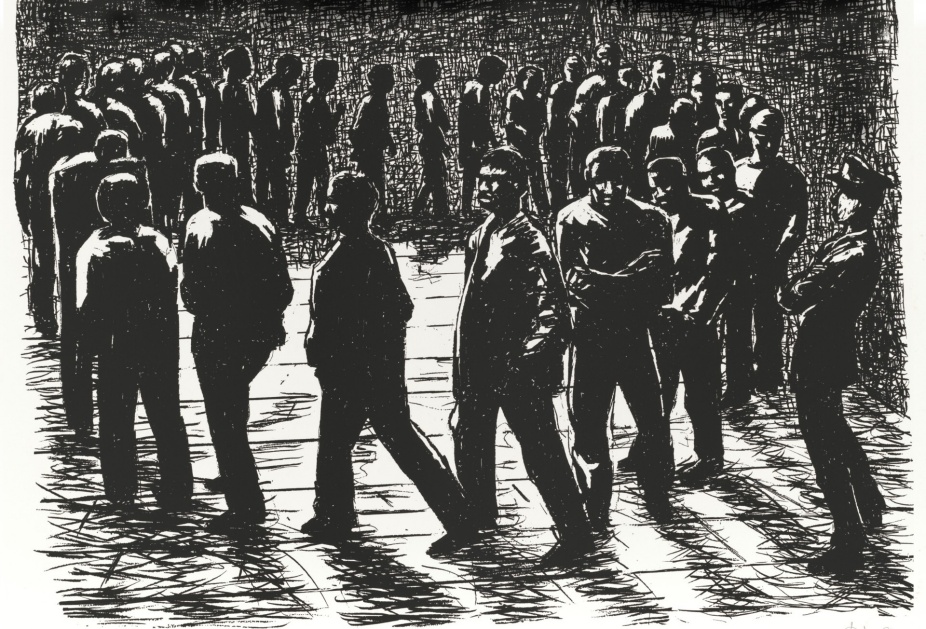
Screen print detail based on the etching, Newgate Prison Exercise Yard, by Gustave Doré, and a series of graphics from the late 1800s, as updated by Jos Sances, 1992. Image courtesy of the U.S Library of Congress.
Resnik, Giammatteo, and Harrington discuss the boundaries of state power in prison systems.

Published April 20, 2026
Judith Resnik, John Giammatteo, and Alexandra Harrington come together in Episode 54 to discuss Resnik's book, Impermissible Punishments: How Prison Became a Problem for Democracy. Their conversation is about how prisons evolved as institutions shaped by democratic ideals while simultaneously undermining them. Considering the role of law in structuring punishment, they talk about the ongoing struggle to define the boundaries between permissible and impermissible state power.
KEYWORDS: Prisons, Democracy, Punishment, Carceral State, Abolition, Legal Theory, Civil Rights, Human Dignity, Public Policy, Law and Society, Mass Incarceration
HASHTAGS: #Prisons #Democracy #MassIncarceration #Abolition #LegalTheory #BaldyCenter #JudithResnik #CriminalJustice #LawAndSociety
Podcast Streaming 24/7
STREAMING AUDIO 24/7
You can stream each episode on PodBean, Spotify, Apple Podcasts, and most any audio app. You can also stream the episode using the audio player on this page.
Podcast Audio Player
- Episode 54
Note: Audio Player may not function ideally on small-screen devices.
Prisoners tell judges, we're rights bearers, and that's the trigger that gets judges in. And prisoners are inventing a different kind of political theory for punishment that says that, however you can punish me, you can't punish me like that. They are presentists. And they do this starting in the 1950s as part of the US Civil Rights Movement, and part of a broader human rights movement because of the uncomfortable, horrific parallels between enslavement and plantation and prisons. There are also horrible parallels between concentration camps and prison, using food deprivation, violence corporal as in whipping, corporal as an incredible visceral pain and imposition, and of course deaths camps. And they are therefore important to integrate into this transatlantic story. There are lots of people thinking about the bounds and meets of punishment."
—Judith Resnik
The Baldy Center Podcast, Spring 2026
The Baldy Center for Law and Social Policy at the University at Buffalo
Podcast Episode #54
Podcast recording date: 03/27/2026
Host-producer: Jeffery White
Speakers: Judith Resnik, John Giammatteo, and Alexandra (Ali) Harrington
Contact: BaldyCenter@buffalo.edu
Transcription begins.
Jeffery:
Hello and welcome to the Baldy Center for Law and Social Policy podcast produced by the University at Buffalo. I am your host and producer, Jeffrey White. And in this episode, I'm joined by John Giammatteo, Associate Professor of Law at UB, Ali Harrington, Associate Professor of Law and Director of the Criminal Justice Advocacy Clinic at UB, and Judith Resnik, Arthur Liman Professor of Law at Yale Law School and founding director of the Arthur Liman Center for Public Interest Law to discuss Professor Resnik's new book, Impermissible Punishments: How Prison Became a Problem for Democracy. Drawing on centuries of legal, political, and social history, Resnik examines how prisons evolve as institutions shaped by democratic ideals while simultaneously undermining them. She traces the development of the correction system, the role of law in structuring punishment, and the ongoing struggle to define the boundaries between permissible and impermissible state power. What does it actually mean to punish? And more importantly, who gets to decide what punishment looks like? These are some of the questions that Professor Resnik wrestles with in this episode and reflects on with deeper analysis in her book. Let's get into it.
Ali:
From 2018 through 2020, I was the Arthur Liman Fellow-in-residence at the Center and worked with Professor Resnik on research involving solitary confinement in prison, was able to co-teach the seminar there that focuses on a range of different topics involving incarceration and the courts, and I guess I'll leave it there.
John:
I also worked with Professor Resnik as a teaching assistant, research assistant. The Liman Center sponsored my first legal job representing non-citizens in removal proceedings in New York. And also one of the most formative classes I took in law school was federal and state courts in a federal system. And so maybe to kick us off a little bit, Judith.
Judith:
Liman Professor of Law, which is to say that Arthur Liman has a particular relationship with upstate New York, because he did the Attica Report asked by the New York State government as the chief council. As I’m told, it was one of the first instant paperbacks giving a sad, sad account of the mistakes of the New York state government in invading Attica rather than finding ways to have the conversations that were underway continued. And as a consequence, 43 people incarcerated and incarcerators died in the Attica Correctional Facility, and we all know that there was much more violence and fatality. Well, Arthur went to Yale Law School and after dying, his family and friends endowed a professorship for which there was a little bit of extra funding because there was such enthusiasm to honor him. And in the context of that, thus began, and it will be 30 years next year, the Arthur Liman Center and Arthur Liman Fund and every year, at first one and now 10 or so graduates of the Yale Law School get Arthur Liman fellowships, again some people being in- house, to do incredibly useful things, such as representing people faced with being pushed out of the United States. And thus, I have the great luxury of knowing both John and Ali and learning from and learning with them in a wonderful intergenerational fellowship.
John:
Judith that's a great introduction to some of your work and also your mentorship, but you are expert in so many things, federal courts, procedure, prisons, equality and citizenship, right? So given all that transubstantive expertise, I think transubstantive is a word I probably first heard in your class and learned from you, how did you sort of start on this project? What was the origin of the book? And tell us a little bit about what drew you to this history of punishment.
Judith:
Well, I think about government's relationships to the people inside populations, and hence courts and prisons and post offices and a bunch of other different forms of services, some more cheerful than not. And I taught in different settings about the push against detention that prisoners initiated. And there's a case decided that I discuss here in which federal judges in the 1960s said that Arkansas could continue whipping, that it wasn't cruel and unusual punishment as long as it was not arbitrary and there were no more than 10 lashes and there was some procedures to protect the decision making. And I was just caught by how come, where, how, as well as eventually in 1968, then Judge Harry Blackmun before he becomes Justice Harry Blackmun in the US Supreme Court writes for an appellate panel, that you can't whip. So one was, I just thought, where is this and where does it come from?
Then in another hat, I found what are called the League of Nations in 1934 promulgated the first ever standard minimum rules for the treatment of prisoners in 1934. And I was like, okay, where did this come from? And so the answer is the book, which is both reverse engineering as well as bringing forward these things that are, some people know about the whipping case, the URL for the book gives you the 640 page transcript for those people who want to listen to the only trial on the constitutionality of the thing that I know of in the United States and the people who said they were brutally beaten and the people who say I raised my kids by whipping and whipping's the best thing we can do to discipline. And the head of the Federal Bureau of Prisons who, then retired, said it's medieval. And judges who said it was not good, but who said we’re not going to stop it. Until finally Judge Blackmun said stop, which is the first time in 1968 that any practice in a US prison by prison officials, championed by those prison officials, is ruled out completely.
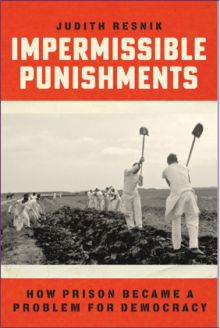
There are cases that say, don't put you or me into isolation for this moment, or there's a strip cell case. There are various other gross activities, but this is the one that changes. And then two years later, Arkansas is the site of the first ever totality of conditions case where the judge who had initially said you can whip with constraints, said the whole place is cruel and unusual punishment and the lack of food and the utter, violent, stabbing activities of which whipping was but one, have to stop. So thus the story was engaged and therefore, I know you were a journalism major, therefore it made sense to try to understand by reading the newspapers, which were great in Arkansas from the 1960s forward. Daily copy tells you a vast amount about the interactions around incarceration and prisoners that both to just walk away as an escape and on these farms, prison farms, so to speak, otherwise described as plantations and how black and white prisoners were mercilessly beat. One of the great advantages and another one of many Buffalo connections here or upstate New York is the cover picture comes from Bruce Jackson, who's a professor at this university and who in the 1970s was in both Arkansas and Texas taking photographs that become these brilliant books documenting and enabling me to have people who have the book see some of what people were living in.
John:
I wonder if maybe for the readers who haven't yet picked up the book, it's a masterful collection of hundreds of years of history, trends, connections, both United States, transatlantic connections from basically the 1700s up to the present day. But a fair amount of it is about that very deeply sort of grounded experience of particular prisons, particular states, Arkansas being the one building on the work of Bruce Jackson and others who were doing sort of ethnography there or ethnology there. And so I'm curious a little bit about how you thought about the ways that particular history has current residences and why that history was important to tell as part of this story.
Judith:
The reason it's longer than it might have otherwise been, is because there's a potential of saying that's Arkansas, the United States was a culture of enslavement, so it's about Arkansas. I'm sorry that that is true. I'm sorry to report that it's not only true because the problems of horrific prison conditions were upstate New York and California and Illinois and Ohio and Alabama and outside the United States. And so one of the hopes is to intervene in a conversation that tends to say, let me tell you about this country's particular miseries and some of it's the United States, but you can also go and read about France or England and their particular histories through the lens of detention around their countries. And this International Penal and Penitentiary Commission that generated and drafted the first international standards for the minimum treatment of prisoners is a transatlantic organization of people talking to each other, normalizing some, not all of the grotesquery of what was Arkansas.
And to be clear, those standards said be clean and nonviolent. So not utterly nonviolent, but much less violent than Arkansas. On the other hand, those standards also normalized radical micromanagement of human beings in the effort to eradicate their personal agency in a way that is totally detrimental to people's wellbeing. So the reason, I'll get to your, let me tell you more about Arkansas in a minute, but it's so potentially easy if you live or are from the Northeast of the United States to say, oh, that’s the South. And I don't want people to say South.
And moreover, those 1934 rules said, in particular in certain countries and exceptional cases, you can use corporal punishment by which they meant whipping because there's a big Anglo-Saxon tradition of using whips, lashes, birching, flogging, pick your historian, as a US tradition as punishment. We call it paddling of children in schools. So again, the idea, oh, exotic. Yes, whips are part of enslavement, but caning is also currently licensed in Singapore, a part of the English empire's extent and impact. And moreover, paddling is still not unconstitutional in US schools. So I will talk to you about Arkansas with the caveat that it's not just Arkansas. And as you know from having read the book, digging into a newer, better prison in Ohio, horrible violence and uprising, being in California a decade ago, horrible density and New York State, thank you reporters in New York constantly are telling us about enormous violence in New York state prisons.
So that's the run-up to saying nonetheless, Arkansas is interesting, not exotic, but interesting because it is the site of the first decision that says prison officials for 300 years you've been charged whereas you gained charge over 300 years of the authority of prisons, yes, you say you want to do this, no, you can't. And then Arkansas is then the beginnings of this idea of the totality of conditions generating the idea that prisons themselves as iterated in particular ways constitute cruel and unusual punishments.
John:
So in that sort of moment, there's a bunch of people who are making rights claims, but most importantly, something like Mr. Talley, somebody who is incarcerated, who is handwriting his petition, saying I am a rights bearing sparing person, courts recognize that I should not be whipped. So one of the major themes throughout the book sort of picks up on litigation and courts, but not obviously courts themselves, but courts being used by various actors in the system. So whether or not it's as one sort of form of management or rights blaming or whatever else. So one is obviously those incarcerated themselves, who are staking their claims, advocates on their behalf, sometimes appointed by courts to advocate that. So maybe not the cause lawyers or things that we might normally think of in some of these spaces. And then also sometimes the defendants themselves, right? I'm thinking of the example of Robert Sarver, who's a defendant and feels one of the things that your research uncovered was him sort of throwing the case a little bit, helping at least or testifying.
Judith:
Welcoming the idea that federal judges agreed with him that what he was doing was utterly inadequate as the first director of the Arkansas Department of Corrections.
John:
Partly because, if I understand it correctly, it would help his leverage with the legislature, right?
Judith:
He had been trying. So if we do a mini little brief, Arkansas had no budget for prisoners. In the 1960s, it's all sweat labor for Arkansas to make quote “a profit” from prisoners from the labor of their work in the fields with hoes and incredible, on an efficiency story, idiotically inefficient mechanization to generate something called “profits,”, if that's what you wanted to be doing. Instead, they also wanted to be degrading and insisting on extremely harmful work. So Winthrop Rockefeller, Nelson Rockefeller's brother, becomes the first Republican governor of the state of Arkansas in a hundred years in 1968 or ’69. I mean, he takes office in ’68,‘69. He takes office when Judge Harry Blackmun holds, or along the same time, that it is unconstitutional to win. And Winthrop Rockefeller wants to reform prisons, and moreover there's been the state police had investigated and uncovered an incredible violent, aggressive sadistic set of people running the prison farms who were literally torturing people with shocks and other grotesque things.
And there was Winthrop Rockefeller's inaugural lecture, says the pain and weight of our prisons plays heavily upon us and we have to make fixes. So he and a blue ribbon commission that comes out of this total scandal documented by the state police, create the first ever Arkansas Department of Corrections and hire the first ever director of the Department of Corrections named Robert Sarver, who had come from West Virginia as a reformer. And so Sarver is committed to a system that is regenerative versus securitization - one of his terms. He's not for securitization. How can you teach someone to swim in a desert? He has various ways. He describes in the first ever report that then his name gets whited-out because he gets fired, that Arkansas’ prisons are the worst of the worst. So he is an example of a person who runs something called corrections, who understands himself as trying to provide goods and services to make people safe and enabled. And he is in a system that is violent and disabling. And he is running at the legislature along with Rockefeller regularly to say, give us more money, give us more money, give us more stuff. Arkansas had 35, what they called free work staff in the 1968-70 period, because it was all sweat labor and prisoners quote, "guarding each other." Trustees was the word with guns. And so along the way, Sarver is seeing that he cannot, and Rockefeller in a Democratic legislature with Republican governor and the old Dixie Democratic legislature, Republican governor is unable to make movement. And the judge himself who's presiding is horrified at the acquittals by Arkansas jurors of defending police prison staff, who do things I don't want to talk about and very uncomfortable writing about. I am uncomfortable writing about. And they're acquitted by juries. And so the judge over time says, help. And then he gets two lawyers, one a civil rights lawyer, the other a part of the Arkansas legal establishment who is also a very adept criminal defense lawyer and who goes on to become the Chief Justice of the Supreme Court of Arkansas. And he brings them together, appoints them and says, go bring a class action. Does that in December and in February he holds the whole system unconstitutional, and Sarver opens the door.
So for people who, like the people in this room who know a lot about litigation, it's to start a “class action” in December, and have dozens of pages of judgment with all this material, and a trial that is ended with an opinion in February, is unbelievably rapid movement documenting the degradation that's there. So Sarver is completely on board with the project of trying to get remedies. And then it's from 1970 when the first of a series of opinions are issued. Anybody who thinks about legal documentation, the docket sheet is 34 pages long of the entries of Hope v. Sarver. As it goes, the names change, the heads of the prison system change, Sarver gets fired. Everybody's names change it over the time. It ends up in the Supreme Court, it ends up as a settlement, it doesn't end up because of they're not complying. And so it goes on the docket to 1982 and there are new cases that have filed thereafter.
All of which is fighting with the legislature for getting resources to make something decent. Johnny Cash sings at Cummins. It's not as famous as the Folsom singing. And he has a line that I quote that says, you know, walk up to that door, capitol steps and legislators give money. He campaigns for Winthrop Rockefeller doing concerts of Johnny Cash. In the context of that, they never get the legislature to really fund decent activities, although they get much better, to be fair. The prison moves from being beyond grotesque with no staff to a Department of Corrections and staff that are paid. But the legislature's appetite for lock-up, for more prisons, for more concrete. So from going from zero to multiple millions and millions of dollars poured into concrete, because as Sarver says, securitization wins when Dale Bumpers, the governor, the Democrat candidate beat Winthrop Rockefeller. I mean, for many reasons, Rockefeller was not an idyllic candidate on a host of other scores, but he was committed to improving Arkansas’ services. And when he leaves with the price being, firing Robert Sarver, the legislature gives some money to Dale Bumpers to do some of the things that Sarver and Rockefeller wanted the legislature to do. And as the judges are writing, they're clearly writing to try to persuade the legislature and not let them say, new jerks, blah, blah, blah. They're saying, here's what's needed, here's what's needed. And they give these histories repeatedly over the course of these many long opinions about the mistreatment in Arkansas. And just one shout out, I know a ton about this, not only because the Arkansas Democrat and the Arkansas Gazette, but because the Arkansas historical materials in their history society, in their Butler collection for the University of Arkansas, Little Rock, many, many sites of great resources and keeping of these records and data. So for all of us who have lots to worry about if there's not protection of state and federal documents and information.
John:
So I think courts in conversation with other institutions, with other…
Judith:
Yes. We're going to get to courts.
John:
No, actually, maybe not actually, because I think this. Well, I guess maybe my broader point is, or broader question is we, I think, fall back in a little bit later on, on a sort of more court-centric view that courts aren't in conversation. The litigation is the focus, not just in this book, but just more broadly. I think my students now, if I talk to them about this, would think about the litigation itself as this vehicle and not in conversation and the judges not doing the types of conversation with the legislature and the litigants themselves not thinking about that as one piece of a broader thing, partly because courts have constrained themselves, and partly because Congress has constrained it. And the whole set of ways in which we've retrenched from some of that litigation or litigation as a tool. Well, we are stuck in the retrenchment. And so I'm curious a little bit about how you think about that retrenchment alongside this history. I mean, the class litigation piece, the aggregate litigation, the curtailing of remedies to structural injunctions, but also other forms of remedies, the prison litigation reform act. So Congress stepping in and making it harder to bring some of these cases.
Judith:
So step back for a second. And one of the things, one of the reasons to start in the Enlightenment when Beccaria and Bentham and de Tocqueville and de Beaumont say, you've got to have justified your punishment, there have to be reasons. Incapacitation, deterrence, reformation, backward-looking, forward-looking reasons, utilitarian or anger retributive. The reason to talk about that is one, to say thank you. We want justification for punishment. Two, to say it's insufficient, we'll get there a bit. Three, to realize that there's a lively discussion, a latent discussion, an extensive discussion about the function of punishment in which judges are not speakers.
Judges only come into this story because prisoners like Winston Talley, and my frontispiece, the first page in this book is his handwritten petition, smuggled out of prison saying, stop the whip. Prisoners tell judges, we're rights bearers, and that's the trigger that gets judges in. And prisoners are inventing a different kind of political theory for punishment that says that, however you can punish me, you can't punish me like that. They are presentists, their present matters, and that they have equal rights. And they do this starting in the 1950s as part of the US Civil Rights Movement and part of a broader human rights movement because of the uncomfortable, horrific parallels between enslavement and plantation and prisons.
There are also horrible parallels between concentration camps and prison, using food deprivation, violence corporal as in whipping, corporal as an incredible visceral pain and imposition and of course deaths camps. And they are, therefore ,important to integrate into this transatlantic story. There are lots of people thinking about the bounds and meets of punishment. The abolitionist for the death penalty is 1764 Beccaria in Italy, lots of conversation, not about prisoners as rights bearers, but that states shouldn't do it. Prisoners say we're rights bearers. They get to do this in the context of a social human rights movement starting in the ‘40s and the wake of World War II, starting to gain steam. It exists before that with suffragettes and enslavement issues with anti-slavery. And in the context of that, they bring judges in. So judges are the kind of, I guess it's Johnny-come-lately to the conversation, but once you say, hey, you can't do that cruel and unusual, judges have to say, well, what's punishment? What are the penological purposes for punishment? And they're the speakers then. Then for a while, and here to your doing some thinking about how we know we're retrenching, judges say, oh, wow, you can't do that. Look, I'm pointing to the picture on the cover by Bruce Jackson. You can't do this kind of direct degradation enforced by whipping. You may be able to make them work, but you got to, not 12 hours a day with no medical care and no food and blah, blah, blah, blah, on and on. And not only judges, there's a draft state model statute for prisoners' rights that a national organization pens. Well then members in Congress are putting in proposed bills that mimic international conventions by now the UN has revised the standard minimum rules. And in 1955 says rights and dignity and liberty, and limits on, and no whipping and goes on. So judges get into this and for a while they're kind of all in. They're ambivalent. They're not sure this is it. They're in a complicated relationship in general, as you all know with legislatures and executive branch officials. This is Arkansas school desegregation.
There's no limit to the kinds of walking on tiptoes that federal judges are doing, but they are doing something. And then in the political backlash for which Dale Bumpers is one placeholder, and then we can move on through the ‘80s and the demonization, or the re-demonization on race and crime and drugs and the like that generates a war on crime and the war on drugs and the violence that it ensues. The US ramps up, both federal and state the criminalization and the length of sentences.
Probably if you could take away one thing in the construction, if sentences didn't get longer, then people had no backend release, in which Ali is expert. You would have then not necessarily had such a massive system to fix. And the sort of bizarreness from rational acting economic theory is willingness to pay all that money for this very unsafe system where people are unsafe. And then you get the political backlash against the rights movement. You get judges installed who had no or limited, no or limited sympathy for the people who are in detention. You get Congress marshaling this no more prison litigation, as little as possible with this thing called the Prison Litigation Reform Act. And then you get the pulling back on all of this, with nonetheless still a trickle of cases and some of that iterative dialectic interaction where a judge is writing carefully but nonetheless writing. And we see, if we want the present moment, hundreds of judges, state and federal, around the United States saying, you may be able to put someone in detention, but not like that. You may be able to pause and stop someone, but not like that.
As we're watching, judges believe there's a very moving last paragraph in a case coming out of Portland, Oregon's immigration protest with a trial judge who enjoined the misbehavior. And then there's a panel decision before the trial, the Court of Appeals takes away the preliminary injunction, stays the preliminary injunction, and the dissenting judge says, don't give up on law yet. And so her voice joined by lots of others is telling us we're right now in a struggle for understanding of law where all of us are understood, whether we've done terrible things or not, as people who are equal and rights holders. So that's the sort of trajectory. So all of our students and current readers should both appreciate barrier breaking and appreciate the barrier of breaking in both directions.
Ali:
So I guess I want to pick up on that, on the law of punishment, the substance of punishment, because the book starts with whipping and with Talley's handwritten petition saying whipping is unconstitutional. And you have a quote from then Judge, future Justice Blackmon asking, "If whipping is to be authorized, how does one ascertain the point at which you can distinguish the permissible from the cruel and unusual?" And you can imagine that same question being applied to all forms of different punishment and in this day and age when we're not grappling perhaps with whipping, but with other forms of punishment, I guess I'm curious what you think has perhaps supplanted whipping in the modern era as a form of punishment.
Judith:
So I'm careful in the book to not use the word corporal punishment to equal whipping. Because it is the corporality of imprisonment that I'm hoping people will come to see as startling in its micro breed efforts to alter people's ability to move in space. So first of all, there is still excessive forms of violence that are that closer to that form with or without whips. Not that the clear difference is not as, here's our rules. The Arkansas system promulgates something called Talley’s rules to say, here's how we can whip. So we don't have that, but we do have, here's how we can isolate in profound isolation, and here's how we can change food as in food deprivation, and here's how we can take away all your opportunities to visit with your children, and here's how going on. So the invitation for everyone is to ask about the challenge of line drawing. The peculiarities actually inside the whipping litigation was there was an argument about whether or not could you whip with studs versus whip without studs. And as I'm not a connoisseur of whips, it's a blur. They all look the same to me, and they all look grotesque. In that context, Blackmon and his colleagues are clearly aware that what they're doing is, and he's very proud of and actually later speaks to the whipping case as one of his most important decisions as an appellate judge, that they are limiting the authority of this enterprise called corrections with a footnote that another ambition of this book is to tell the history of the creation of a profession called corrections. And in the context of that, are not willing, indeed, their private conversation says, well, what about solitary confinement? I'm not going to go there. So they are very aware that there are many other practices of aggressive discipline of prisoners that are potentially on the table once they hold whipping unconstitutional. And they are anxious but unclear about what they will do. And as we who live inside law know, prisoners do say, stop isolating me profoundly. There are a few lower court opinions who agree that there's such clear science, as if you needed science, to say that profound isolation is anathema to human beings’ functioning. And so there's some that say total isolation is itself proven unusual punishment. The US Supreme Court has said total profound isolation triggers some procedural protection kind of eerie parallels to the earlier whipping cases. And there's clearly a same movement as there has been to abolish solitary confinement or to abolish solitary confinement like there was to abolish the death penalty. So are there easy examples of things that are grotesque and actually incredibly visceral? There's a way solitary confinement looks antiseptic and it's not antiseptic and it looks like it's not interpersonal and it's incredibly interpersonal. And it's incredibly harmful for the people who do it as well as the people to whom it's done too. And there's not good evidence that it makes anybody, I mean, there's good evidence and it makes people very ill, physically and emotionally and the like. But there's a continuum. I once wrote an essay called “Not Isolating Isolation” because as New York State is in vivid debate about with a statute called HALT, which was to end profound isolation, can you quote, stop isolating them under solitary confinement and lock everybody up in their own cells? Indefinitely, yes, you can. So the problem is that it's not the name, it's the lived experience of how much time lost and left in a cell and how ill it makes people. The staff response is, some parts of the staff, not all, is sad because it doesn't appreciate how harmful it is for the people subjected to it or for the system that's doing it and that the anxiety about safety is not sad but well founded.
If you create institutions that are stuffed with people who have either in the past done violence or have had great emotional physical challenges, staffed by people who have parallel limits with underfunding and too many people in metal and concrete, you create incredibly scary spaces. And so another aspiration of the book is to help people see that this sort of veneer of securitization, as if prisons were secure and safe either for the people inside or the people outside, is a mistake. So there are lots of other kinds of punishments that are impermissible, and some social orders say, yes, stop doing that. And then we, the United States among others have not insisted as a matter of right, a matter of statute, a matter of practice, a matter of rule that enough is ended. Colorado has a rule that says, at least the last I looked, no, you can't isolate, in contrast to some states that have rules that say, yes, you can take away all family life.
Ali:
I want to pick up on that last point that you raised, and I think you invoked this earlier. So solitary is one example that often looms large and where there's then some efforts to reform, but there are these other maybe more quotidian feeling examples or ones that don't perhaps strike the average listener as so extreme, like you can't have visits anymore, you can't have phone calls, you don't get programming, you don't get to go out and socialize outside of yourself for however many hours a day, which can lead into the question of solitary confinement. And some of these are very much intersected with what you raised about the conditions within the prisons, both for the people who work there and the people who are incarcerated there. And we're seeing this really starkly in New York State. We had the strike going on two years ago by corrections officers because of the understaffing and the overcrowding and the conditions in the facility. And what has resulted is functional loss for everybody of visitation, of programming, of other forms of outside communication because of the continued understaffing, arguably. And I guess the question is, where do we draw the lines between what is punishment, what is a condition, and how do we assess the constitutionality of it all?
Judith:
One road in is to ask back to the law, what's the word punishment mean in the US Constitution? Another road in is to ask, what's the word liberty mean in the US Constitution? And another way in is to say, what's the utility and morality of what it is we're doing, whether or not they're in those pigeonholes or not? And so on the utility function, there's no utility in undoing people's lives, but we just, we the Liman Center, joined in a program on something called supervised release, which in the federal system get a sentence. And when you're released from prison, you get something called supervision aiming at the best level, to be enabling. And the sad part is it imposes a series of conditions. And the sadder part is that a breach of those conditions, which could be reporting or not traveling, crossing a line because you're a person delivering something from Connecticut to Massachusetts, could result in reincarceration. And so we had at this program, a federal judge, a prosecutor, a defense lawyer, a psychiatrist, and a member from a probation office, and the woman from the New Haven probation office spoke about how much prison broke people and broke their family, her words. And in those words, and that therefore probation was needed because people didn't have what they needed. And of course, that's right, that something is needed. And then of course, not of course, powerfully the psychiatrist said, you don't need to punish people by taking them back into prison in order to be providing the services that you think are needed. There are incentives for people to provide this without the risk of reincarceration. So on the idea of the need for sociability, I don't know if it's true, but I was at one solitary international conference where someone said in some Scandinavian countries, you can't have one horse, you have to two because horses are social. I mean, I haven't read the regs, but the idea that you think that there's anything good to come from taking away all forms of community with the consciousness that if you create a very scary place, and by the way, the inside is the outside. So if you're members of something that prison officials call security group threats or threat groups, and we call gangs, is it possible that there will be harsh to violent interaction that happens on the street happening in prison? And if so, what are you supposed to do about it? So I'm not for a second suggestion that once you create an alternative space, as dense and scary as it is, that you are in a regulation free world because the issue is horizontal as well as vertical in terms of risk of harm and violence.
A person who ran a state prison system once told me, because I was distressed at the regulations that say you can't take more food. And I was saying, why are you micromanaging that? And she explained that food can come as a barter system and exploitation and risk. And then she went on to say, so what we've done is create a big basket of fruit that anybody can take some from. So the issues about how you recreate a world in which there's need, violence, stress, anxiety, mental health challenges of all kinds, and make anything that is safer. The current nomenclature inside corrections, or at least a thread, is called dynamic security, where the idea is that people understand that the incarcerated and the people in detention are in a dynamic relationship with each other. And therefore, and San Quentin is now an example where you can watch a video of people playing volleyball together staff and the detained. If you see people as in relationship to each other, then you have the possibility of realizing the toxicity, people who work in prisons have higher blood pressure problems and emotional problems than people who don’t and figure out ways to detox. And so I think that one way to approach the potential, what are the alternatives and how can you keep the word punishment? One version, obviously, is people say abolish punishment. Another version is there are real bases to be really mad at people who stolen the Capitol or kill people on streets with badges or not. And therefore, you don't want to end punishment, but you are absolutely clear that the form we have developed, which didn't exist, that we made up and that doesn't exist everywhere in the same form, while it's also called incarceration, is not something that is natural, and it is destructive.
So I have this idea of ruination and anti-ruination. The Enlightenment, thank you very much, gave us, helped us. Yes, you need to justify punishment. That's a good move. What are the justifications? Prisoners said, there's got to be another justification if you're in a democratic political order, and that other justification has to take into account my equality as a person, a rights bearing person in the social order. And in order to do that, I think there's a vocabulary, excessive fines shouldn't ruin people. That's justification for another prohibition in the US Constitution. And so the idea is ruining people should be impermissible punishment, whether it's economic or non-economic. And to get there is a real burden if you're going to detain anybody. how you figure out how to do it without rumination, which gets us right back to, of course, not breaking all the relationships with the families, friends, and community in which we hope they will be littered.
Ali:
I'm really glad you touched on that because I thought that was really fascinating in the last chapter where you turned to this ruination principle and it picks up on so much of what you were just talking about from the probation officer who talked about the system breaking people or we have broken people, to the toxicity of the system, it feels like ruination touches across these different themes. And I don't know if there's any more you would say in conclusion about why this principle is compared to other standards like evolving standards of decency, different ways of assessing the constitutionality of punishment might help us get at the heart of what is at stake.
Judith:
Part of it is I'm trying to keep saying to all of us, even though we're inside of law school, it's both a question, of however you think about law and however you're going to define punishment and excessive fines and expos facto and liberty and the question of running a democratic social order, it's not one or the other. And so in the context of that, what are the means in which you can say, I'm infuriated and horrified at the behavior and the harm and honor and recognize the injury done to individuals, let alone the body politic, without ruining those individuals who did the wrongdoing as well as the body politic. And so that, no, I don't for a second think it's easy. I think the vocab, hang on prisoners, bank prisoners.
There wasn't a concept of something called excessive force in prisons because it was force. You could do whatever you wanted. Now we have, as pathetically limited as the current Supreme Court has interpreted it, some limits on the idea that force of some kind is not listed even for the detained. There's a much broader vocabulary to come and the vocabulary, decency, dignity, not editing out, rights all those things, but the idea of trying to get people's attention to ruin, to degradation, taking people down and harming them. And the idea that it seems like ruining economically, however undefined that is, has a long English tradition that the US Supreme Court across its political spectrum has embraced at least for people called citizens. And the idea that if we understand ruination and then don't personalize it to only the person who's being the direct object, but to the body politic, we have a chance of adding and I'm welcoming conversation and I'd like to delete some words. I'd like to end the word correction. What does it have to do with agency? I'd like to end the word reentry. I get that there's transition issues, but everybody's always in the same place as in this social order. I'd like to stop talking about civilization because in the name of civilization, more grotesqueries than I can imagine. And I'd like to add. So here's one add and please come on in. The water's fine. And here we are at Lake Erie. And add more to this idea of how a social order understanding. And on the adds, some European documents talk about normalization and regularization that prison be as normal as possible. The Constitute Court of Italy says, of course you should have a right to cook under certain circumstances. That’s normalcy. And so, why think that you generate an abnormal environment and then get anywhere?
Jeffery:
So once again, that was Ali Harrington, John Giammatteo and Judith Resnik. And this has been the Baldy Center for Law and Social Policy podcast produced by the University at Buffalo. To learn more about the Center, visit our website, buffalo.edu/baldycenter. My name is Jeff, and on behalf of the Baldy Center, thank you all for listening.


Judith Resnik, Professor of Law (Yale)


Judith Resnik is the author of Impermissible Punishments: How Prison Became a Problem for Democracy. Her work charts the invention of the corrections profession that called for decent conditions while imposing radical restrictions on human movement as if doing so was normal. At Yale, Resnik is the Arthur Liman Professor of Law and the Founding Director of the Arthur Liman Center for Public Interest Law. Resnik teaches courses on federalism, procedure, courts, prisons, equality, and citizenship.
Related Link: The Arthur Liman Center for Public Interest Law at Yale


Impermissible Punishments: How Prison Became a Problem for Democracy
Abstract: Can prisons escape their ties to plantations and concentration camps? Judith Resnik, Arthur Liman Professor of Law at Yale Law School and the Founding Director of the Arthur Liman Center for Public Interest Law explores the history of punishment inside prisons and the rules that organize prisons. Resnik charts the invention of the corrections profession that called for decent conditions while imposing radical restrictions on human movement as if doing so was normal. She weaves together the stories of people who debated how to punish and the stories of people living under the regimes that resulted.
Resnik maps three centuries of shifting ideas, norms, and legal standards aiming to draw lines between permissible and impermissible punishments. Her account documents the impact of World War II, the United Nations, the US Civil Rights movement, and the pioneering prisoners who insisted that law should protect their individual dignity. Taking us to the present, Resnik analyzes the expansion of imprisonment, the inability of public and private prisons to provide safe housing, and the impact of abolition politics.
Exploring the interdependency of people in and out of prisons, Impermissible Punishments examines what governments committed to equality owe to the people they detain and argues that many contemporary forms of punishment need to end.
The book is available at the UB Bookstore.
Also see Chicago University Press.
John Harland Giammatteo (School of Law, UB)


John Harland Giammatteo
(School of Law)
John Harland Giammatteo researches the intersections between civil procedure, federal courts, and administrative law. His scholarship engages with two primary areas. First, he studies access to courts and rightsclaiming, with a particular emphasis on barriers to federal litigation. Second, he undertakes ethnographic studies of court-like procedures used by mass adjudicatory agencies. Giammatteo’s writing has been published or is forthcoming in the California Law Review, New York University Law Review Online, and the International Journal of Refugee Law, among other academic journals and periodicals.
Giammatteo joined the School of Law faculty following a clinical teaching fellowship at Georgetown University Law Center, where he taught in the Civil Litigation Clinic and supervised students in a wide range of civil litigation matters. Before teaching at Georgetown, Giammatteo represented asylum seekers and noncitizens at Lutheran Social Services of New York’s Immigration Legal Program as a Justice Catalyst and Liman Fellow. He also clerked for the Honorable Gerard E. Lynch of the U.S. Court of Appeals for the Second Circuit and for the Honorable Victor A. Bolden of the U.S. District Court for the District of Connecticut
Giammatteo is a 2017 graduate of the Yale Law School. He holds master’s degrees from SOAS and City University in London, where he studied as a Marshall Scholar. Giammatteo graduated from Syracuse University with a bachelor’s degree in Anthropology and Magazine Journalism.
Alexandra Harrington (School of Law, UB)


Alexandra Harrington directs the Criminal Justice Advocacy Clinic at the School of Law. Through the clinic, student attorneys represent incarcerated individuals in second-look proceedings and advocate for criminal system reforms in New York State. Before coming to Buffalo, Harrington was a Senior Liman Fellow in Residence at the Liman Center at Yale Law School. Previously, she was a Deputy Assistant Public Defender with the Connecticut Division of Public Defender Services in the Innocence Project/Post-Conviction Unit. Harrington helped to shape and coordinate the Division’s representation of individuals who were sentenced as juveniles in adult court to lengthy prison terms.
Harrington’s research explores the aims of sentencing and how these goals influence opportunities for back-end sentence review or “second looks.” She has written about how recent Supreme Court decisions regarding sentences for people who were children at the time of the crime inform our understanding of parole’s function, about the role that prosecutors play in realizing or thwarting resentencing reforms and the ways in which focus on the underlying record of the crime can contravene the purpose of second looks, and about racial disparities in New York’s felony murder law.
Harrington graduated in 2014 from Yale Law School. She holds a B.A. from Vanderbilt University. She grew up in Buffalo, and she is thrilled to be working in her hometown.
Jeffery White, Podcast Producer/Host


Jeffery (Jeff) White
Jeffery White (He/Him) is the current producer/host of The Baldy Center Podcast. As a full-time PhD candidate in Sociology at the University at Buffalo, his research examines how system-impacted students experience higher education as either an extension of or rupture from carceral systems. His scholarship extends traditional understandings of the school-to-prison pipeline by interrogating higher education as a possible site of both containment and transformation in the life course.
White is a researcher, writer, published poet, educator, and social advocate whose work examines the intersections of race, education, and the carceral state. He began his academic journey at John Jay College of Criminal Justice, studying International Criminal Justice and Human Rights, where his research explored the relationship between the U.S. criminal legal system and international human rights frameworks.
He earned his MA from Columbia University in Human Rights and Social Stratification, conducting statistical analyses of police killings of unarmed Black men and examining patterns of racialized state violence. He later completed a teaching fellowship and earned his MS in Special Education (7-12) with a concentration in Urban Education Policy from Brooklyn College.
White taught incarcerated youth at Rikers Island, an experience that shaped his commitment to dismantling the school-to-prison pipeline. He went on to serve as a secondary educator and racial equity curriculum specialist, and worked with the NYC Office of Safety and Youth Development to support culturally responsive, restorative practices in District 15.
Executive Producers
Matthew Dimick, JD, PhD
Professor, UB School of Law;
Director, The Baldy Center
Amanda M. Benzin
Associate Director
The Baldy Center