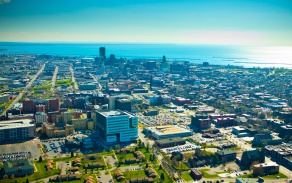
UB continues to expand its presence in downtown Buffalo with
last month’s move of the UB Regional Institute to the UB
Downtown Gateway.
The institute, a unit of the UB Law School that conducts
interdisciplinary research and policy studies, moved in
mid-November from its former home in historic Beck Hall on the
South Campus to newly renovated space on the third floor of the
gateway, the former M. Wile Building at 77 Goodell St.
Beck Hall will become the new home to administrative offices,
including the Dean’s Office, for the School of Nursing.
The institute plans to celebrate its new home at an open house
from 4-6 p.m. Dec. 15.
Also housed in the UB Downtown Gateway are the administrative
offices of UBMD, the practice plan for more than 450 faculty
physicians, and staff in UB’s new Office of Economic
Engagement, a part of the Division of External Affairs.
Other UB programs slated to establish offices at the Downtown
Gateway are Government and Community Relations, and the Center for
Educational Collaboration, a presidential initiative fostering
collaboration with the Buffalo Public School system. The new
Educational Opportunity Center building being constructed on
Goodell Street will become part of the gateway complex via a common
lobby.
Marsha S. Henderson, vice president for external affairs, said
the availability of space for these programs in the Downtown
Gateway building demonstrates the university’s commitment to
working with the neighboring communities as part of the build-out
of UB’s presence on the Buffalo Niagara Medical Campus.
The move to Downtown Gateway has been an exciting one for the UB
Regional Institutes, notes Kathryn A. Foster, its director.
“I marvel at the tremendous job UB Facilities and the
architects have done to create modern offices inside a former
industrial building,” Foster says, adding that the space is
light and airy, and maintains the building’s terrific
structural columns.
“We’re honored and thrilled to be in the vanguard of
UB Downtown,” she adds.
In addition to facilitating collaboration among the
institute’s 10 full-time employees, two graduate assistants
and numerous policy and faculty fellows (Foster says the group was
spread among three floors in Beck, and interaction often occurred
at the foot of the stairway or at the copy machine), the space
downtown will give the institute a “new kind of
visibility,” Foster says.
“We are now in the corridor of the government, foundation
and business partners who are our collaborators, partners and
colleagues,” she says.
Foster notes the institute’s new location downtown will
bring “a new kind of synergy” to the unit, which she
describes as “having one foot in the academy and one foot in
the policy world.”
While the institute will give up the advantages of being on
campus, it will gain a new kind of proximity being located near its
community partners, she points out. “I believe the benefits
outweigh the costs,” she says. “This is a good move for
us; it’s good for UB and good for the Regional
Institute.”
The institute, which now can be reached at 878-2440, leverages
the resources of UB and the binational community to pursue a wide
range of scholarship, projects and initiatives that inform regional
challenges.
Over the years, the institute has studied problems ranging from
vacant properties to air quality, with an eye toward informing
debate about good governance. Recent policy briefs have been
published on the effects of downsizing local government in Western
New York and reorganization of school districts.
The institute’s Region’s Edge initiative focuses on
such issues as binational governance and economic integration
related to Buffalo Niagara’s unique status as a border region
in a global world.