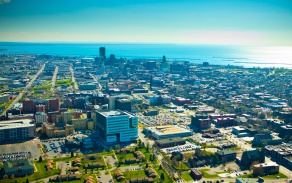
UB’s downtown campus is growing. By early February, nearly
100 UB employees who had been based at various sites will have
moved into new digs in the UB Gateway, the former M. Wile building
at Goodell and Ellicott streets. The historic structure is
undergoing an approximately $4 million renovation.
The Gateway’s largest new tenant is the Department of
Family Medicine, the first department in the School of Medicine and
Biomedical Sciences to move downtown as part of the
university’s plan to improve regional health care and
revitalize Buffalo’s economy by relocating the medical school
to downtown Buffalo.
Other components of UB’s move downtown include the new
Center for Translational and Clinical Research in the UB-Kaleida
Health building under construction at Goodrich and Ellicott
streets, a new Educational Opportunity Center under construction
adjacent to the Gateway building and a new medical school, which is
expected to be completed in 2016.
This week, the Department of Family Medicine finished moving 75
faculty members and staff into the UB Gateway from a cinderblock
building on the campus of Erie County Medical Center on Grider
Street. Beginning today, the department can be reached at
816-7227.
“With the move of UB’s Department of Family Medicine
into the UB Gateway building, we are taking another step in moving
the UB medical school to the Buffalo Niagara Medical Campus (BNMC),
in closer proximity to most of Buffalo’s major hospitals and
medical research institutions,” says Michael Cain, vice
president for health sciences at UB and dean of the School of
Medicine and Biomedical Sciences. “The Department of Family
Medicine also now will be closer to the resources of UB’s New
York State Center of Excellence in Bioinformatics and Life
Sciences, and the new Clinical and Translational Research Center
under construction within the joint UB-Kaleida Health building on
the BNMC.”
Thomas C. Rosenthal, department chair, notes that the
unit’s new home has some distinct advantages.
“It’s a nice, new, modern facility on the downtown
campus; it will allow for better work flow in the
department,” he says.
In addition, the proximity to some of UB’s most
sophisticated information technology resources is a big asset.
“One of the challenges we face in primary care is that we
work with so many different diagnoses and diseases with our
patients, it is often difficult to detect patterns,”
Rosenthal says. “In order to more readily see trends, we tend
to do a lot of research on large population databases. Being so
close to the facilities and expertise of the Center for
Computational Research in the UB Center of Excellence is going to
provide a real benefit.”
The UB Gateway building is part of the UB Downtown Gateway
complex, which will consist of the Gateway building and the
four-story Educational Opportunity Center building, expected to be
completed in spring 2013; the buildings will be connected. The
Gateway complex will form a cornerstone of UB’s downtown
campus, providing the Buffalo Niagara community with greater access
to UB’s academic and community programs, strengths and
resources.
The overall goal of the UB Gateway to enhance the quality of
life in Buffalo and surrounding communities prompted the move of
the administrative offices of Millard Fillmore College (MFC) into
the Gateway building last month. The move returned MFC, UB’s
college for continuing education and academic outreach, to its
roots in downtown Buffalo after nearly 60 years on the South
Campus. MFC’s current course and certificate programs will
continue to be offered primarily online and at the North and South
campuses.
“MFC’s move to the UB Downtown Gateway is
significant to its mission and to UB’s commitment to serving
citizens of Western New York,” says Larry R. Gingrich,
associate dean of MFC. “We look forward to developing
partnerships with business and organizations, and launching new
programs for continuing and professional studies.”
Over the next four to six weeks, additional units moving into
the UB Gateway include the School of Management’s Center for
Entrepreneurial Leadership, which helps local businesses grow and
prosper through leadership development and experiential learning,
and the Center for Educational Collaboration, a comprehensive,
joint effort between UB and the Buffalo Public Schools to improve
academic outcomes for all of the district’s students.
Existing tenants of the UB Gateway, some of which are moving
into newly renovated space in the building, include the UB Regional
Institute, an interdisciplinary research and policy center that
applies evidence-based analysis to issues affecting regions; the
Office of Economic Engagement, which provides resources and
expertise to assist local businesses and governments; and the
administrative offices of UBMD, the parent organization of the
medical practices of the UB medical school. UBMD represents more
than 500 UB faculty physicians.
The Buffalo Employment Training Center and URS are the Gateway
building’s non-UB tenants.
The historic UB Gateway structure forms the gateway to
UB’s downtown campus and the nearby Buffalo Niagara Medical
Campus. Home to the local clothing manufacturer M. Wile Co. from
1924 to 1964, this example of a “daylight factory” is
on the National Register of Historic Places. The building’s
refurbished space, envisioned and developed by UB’s Capital
Planning and Facilities units, preserves its historical character
while providing a highly functional space for its new
tenants.