
Archives
Socially relevant computing
Undergraduates create practical solutions for real-world problems
By ELLEN GOLDBAUM
Contributing Editor
Michael F. Buckley, a UB computer science lecturer, is leading a national movement to change the way computer science is taught in college.
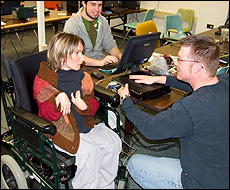
UB seniors David
H. Fine, left, and David L. Veazie learned how computer scientists can
help society by designing a "smart wheelchair" for their
disabled client.
PHOTO: MICHAEL BUCKLEY
His students learn about Buddhism. They read “The Tao of Pooh.” They visit a center for children with disabilities and are asked to design technologies that can improve the way these children live and learn.
The Assistive Technology Laboratory that Buckley and Kris D. Schindler, a lecturer in the Department of Computer Science and Engineering, School of Engineering and Applied Sciences, have created on campus is now a popular hangout for computer science undergraduates.
Buckley calls his movement “computing for a cause,” or socially relevant computing. He thinks it could save computer science from its current slump: America’s 2007 graduating class had its lowest number of majors in 10 years, down to just 8,000 graduates nationwide, according to the Computing Research Association.
“Creating practical solutions to socially relevant problems focuses incredible philanthropic and creative energy,” said Buckley. “When students work on these projects, they see themselves less as geeks and more as citizens.”
Microsoft Corp. agrees.
The software giant has been funding Buckley’s efforts since 2004. He currently has about $60,000 in support from the company and visits with Microsoft executives on a regular basis to discuss the project.
“Microsoft is excited to support Professor Buckley’s commitment to engage more students to pursue majors in computer science,” said Gus Weber, Greater Northeast Microsoft academic relations manager. “His socially relevant computing programs assist in problem-solving for real-world applications and map to Microsoft’s commitment to innovation.”
Buckley teaches freshman courses in introductory programming and systems design in the Department of Computer Science and Engineering.
Students in the Assistive Technology Lab have designed and developed more than 20 socially valuable technologies, several of which have been licensed to companies and are being introduced to the marketplace.
“We are pushing socially relevant computing as a means to attract a diverse population of students to computer science,” said Buckley. “Students don’t know that they can address societal concerns with computer science.”
Eventually, the goal is to attract interest from high schools so that students come to college with some awareness of the societal value of computer science.
With the support of Microsoft and Applied Sciences Group Inc., of Buffalo and with colleagues at Rice University, Buckley developed a Web site to make it easier for computer science departments at other institutions to start courses in socially relevant computing.
“Too often, undergraduate computer design courses lack social relevance,” said Buckley. “They don’t help students figure out how it’s relevant to society’s technology needs, like helping people with a range of disabilities or establishing a region’s safest evacuation plan in case of a natural disaster.”
Every semester, Buckley takes his “Software Engineering” students to the Center for Handicapped Children’s Learning Center in Williamsville. Clients of the center have multiple disabilities and are too severely disabled to attend public schools.
“I ask my students, ‘How can you use technology to improve their lives?’” said Buckley.
Initially, he expected that some of his students would be uncomfortable with the level of disability that they saw at the center and some might opt to choose another project. “But in the end, all participated and each student was changed by the experience,” he said. “Suddenly, they were working on projects that could impact real families.”
One of the first projects to come out of the Assistive Technology Lab, the UB Talker, was customized to allow a 43-year-old stroke patient to communicate for the first time in 20 years. The technology uses voice synthesis and a touch-screen laptop computer to allow for natural, two-way conversations.
“This gentleman could think and move, but not speak,” said Schindler. “We simply turned our students loose and their creative energy came through.”
A subsequent team of students then adapted the technology for children at the Center for Handicapped Children. The UB Talker is now available from Applied Sciences Group and hundreds are expected to be delivered to disabled children and adults this year.
UB students also developed a programmable light and sound station used to teach physically handicapped, autistic and developmentally delayed children. “It’s very difficult to teach cause and effect and choice-making to severely disabled children,” said Buckley. “It can take years.”
Through the use of light, music, spoken words, even fog machines, the systems developed by the students provide positive feedback to the children through enhanced sensory experiences, encouraging them to learn to make choices and to begin to understand cause and effect.
Another student team has developed an Incident Response Monitoring System that monitors the vital signs of emergency responders in the field and can notify others when an individual is in trouble.
Buckley’s lab is now developing the system into a prototype, with help from Spectracom Corp. in Rochester and researchers at Rochester Institute of Technology and Syracuse University.