
Archives
DREAM changes girls’ lives
Social Work program builds relationships, makes a difference in community
By CHARLES ANZALONE
Contributing Editor
School of Social Work student Jordan McCarthy remembers when she first met the very shy 6-year-old who tried to hide behind the other girls who gathered each week at the Edward Saunders Community Center on Buffalo’s East Side. She was usually the youngest one there, and it didn’t help that others sometimes had a hard time understanding what she was saying.
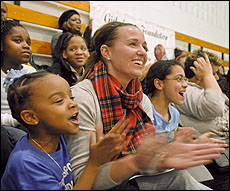
Jordan McCarthy watches a talent
show at the Edward Saunders Community Center with girls participating in
the School of Social Work’s DREAM Program.
PHOTO: NANCY J.
PARISI
Things have changed—and so has the young girl—in the four months since she met McCarthy, a volunteer in UB’s DREAM Program. She now eagerly joins in the center’s activities, whether basketball drills or informal group talks about peer pressure, study habits or setting a course for her young life.
And when an even younger girl comes to the weekly meetings, the 6-year-old is the one who takes her under her wing.
“You can’t tell she was shy anymore. She can really ramble now,” says McCarthy, who is in the final semester of study for a graduate degree in social work.
The close relationship making a difference in both McCarthy’s and the young girl’s lives is exactly what UB staff had hoped for starting the DREAM—Developing Relationships through Empowerment, Advocacy and Motivation—Program. Begun in 2004 and coordinated by Susan A. Green, clinical assistant professor in the School of Social Work, it aims to reach families in the community for short-term, as well as more lasting success.
“We’re always reminding our students that the bottom line of the DREAM Program is the opportunity to be in relationships with others,” says Green. “That’s what this is all about. Repeatedly, the volunteers of the DREAM Program state over and over how fortunate they feel to be invited into the lives of the people they are meeting in the community.”
In four years, the DREAM Program has evolved to fit the needs of community groups asking for its assistance. Originally, the program held DREAM Night Saturday evenings at Gerard Place, a transitional facility offering support and services for homeless single parents and their children. Eventually, the DREAM Night turned into educational enrichment programs to help residents earn their GEDs.
Now, the DREAM Program has joined forces with the Girls Sports Foundation, a community group formed last year to mentor inner-city girls. Each week, between 40 and 60 girls between the ages 4 and 18 meet at the Saunders center. What began as a basketball program became a place where the girls can talk about values and peer pressure.
Cecelie Owens, one of the founders of the Girls Sports Foundation, knew Green, and when Owens discovered Green was looking for places in the community where social work students could make a difference, the School of Social Work and the Girls Sports Foundation formed a natural alliance.
“We thought the age difference might be a problem,” says Carlette Daniels, who co-founded the Girls Sports Foundation with Owens, Daniels’ sister. “But the older girls want to help the younger ones, and the younger girls have shown they’re just eager to participate.”
Daniels easily has seen the differences in the young girl McCarthy has befriended, and says at least part is a result of her ongoing relationship with McCarthy. “She’s being much more active. Her speech has improved and become clearer,” says Daniels. “It’s allowed her to open up and participate more, to feel more comfortable.”
And Daniels is a big fan of McCarthy.
“She comes and delves right in,” says Daniels. “Kids can tell if someone wants to be there or if they feel it’s an obligation.
“Jordan is great,” says Daniels. “We love Jordan.”
As for McCarthy, she admits she originally volunteered because she thought it would look good on her resume. Now, she says, she’s the one who is thankful for being there.
At one of her first sessions at the Saunders Community Center, McCarthy—who had not played basketball since high school—volunteered for a free-throw contest against Daniels. When McCarthy hit the first basket, all 30 or so girls in the gym surrounded her and gave her a loud, enthusiastic group hug.
“I got really emotional,” says McCarthy. “It was not something I expected, having only been there two times. It reminded me why I wanted to get into social work in the first place, why I wanted to help people. It’s the little things in life. It reminds you how important it is to give back.”
The DREAM Program, which so far includes about 30 student volunteers, is interested in reaching out to community groups looking for mentors, tutors and other positive role models. And the student volunteers can play basketball, if that’s what it takes.
“They help us reach the girls in the community by consistently encouraging high academic achievement and by keeping open the lines of communication,” says Daniels. “They’ve been very helpful. We can use them as much as they’re willing to help.”
“We do whatever they need us to do,” says Maurice Samuel, one of the DREAM Program student leaders. “We don’t present ourselves as social workers. We’re not acting like Mom or guidance counselors. We’re just trying to be positive people in the community. The girls know there is someone who really wants to help out with homework, or really wants to talk about what it’s like being misunderstood.”