
Archives
New data impacts climate change models
Digital imaging techniques extract new information from old aerial photos
By ELLEN GOLDBAUM
Contributing Editor
A comprehensive new study authored by UB scientists and their colleagues for the first time documents in detail the dynamics of parts of Greenland’s ice sheet, important data that have long been missing from the ice-sheet models on which projections about sea-level rise and global warming are based.
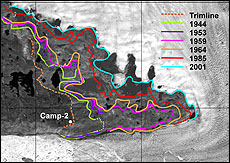
The trimline (broken brown line) marks
the maximum extent of the ice sheet at the end of the 18th century and
the subsequent retreat of the glacier and land exposed since
1944.
The research, published online this month in the Journal of Glaciology, also demonstrates how remote-sensing and digital-imaging techniques can produce rich datasets without field data in some cases.
Traditionally, ice sheet models are very simplified, according to Beata Csatho, assistant professor of geology, College of Arts and Sciences, and lead author of the paper.
“Ice-sheet models usually don’t include all the complexity of ice dynamics that can happen in nature,” said Csatho. “This research will give ice-sheet modelers more precise, more detailed data.”
The implications of these richer datasets may be dramatic, Csatho said, especially as they impact climate projections and sea-level rise estimates, such as those made by the United Nations Intergovernmental Panel on Climate Change (IPCC).
“If current climate models from the IPCC included data from ice dynamics in Greenland, the sea-level rise estimated during this century could be twice as high as what they are currently projecting,” she said.
The paper focuses on Jakobshavn Isbrae, Greenland’s fastest-moving glacier and its largest, measuring four miles wide.
During the past decade, Jakobshavn Isbrae has begun to experience rapid thinning and doubling of the amount of ice it discharges into Disko Bay.
“Although the thinning started as early as the end of the 18th century, the changes we are seeing now are bigger than can be accounted for by normal, annual perturbations in climate,” Csatho said.
In order to document the most comprehensive story possible of the behavior of Jakobshavn Isbrae since the Little Ice Age in the late 1800s, Csatho and her colleagues at Ohio State University, the University of Kansas and NASA used a combination of techniques.
These included field mapping, remote sensing, satellite imaging and the application of digital techniques in order to glean “hidden” data from historic aerial photographs as many as 60 years after they were taken.
By themselves, Csatho explained, the two-dimensional pictures were of limited value.
“But now we can digitize them, removing the boundaries between them and turning several pictures into a single ‘mosaic’ that will produce one dataset that can be viewed in three-dimensions,” she said.
“By reprocessing old data contained in these old photographs and records, we have been able to construct a long-term record of the behavior of the glacier,” said Csatho. “This was the first time that the data from the ’40s could be reused in a coherent way.”
The data from the historic photos were combined with data from historical records, ground surveys, field mapping and measurements taken from the air to document important signs of change in the glacier’s geometry.
Csatho explained that conventional methods of assessing change in glaciers have depended on documenting “iceberg calving,” in which large pieces at the front of the glacier break off.
“But we found that you can get significant changes in the ice sheet without seeing a change in front,” she said.
Other key findings of the paper are that two different parts of the same glacier may behave quite differently and that a glacier does not necessarily react to climate change as a single, monolithic entity.
“Climate forces are complex,” Csatho said. “For example, we found that the northern part of Jakobshavn was still thinning while the climate was colder between the 1960s and the 1990s.”
Csatho, who is a geophysicist, added that the research is the result of a strong interdisciplinary team involving experts in glaciology, ice-sheet modeling and photogrammetry, the science of making measurements based on photographs.
At UB, research in Csatho’s remote sensing laboratory focuses on a multidisciplinary approach that integrates information across the geosciences.
Csatho’s co-authors on the paper are Tony Schenk of the Department of Civil and Environmental Engineering and Geodetic Science at Ohio State University, Kees van der Veen of the Center for Remote Sensing of Ice Sheets at the University of Kansas and William B. Krabill of NASA’s Cryospheric Sciences Branch.
The research was funded by the National Science Foundation and NASA.