
Archives
A rare look inside prison walls
Photographs of Arkansas prison by Bruce Jackson are on view at Duke
By KEVIN FRYLING
Reporter Staff Writer
America’s prisons are a place into which few are ever granted a window—much less a place where modern journalists and documentarians are given unrestricted access—which makes unique an exhibit that opened last week at Duke University by a prominent UB faculty member.
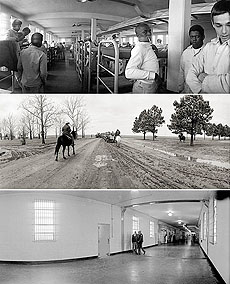
Bruce Jackson used a special
Widelux camera to take these photographs at Cummins Prison Farm in
Arkansas in 1975. The prints that are on exhibit at Duke University are
more than three feet wide.
“Cummins Wide: Photographs from Inside the Arkansas Prison” features a series of wide-angle photographs from 1975 taken inside the Cummins Prison Farm in Lincoln County, Ark., by Bruce Jackson, SUNY Distinguished Professor and Samuel P. Capen Professor of American Culture in the Department of English. Two years before Jackson’s first visit to the prison in 1971, the Arkansas prison system, including Cummins, was declared unconstitutional by a federal judge based on the terrible conditions inside the prisons.
The exhibition, which is sponsored by the Center for Documentary Studies at Duke, opened Jan. 17 in the Kreps Gallery and will run through April 6. Jackson will deliver a talk tonight at a public reception in the gallery. He will return next month for a series of workshops taking place Feb. 6-10 in conjunction with the exhibition.
“It’s all stuff that I couldn’t possibly do now,” Jackson says of the photos in the exhibition. “I can’t imagine a prison in the country that would let anyone wander around freely the way I did then,” he adds, noting that a friendship with the commissioner appointed to clean up the prison after the court ruling allowed him to explore the facility alone and unsupervised.
In one photo from the exhibit—a shot of prisoners in a train of carts riding out to work in the fields—he says the viewer can tell he took the photo from alongside other prisoners riding in the same cart. Another close-up shot not only shows prisoners standing beside their bunks, but also inmates observing Jackson’s picture-taking from the sidelines. The special Widelux camera used to take the photographs captures a 140-degree field that simulates the natural range of human vision, he says.
“Wide images let you see the context in which the image is being made, so it’s a far more complex view of the physical environment than is possible with a regular camera,” Jackson says, pointing out that details lost to the naked eye in traditional photos and reproductions are clearer in large-scale photographs. The prints in the exhibit are all more than three feet wide. “You have to move your eyes to look at photos this size,” he says, “so you have a very physical experience of seeing the place.”
As a scholar, Jackson has been performing complex ethnographic studies of prison as a cultural site for more than 30 years, including books and film, as well as photographic work. A small selection of his work on the subject includes both a book and film entitled “Death Row”—a collaboration with his wife, Diane Christian, SUNY Distinguished Teaching Professor in the Department of English—as well as a collection of traditional narrative poems by Southern black prisoners that originally was published in 1974. All 49 photographs from the current exhibition have been published as a book by the UB Center Working Papers and the Center for Documentary Studies at Duke, he says.
“One thing people on the outside often forget is that people who are in prison live there,” says Jackson, whose work on prison culture has taken him inside penitentiaries in Texas, Arkansas, Missouri, Indiana, California, Massachusetts and New York state. “It’s their community and they do things that people do everywhere people live: They have social relationships, they have friends, they make art, they have fights, they write letters, they write books, they get through the days.”
Although he saw improvement during the years he visited Cummins Prison Farm—a total of seven trips between 1971 and 1975—Jackson says America’s prisons basically remain today as they were 30 years ago, except now they’re much more overcrowded. New York state is notorious for large numbers of people serving long sentences for minor drug offenses, he says, and the state has instituted dramatic funding cuts to prison education programs in recent years. Many prisoners remain illiterate or subliterate, he adds, frequently returning to jail because of their lack of marketable skills or trade.
“Some of the conditions have changed, but the basic facts of prison life are exactly the same as they ever were,” Jackson says. “Prisons are places where people are kept away from their families in the company of people they would rather not be with for long periods of time, usually under circumstances that deny them much of their humanity and are very repressive—most of the other differences are matters of degree.”