
Archives
600 attend ’Building UB’ forum
Presentation aimed to collect input from university, local communities
By KEVIN FRYLING
Reporter Staff Writer
Visit the UB2020 Web site to view a Web cast of the forum.
About 600 members of the UB and local communities turned out Tuesday for the first of four public forums on “Building UB,” the comprehensive physical planning process being developed by UB in conjunction with its plans to grow by 40 percent by the year 2020.
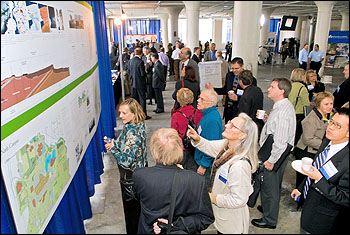
UB faculty member Lynda
Schneekloth (center) points to an artist’s rendering on display as
part of the first of four public forums on "Building UB." The
forum was held at the UB Downtown Gateway, the former M. Wile Building
on Goodell Street.
PHOTO: DOUGLAS LEVERE
The forum, which was part of an open house that ran from 9 a.m. to 9 p.m., took place on the third floor of the UB Downtown Gateway—the former M. Wile Building at 77 Goodell St. that recently was purchased by the university. Speakers included President John B. Simpson; Satish K. Tripathi, provost and executive vice president for academic affairs; Robert G. Shibley, professor and director of the Urban Design Project in the School of Architecture and Planning; and Frederick A. Bland, a partner in charge for Beyer Blinder Belle Architects & Planners, the firm that received the contract to lead development of the $4.5 million comprehensive physical plan.
“We have now embarked upon the creation of a comprehensive physical plan whose implementation will make possible our aspirations for academic achievement and greatness,” said Simpson. “It is important to note that all the progress we have made—our comprehensive plan, our plans to grow by 40 percent and our ambitious academic agenda, which these plans will support—is taking place through an inclusive process involving input and engagement from within the University at Buffalo, as well as from within the communities that are our hosts.”
“My view is that this kind of inclusive process, involving the university and our communities, is simply the only way we can accomplish the kind of progress that we envision in terms of the scope and magnitude that it promises,” he added.
Shibley, who as senior advisor to Simpson is overseeing UB’s ongoing master-planning project, said more than 100 meetings have taken place over the past year devoted to the fiscal aspects of the comprehensive physical plan—not to mention hundreds more concerning its relationship to the academic aims of the university.
“This conversation is just beginning,” he said, noting that the university is seeking to include everyone in the discussion—from UB’s vice presidents, deans, faculty, staff and students to policy-makers, regional agencies and neighborhood residents in the state, local and regional community. “We have not had a lot of practice over the decades with really good conversation with our region,” Shibley added, “and we want that to be different.”
Several broad patterns have emerged from conversations with UB’s constituents thus far, he said, including concerns about space for the new facilities required to support the university’s physical expansion—from bathrooms, libraries, labs and offices to residential housing and student apartments—and questions about transportation, including accommodating not only commuters, but also making the campus a pleasant place for pedestrian foot traffic and bicycles.
Another criticism is that UB’s campuses are difficult to navigate and fail to provide a warm and friendly environment conducive to learning. Creating a plan in which all three campuses retain “strong, distinctive” personalities while also feeling “seamlessly connected” as part of the same university is a challenge, Shibley noted.
In his comments, Bland discussed the three campuses’ architectural history, as well as various elements of their physical landscapes that he feels have been under-utilized, including the Niagara Escarpment on the South Campus and Lake LaSalle on the North Campus. There also are places in which the original plans have gone unfulfilled, he said, such as integrating the North Campus with the Town of Amherst as outlined in the campus’s 1968 master plan.
One of the greatest planning challenges on all three campuses relates to parking, he added, noting that nearly 100 acres are devoted to parking on the North Campus, 96 percent of which is in use during peak hours, and 28 acres on the South Campus, 92 percent of which is in use during peak hours. The major roads on North Campus—Audubon Parkway, Augspurger and White roads and Putnam Way—also were pinpointed as being a challenge since their concentric design creates multiple barriers that cut the North Campus off from the neighboring community.
In tackling the challenges of UB’s comprehensive physical planning process, Bland encouraged the regional and university communities to imagine, “What if…”
“What if all the historical buildings on the South Campus were fully utilized and functional?” he asked. “What if the path systems on campus were more inviting with no dead ends?” Or if an all-season trail system linked Lake LaSalle with the surrounding woods? Or the buses had wi-fi?
“This process really started for me today in this room with you people,” Bland added. “Planning is about the future—it’s saying at this moment there’s no such thing as a bad idea. Let’s put all the ideas out there; we’ll figure out the bad ones in good course.”
Although the focus of the forum was on the future, Simpson and Tripathi took a moment to outline several of the university’s current development projects. Simpson pointed across the street to the future site of the Educational Opportunity Center, a $30 million project sponsored by UB and New York State, and Tripathi cited renovation of Acheson Hall on the South Campus, as well as construction of a new building on the North Campus for the departments of Computer Science and Engineering and Electrical Engineering. He also said a new 600-bedroom, suite-style residence hall is in the works for the North Campus, just south of the Ellicott Complex.
“We can never afford to choose between working for today and planning for the future,” Tripathi said. “So we are happy to be moving forward as quickly as we can to meet the needs of today, while at the same time keeping an eye focused on the future that we want to create.”
The second public forum on “Building UB,” which will focus on “campus concepts,” will take place on April 22 on the North Campus, and a third that will focus on a draft of the plan is set for Nov. 19, 2008, on the South Campus. The final forum, focusing on plan implementation, will take place on April 22, 2009.