
Archives
‘City Lights’ to open Buffalo Film Seminars
By SUE WUETCHER
Reporter Editor
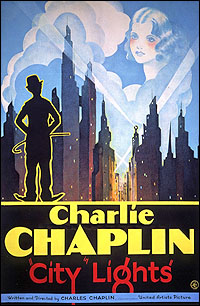
"City Lights," generally viewed as Charlie Chaplin's greatest film, will open the 15th edition of the Buffalo Film Seminars, the semester-long series of screenings and discussions sponsored by UB and the Market Arcade Film and Arts Center.
The series will take place at 7 p.m. on Tuesdays, beginning Aug. 28, in the Market Arcade Film and Arts Center, 639 Main St., in downtown Buffalo. The series is hosted by Diane Christian, SUNY Distinguished Teaching Professor in the Department of English, and Bruce Jackson, SUNY Distinguished Professor and Samuel P. Capen Professor of American Culture in the Department of English.
Christian and Jackson will introduce each film. Following a short break at the end of each film, they will lead a discussion of the film.
The screenings are part of Film Directors (Eng 413), an undergraduate course being taught by the pair. Students enrolled in the course are admitted free; others may attend at the Market Arcade's regular admission prices of $8.50 for adults, $6.50 for students and $6 for those 62 and over. Season tickets are available any time at a 15 percent reduction for the cost of the remaining films.
"Goldenrod handouts"—four to eight-page notes on each film—are available in the lobby of the Market Arcade 30 minutes before each screening, and later online at the Buffalo Film Seminars Web site.
Free parking is available in the M&T fenced lot opposite the theater's Washington Street entrance. The ticket clerk in the theater will reimburse patrons the $2 parking fee.
Subtitled "A Comedy Romance in Pantomime," "City Lights" is a silent film released three years after the start of the talkies era of sound. The episodic film features Chaplin's famous Little Tramp character in a tale of the Tramp's attachment to a blind girl and his efforts to aid her and a millionaire, and persuade them both that life is worth living.
The remainder of the schedule, with descriptions culled from the IMDb online movie database, as well as www.filmsite.org and www.greatestfilms.org:
Sept. 4: "L'Atalante," 1934, directed by Jean Vigo. One of the cinema's greatest unsentimental romances, this film, set on a Seine River barge, tackles the pitfalls of marriage and possessive relationships.
Sept. 11: "The Letter," 1940, directed by William Wyler. A melodramatic film noir of murder and deceit starring Bette Davis.
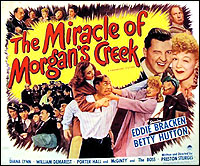
Sept. 18: "The Miracle of Morgan's Creek," 1944, directed by Preston Sturges. One of Sturges' top screwball war-time comedies, it was considered controversial at the time due to its scandalous content. A hapless, small-town girl from Morgan's Creek, Trudy Kockenlocker (Betty Hutton) attends a wild party with servicemen from the local army base, gets drunk and marries a soldier. She finds herself pregnant, but can't remember which soldier she married. She convinces a 4-F reject to marry her and pretend to be the father. She gives birth to sextuplets, and the couple becomes national celebrities.
Sept. 25: "Sansho the Bailiff/Sanshô Dayû," 1954, directed by Kenji Mizoguchi. In 11th-century Japan, an exiled governor's wife gets sold into prostitution, his son and daughter into slavery.
Oct. 2: "Army of Shadows/L'Armée des ombres," 1969, directed by Jean-Pierre Melville. This film takes an austere look at the everyday lives of members of the French Resistance during World War II. Both Melville and writer Joseph Kessel were members of the Resistance.
Oct. 9: "Ikiru," 1952, directed by Akira Kurosawa. In post-War Tokyo, a bureaucrat discovers he has terminal cancer and decides to live his last months to the fullest. He finds the meaning of life and fights for the construction of a playground in a poor neighborhood.
Oct. 16: "Closely Watched Trains," 1966, directed by Jiří Menzel. Comedy-drama about a young man employed in a tiny rail station during World War II. Oblivious to the war and the resistance that surrounds him, he embarks on a journey of sexual awakening and self-discovery.
Oct. 23: "That Obscure Object of Desire," 1977, directed by Luis Buñuel. Just after boarding a train, a man pours a bucket of water over a young girl on the platform. Through flashback, he explains how he became obsessed with her.
Oct. 30: "Aguirre: the Wrath of God/Aguirre, der Zorn Gottes," 1972, directed by Werner Herzog. Ruthless conquistadors venture up the Amazon River in 16th century South America in search of fortune, only to find the journey becoming more and more dangerous. Morale and feelings of loyalty to Spain deteriorate as power struggles ensue among the soldiers
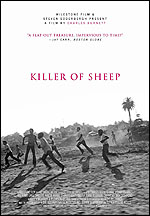
Nov. 6: "Killer of Sheep," 1977, directed by Charles Burnett. This film examines the Los Angeles ghetto of Watts during the mid-1970s through the eyes of Stan, a sensitive dreamer who is growing detached and numb from working at a slaughterhouse. Filmed by Burnett for $10,000 as his master's thesis at the UCLA film school, it could not be distributed because Burnett couldn't afford the rights to the music on his soundtrack. Now, 30 years later, the film has been restored by UCLA, and blown up from 16 to 35mm.
Nov. 13: Full Metal Jacket," 1987, directed by Stanley Kubrick. A two-part drama, the first part of the film takes place at boot camp at Parris Island, where young Marines are transformed into killing machines. The second part takes an unemotional look at urban warfare at the time of the Tet Offensive—the turning point of the Vietnam War.
Nov. 20: "Crimes and Misdemeanors," 1989, directed by Woody Allen. In two separate stories of adultery, a New York doctor resorts to desperate measures to cover up his long-term affair, while an unhappily married documentary filmmaker fights temptation while making his latest film.
Nov. 27: "Divine Intervention/Yadon Ilaheyya," 2002, directed by Elia Suleiman. Several vignettes of Palestinian life in Israel in a neighborhood in Nazareth and at Al-Ram checkpoint in East Jerusalem.
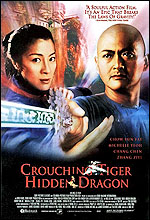
Dec. 4: "Crouching Tiger, Hidden Dragon," 2000, directed by Ang Lee. This martial-arts fantasy and poignant romance tells the story of two warriors in feudal China in pursuit of a stolen magical jade sword and a fugitive. Nominated for an Academy Award for Best Picture, it won for Best Foreign-Language film (for Taiwan), Best Cinematography, Best Art Direction and Best Score.
For further information on the Buffalo Film Seminars, click here.