
Archives
Ecklund tackles hot-button issues
UB sociologist studies race, religion and immigration
By KEVIN FRYLING
Reporter Staff Writer
Elaine Howard Ecklund isn't afraid to take on such hot-button issues as race, religion and immigration to dispel the myths that surround them.
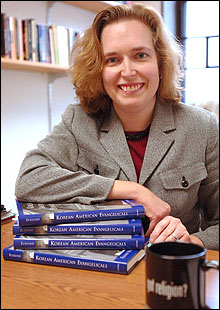
Elaine Howard Ecklund’s first
book, "Korean American Evangelicals: New Models for Civic
Life," was published last month by Oxford University Press.
PHOTO: NANCY J. PARISI
Her two major research projects at the moment are an investigation into the influence of religious beliefs on academic scientists and the effect of Korean-American immigration on Christian evangelicalism.
"I think that we need data on these sorts of issues to inform public discussion in a deeper way than just rhetoric, says Ecklund, assistant professor in the Department of Sociology, College of Arts and Sciences. "These issues are very contentious...but I think it's better to get data out there. I'm a firm believer that data is better than no data."
The recipient of a doctorate from Cornell University in 2004, Ecklund became interested in the influence of second-generation Korean immigrants on American religion through the well-known sociologist Robert Wuthnow, who she studied under at Princeton during a visiting graduate fellowship in 2001-02.
Later, in 2004-06, she received a two-year postdoctoral fellowship at Rice University in Houston, which led to a second project, "Religion Among Academic Scientists," a major $283,549 research grant from the John Templeton Foundation.
Both projects required significant time in the field. The first involved a survey, interviews and participant observation conducted at congregations in the Northeast, Midwest and West Coast; the second more than 270 in-depth interviews and a 1,700-person survey with scientists in seven social and natural science fields at 21 elite research universities—public and private—across the United States.
"It was a lot of hard work," Ecklund says of the research on religion and scientists. "I would typically fly out for two or three days, get a campus map, walk around...and interview people in their offices."
Some interviews were more casual, conducted over coffee; some lasted 20 minutes, others up to three hours.
"People are interested in this topic," she points out. "They seem to want to talk about it."
The project—which has garnered considerable media attention, including articles in The Washington Times and the most recent edition of The Chronicle of Higher Education—asked scientists questions about personal religious and spiritual beliefs, the effect of religion on their teaching and student interaction, and the connection between science and religion.
"There is all this stuff floating around about scientists when it comes to religion," Ecklund says, "but no one had actually asked them."
Although 60 percent of those interviewed were categorized as atheist or agnostic, Ecklund notes that 70 percent still defined themselves as "spiritual."
"One does not exclude the other," she says, but adds that the results—which she calls "surprising"—merited the term "spiritual atheist," a distinction uncommon in the general population.
Scientists often talked about a sense of awe and wonder at the world that went beyond rational and scientific bounds. Yet, the interviewees resisted attempts to be defined.
"The feeling that there is something that goes beyond themselves is not the same to these folks as believing in God in a conventional sense," she explains.
In addition, Ecklund notes a "strong minority" interviewed identified with traditional religions, such as Judaism, Catholicism or Protestantism.
The study on Korean-American evangelicals also brought about unexpected conclusions. "I found that those who remain part of ethnic churches follow the public model of American white evangelicalism," she says, "and those who left the environment of ethnic-only churches tend to model themselves more after black Christians and black church organizations."
The homogeneous congregations leaned toward political conservatism and interest in local community, she explains, while the multiethnic congregations leaned toward broader-based concerns related to social justice.
The increased influence of Korean-Americans in religion in the United States speaks to a larger immigration trend, Ecklund says, pointing out that 40 percent of U.S. immigration in 1990-2000 came from Asia and data suggest 10 percent of the population will be Asian American by 2050.
The common thread among both studies is Ecklund's interest in the influences that cause major institutions to change over time.
"Religion," she says, "is certainly one of our big institutions. Religion just seems to be a powerful force in society right now," she continues. "So it seems natural in some ways when you think about the social world to tie these demographic trends about immigration and changes in race and ethnic composition to religious identities and practice."
This semester, Ecklund has been editing her research on religion among academic scientists into a book. Her first book, "Korean American Evangelicals: New Models for Civic Life," was published by Oxford University Press last month.
She also teaches a 300-level course on "Race and Ethnic Relations."
One of the best parts about joining the UB faculty this fall, Ecklund says, has been the opportunity to teach a student population that is more diverse than that at Cornell or Rice. She calls UB unique in its dual commitment to being a premier research institution, as well as providing affordable education to low-income students.
"Both those things are of concern to me," she says, "and it's hard to find that in the same institution.
"In a class on race and ethnic relations," she continues, "I actually have a class that's racially and ethnically diverse. We have very good discussion; we have heated discussion."
She adds that she learns a lot from her students. "I run it something like a talk show. I call on them for discussion, even though it's a large class. These are such difficult questions in our society; I don't think you can teach without asking the students what they think."
A native of Trumansburg, a small town outside Ithaca, Ecklund has settled in Amherst with her husband, Karl Ecklund, assistant professor in the Department of Physics. The Ecklunds, who sometimes can be spotted out and about on a tandem bicycle, also enjoy other outdoor activities, such as camping and cross-country skiing.
"I'm enjoying Buffalo," she says. "I'm an upstate New York person."