
Archives
Assessing the damage from Katrina
Home from the Gulf Coast, UB engineers post data, model forces from storm
By ELLEN GOLDBAUM
Contributing Editor
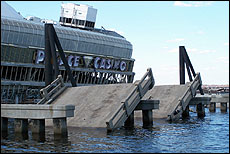
PHOTO: JERRY O'CONNOR
After spending five hectic, sleep-deprived days on the Gulf Coast assessing structural damage to buildings in the wake of Hurricane Katrina, engineers from UB's Multidisciplinary Center for Earthquake Engineering Research (MCEER) have returned home to start doing the scientific work that they hope one day will help curb structural damage from future severe events.
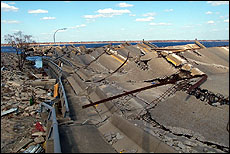
These two photos taken by an MCEER
engineer show U.S. Route 90 over Biloxi Bay between Harrison and
Jackson counties, in Mississippi. The images indicate how the roadway
twisted beforedropping, severely breaking uo the concrete
deck.
PHOTO: JERRY O'CONNOR
The MCEER team, primarily sponsored by the National Science Foundation, focused on damage to bridges and commercial structures in affected areas as a first step toward identifying how earthquake-engineering expertise can be applied to designing structures that will better withstand all kinds of hazards, including hurricanes, earthquakes and terrorist attacks.
Even before leaving Buffalo last week, the MCEER engineers were teleconferencing with other researchers, mostly wind engineers, to decide where they should concentrate their efforts based on where damage was most severe and areas to which they would have access.
Starting when they arrived on the Gulf Coast on Sept. 6, the team posted to the MCEER Web site daily findings that can be viewed at http://mceer.buffalo.edu.
Their findings contain detailed reports and high-resolution photographs of individual structures in Biloxi, Gulfport and other cities along the Mississippi coast that sustained a range of damage, such as the Grand Casino Hotel and parking garage, U.S. Route 90 and the Ocean Springs Hospital.
"Right now, for structural engineers, the Web site is probably the best source of information about damage in some of the affected areas," said Gilberto Mosqueda, assistant professor of civil, structural and environmental engineering and leader of the team.
He and his colleagues hope that the site will spur collaborations between engineers to begin assessing damage from a multi-hazard perspective.
Some of the most costly damage the engineers saw was similar to what occurs after an earthquake.
"Sometimes we will see no major damage to a structure, but damage to equipment and other nonstructural components inside the building that will put it completely out of service and we saw a lot of that on the Gulf Coast," said Mosqueda.
The MCEER group was divided into two teams. Mosqueda, Jerome S. O'Connor, MCEER senior program manager for transportation research; Keith Porter, senior research scientist at the California Institute of Technology; and Paul McAnany, a professional engineer who is volunteering his services as a bridge inspector, comprised a team that investigated the scope of structural damage along the Gulf Coast.
Shubaroop Ghosh of ImageCat Inc. and J. Arn Womble of the Wind Engineering Research Center at Texas Tech University comprised a team that focused on collecting available, remotely sensed data of damage caused by the hurricane and deployed MCEER's VIEWS system to rapidly collect satellite video surveys of damage over large geographical areas.
"Our goal was to go as soon as possible to collect the perishable data before things get moved around and buildings get torn down," said Mosqueda.
To access sites of damaged structures, the engineers, who were carrying institutional credentials, went through numerous military checkpoints.
While Mosqueda had seen plenty of images on television of the damage to structures, he said that seeing the damage to bridges firsthand, in particular, was striking, especially, large heavy pieces of concrete deck that had been thrown a few hundred yards, probably by the storm surge.
"One thing we are going to try and do now is to find out what kinds of forces this storm applied to bridges and other structures near the coast so that we can model them and see what it might take to design bridge decks or building columns that could withstand that kind of damage," Mosqueda said.
In other cases, he said, the storm surge carried floating casinos ashore, smashing them against hotels and parking garages.
"We want to try to better understand how the storm surge comes onshore and applies loads to these structures," he said. "The goal is to find out, 'What would it take to prevent these structures from collapsing?'"
While in some cases, protecting structures may require a system that is specific to a certain type of hazard, MCEER director Michel Bruneau noted that in others, designing structures to resist damage from multiple hazards may be useful from both engineering and economic perspectives.
"When you use one set of goggles to view earthquakes and another to view hurricanes and still another to view blasts from terrorist attacks, then you end up with three different costs that add up," said Bruneau, professor of civil, structural and environmental engineering. "We want to know, 'Are there instances where the logic of multi-hazards can apply?'"
Once the rescue and response phase ends, MCEER will be sending a team of social scientists, environmental experts and specialists in post-earthquake recovery to the areas affected by Katrina to see how they can apply their knowledge to the recovery efforts.