
Archives
Book beckons Scottish curator
Pamela Robertson makes trip to UB from Glasgow to view rare watercolors
By JESSICA KELTZ
Reporter Contributor
During a quiet week in January, with most of the university community away from campus, a museum curator traveled from Scotland to look at one item in UB's Rare Books Collection, examine the original paintings bound between its pages and figure out who commissioned the artist and how it got where it is today.
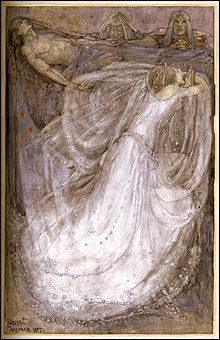
Scottish curator Pamela Robertson traveled to Buffalo recently to view watercolor illustrations by Scottish painter Frances Macdonald McNair bound in a book in UB’s Rare Books Collection.
"We have many unique materials that attract the attention of scholars worldwide and this is just one example," said Nancy Nuzzo, director of music and special collections in the UB Libraries. Although it's more typical for visitors to want to study a group of books or manuscripts, international travelers are not an unusual sight on the fourth floor of Capen Hall, coming perhaps monthly, Nuzzo said.
One such visitor was Scottish curator Pamela Robertson, an expert on the Arts and Crafts Movement, who recently spent three days in Buffalo.
Last year, Robertson began trying to catalogue all of the work of turn-of-the-century artist Frances Macdonald McNair for an exhibition that will open later this year in Glasgow, Scotland. She came upon eight or 10 photographs of watercolor paintings that were unsigned and undated, and began trying to figure out who had painted them, when and for what purpose.
One thing that was immediately clear, she said, was that the photos represented work by either Frances Macdonald McNair or her sister, Margaret Macdonald Mackintosh. The two women and their husbands, Charles Rennie Mackintosh and James Herbert McNair, together formed a circle of influential artists known as "the Glasgow Four," or simply, "the Four."
Robertson is compiling a complete list of Frances' work in conjunction with "Doves and Dreams: The Art of Frances Macdonald and J. Herbert McNair," which will open in November in Glasgow, where the sisters and their husbands lived and worked.
Around the time that Robertson found the unsigned photographs, John Edens, interim UB archivist, had been trying to find information on a few works in UB's Rare Books Collection, also for an upcoming exhibition. He decided to contact an expert in the field to see if the 21 watercolors bound in a special edition of William Morris' book of poems "The Defence of Guenevere" were authentic and how the special edition had come together.
"It was serendipitous to say the least when John Edens from here at UB emailed me," Robertson laughed. "I was pretty much on the phone straightaway."
Robertson's enthusiasm convinced Edens that the paintings, layered between pages of a century-old book bound by a notable art press, were worth looking into further. He had them evaluated and discovered that they were, in fact, original works by the Macdonald sisters.
Robertson, who came to Buffalo with the aid of a grant from the Carnegie Foundation, describes the paintings as "remarkably fresh," as they have not been handled extensively or exposed to daylight often. She said she hopes to work out an arrangement with UB to borrow the book for her upcoming exhibit.
The mystery surrounding this rare book swirls around how it came to exist in the first place and how it found its way into the hands of Thomas B. Lockwood, who eventually donated it to UB.
"Who was it done for?" Robertson said, noting the unusual nature of having original paintings by a fairly well-known artist bound in a work of literature. "It was obviously a very specific commission."
All of the paintings, she said, appear to have been created in 1897 and are equally divided between the Macdonald sisters. But to add to the mystery, the firm that bound the volume was not established until 1901. Additionally, UB has another copy of the same edition of "The Defence of Guenevere," but it has different binding and is not illustrated. Robertson also noted that Morris was a leader in the Arts and Crafts Movement, which encompassed many different media and which was seen as a reaction to the Industrial Revolution.
Some of the materials she has examined indicate that Thomas Glen Arthur, a noted patron of the arts, may have owned the book at one time, Robertson said. But his collection was sold off in 1914, and this work is not listed among the items sold at that time.
"There are some missing pieces in our knowledge," she said. The Macdonald sisters may have done the paintings in 1897 and the book just wasn't bound until years later, she said. Or, it may have been done right away, but then re-bound for some reason.
In any case, Edens said the book eventually became part of Lockwood's collection. UB does have a record of him donating it to the university.
"We don't know where he got the book. We don't know who commissioned the watercolors," Edens said. "That's the real mystery here."
Nuzzo said that within the past 10 years or so, UB's collection has attracted more interest from distant scholars because they can see online what the collection contains.
"Now that we can have finding aids and other means of making these collections known on the Web, we receive many more inquiries," she said. "People find out about us and, a lot of times, the scholars that come here can tell us something about the material we didn't know."