Economics
students take the challenge
UB team makes impressive showing "playing
Greenspan" for the day in NY Fed contest
By SUE
WUETCHER
Reporter Editor
The
six economics students weren't about to let a little thing like plane
fare keep them from "playing Greenspan" for the day.
| |
 |
| |
UB
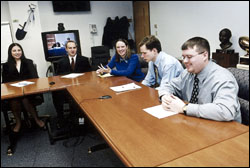
economics students (from left) Elizabeth Dollinger, Tom Hitchcock,
Colleen Murphy, Mike Klingensmith and Joseph Beck wait to be "challenged"
by the NY Fed judges. |
| |
Photo:
Nancy J. Parisi |
| |
|
So
thanks to some high-tech ingenuity, the students last week joined teams
from New York University, Columbia University and Pace University as
participants in the annual "Fed Challenge," sponsored by the Federal
Reserve Bank of New York.
While
the UB team didn't win the competition—that achievement went to
the team from NYU—team members did impress the judges with their
presentation, according to Isaac Ehrlich, Leading Professor and chair
of the Department of Economics, citing a confidential source at the
NY Fed. Moreover, Richard Deitz, an economist with the NY Fed's Buffalo
branch who helped coach the UB team, "also heard good words about our
team" from NY sources, Ehrlich said. A UB team will be invited to participate
in the challenge again next year, he added, noting, "We are already
gung-ho about preparing a winning team for next year. Three of the students
participating in this year's team are continuing their education with
us—they are enrolled in our MA program in applied economics—and
thus will be able to help coach next year's team."
The
challenge offers aspiring economists the opportunity to assume the role
of Alan Greenspan, chairman of the Federal Reserve System, and determine
the Fed's next move on interest rates, based on the relevant macro-economic
environment, Ehrlich said. In fact, each university's presentation mimicked
the Fed's regular meetings, with students recommending that interest
rates either remain stable, go up or go down, depending on a number
of economic indicators, among them unemployment claims, increases in
consumer and government spending, industrial production, saving rates
and retail sales.
Ehrlich
pointed out that while the Fed Challenge has been going on for years
at the high school level, this was the first time it had involved college
students. The NY Fed wanted to include a team from a SUNY institution
in the challenge, he said, and he was asked to organize a team of undergraduate
economics students to participate.
The
greatest "challenge" was not in fielding a good team, he said, but in
finding a way to get the team before the judges. The NY Fed did not
have the money to fly the students to New York City, and an attempt
to hook up with New York via videoconferencing from the Fed's downtown
Buffalo branch failed, he said.
Arrangements
then were made to beam the students to New York via videoconferencing
equipment located in the Furnas Room in Capen Hall.
The
students—Colleen Murphy, Joseph Beck, Michael Klingensmith, Elizabeth
Dollinger, Thomas Hitchcock and Jessica Loh—were calm and professional
during the presentation on March 4, during which they recommended that
the Fed keep interest rates stable, "with a slight bias toward tightening."
Hitchcock
told the judges—Deborah Perlmutter, a senior vice president at
the NY Fed, and Richard Peach, vice president of the bank's research
group—that based on the available data and "our economic intuition,"
the team had come to the consensus that "interest rates should remain
unchanged. We feel that the economy is bottoming out and we expect economic
conditions to improve" as the effect of the Fed's record-setting 11
interest-rate cuts in 2001 continues to filter into the economy.
After
a 15-minute presentation in which the students offered various economic
indicators to support their opinion, they fielded questions from the
judges.
The
students said they had been well-coached by economics department faculty
members Juan Mendoza and Chetan Subramanian, both assistant professors,
as well as Deitz and Ehrlich, and were prepared for the judges' questions.
In particular, Murphy noted, they had anticipated a question about how
the events of Sept. 11 affected the Federal Reserve.
In
response to that question, Dollinger told the judges that the team felt
that consumer confidence was the main issue for the Fed following Sept.
11, noting that consumer spending makes up two-thirds of the GDP (Gross
Domestic Product) in the U.S. economy, which is greatly affected by
consumer confidence.
Klingensmith
added that when the Fed lowered interest rates again after the terrorist
attacks, retail sales picked up in the fourth quarter. "The Fed did
the right thing in boosting consumer confidence," he said.


