Tapping into Spring

While
many eyes focus on the NCAA basketball tournament in March, there is another
kind of "March Madness" taking place. Below-freezing nights and sunny,
warm days provide optimal conditions for sugar maple sap to start moving,
possibly draining into a bucket or through a network of tubes to a sugarhouse,
where it is evaporated over roaring fires and transformed into a regional
delicacy sought round the world—maple syrup.
The
sugar maple (Acer saccharum) is the most common maple species in New York
and provides the brilliant red leaves of autumn. In early spring, the
trees further stimulate our senses with maple syrup derived from their
sap. This leaves little wonder why the sugar maple is New York's official
state tree and appears in the center of the Canadian flag.
As
the daytime temperature begins to rise, starch accumulated during the
previous summer and stored over the winter in the tree's xylem parenchyma
is hydrolyzed by special "contact cells." Hydrolyzed starch products include
the sugar—sucrose—which can reach concentrations of 3-5 percent.
Each tree functions as a primed osmotic pump, with its high concentration
of sugars dissolved in the maple tree's large plumbing network of phloem.
It takes about 42 gallons of sap to produce one gallon of syrup. Cornell
University and the Cornell Cooperative Extension have an outstanding Web
site http://www.dnr.cornell.edu/ext/maple/
that is dedicated to New York's maple forests and maple-syrup producers.
This site also provides access to material on the history, science and
art of maple-syrup production.
| |
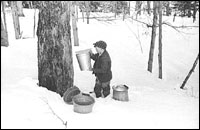 |
| |
|
With
high-quality syrup predicted this season, it is prime time to watch the
maple-sugaring process in person. You can visit any number of maple-syrup
operations in the Niagara region by pointing your browser to "Round the
Bend's" maple sugaring Web site at http://www.roundthebend.com/niagara
/niagsugr.html. You can take a longer country ride to the Chautauqua/Allegheny
region http://www.roundthebend.com/chautauq/
or to New York's Finger Lakes region http://www.roundthebend.com/finger/.
Many of these facilities provide live demonstrations showing maple-sugaring
techniques from the early Native Americans and 18th-century pioneers to
the present-day sugarhouse. Hopefully, your motor trip will be capped
off with buttermilk pancakes hot off the griddle and laden with 100 percent
fresh New York maple syrup.
Yes,
you will be able to buy maple syrup to take back home. Test your tasty
treat in any one of the scores of recipes provided by the folks at Cornell
at http://www.dnr.cornell.edu/ext/maple/Maple%20Tour/Recipes/recipes.htm.
The
Science and Engineering Library maintains a Web site, "Tapping into Spring:
The Science of Maple Sugaring" http://ublib.buffalo.edu/libraries/units/sel/bio/maple.html
for more details on maple sugaring.
—Fred
Stoss, University Libraries
Front
Page | Top Stories
| Research Digest
| Briefly
Electronic Highways
| Letters | Mail
| Q&A
| Sports
Exhibits, Notices, Jobs | Events
| Current
Issue | Comments?
| Archives
Search
| UB Home
| UB
News Services | UB
Today


