Severin
never forgets life of student
Assistant
dean at med school nominated by students for Humanism in Medicine Award
By
DONNA LONGENECKER
Reporter Assistant Editor
It's
easy to understand why UB medical students admire Charles Severin, assistant
dean for student affairs with responsibility for first and second-year
medical students, and easy to understand why they nominated him for
the 2001 Association of American Medical Colleges Humanism in Medicine
Award.
| |
 |
| |
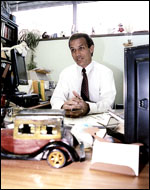
Charles
Severin decided to go to medical school in order to become a better
teacher. "When I lecture to the students, I try to put myself
in their shoes," he says. |
| |
Photo:
Jessica Kourkounis |
| |
|
His
constant message—"Don't ever forget what it's like to be a student"—is
embodied in everything he does, in every class he teaches and in every
personal interaction he has with a student. It's a message he says he
received early on from one his own professors at St. Louis University,
when he graduated with a doctorate in anatomy.
"When
I lecture to the students, I try to put myself in their shoes—learning
information for the very first time as I did in some of the areas that
I felt were difficult, and with that in mind, how I wished the professor
may have presented the information to make it easier for me," says Severin,
an associate professor in the Department of Pathology and Anatomical
Sciences in the School of Medicine and Biomedical Sciences.
In
nominating Severin for the Humanism in Medicine Award, one of his students
wrote: "Without his tireless dedication to the growth of our knowledge,
the patients of tomorrow would be passing into the hands of a new generation
of physicians who are ill-equipped to provide the superior care that
they deserve. More than anyone I have yet had the privilege of meeting,
Dr. Severin exemplifies the highest qualities one could hope for in
a healer and a teacher."
As
one of 56 nominees for the award from across the country, Severin was
thought to possess the five important characteristics of a teacher as
defined by the UB medical school's chapter of the Organization of Student
Representatives: positive mentoring skills, compassion and sensitivity,
collaboration, community service activity and observance of professional
ethics.
Severin's
evolution as a teacher who remains student-focused began when, at age
43, he enrolled in medical school for the primary purpose of channeling
everything he learned as a student back into the classroom as a teacher.
He gave up a potentially lucrative career in family medicine simply
because he loved being a teacher and he wanted to improve the way medical
students are taught.
Severin
says that journey began one afternoon when a former chair stopped him
as he was leaving a gross anatomy lab and asked him why he didn't go
to medical school.
"I'm
too old," was Severin's immediate response. He says he was not enthused
about the idea. But his wife's and his friends' enthusiasm rubbed off
and he thought, "I've got nothing to lose and I do have a reason—I
can use this clinical information in teaching and see what it's like
first-hand to be a medical student."
"I
would hear about the problems students in medical school were having,
but not really understand their problems," he says. "So now, when I
stand up there and see tired eyes, stressful eyes and anxiety, I know
exactly where they're coming from."
There
were no guarantees and it wasn't a free ride. Severin went through the
same application process as everyone else, but with one stipulation—that
he wouldn't take the place of another deserving student. The UB medical
school accepts 135 incoming students every year, and the admissions
office added Severin as number 136. "I didn't have the goal of going
to medical school and then practicing. I was going to go back and use
everything I learned in teaching and working with students," he says.
Severin
tried to keep a low profile for the next four years, but at times that
was difficult. Many of the residents and attending physicians were former
students, and one attending physician even broke out in a sweat when
he realized Severin was now going to be his student.
"I
did have instances where I was treated a little differently, but I didn't
want to be. So when I went to the hospital to start my clinical training,
I didn't let it be known that I was an associate professor of anatomy,"
he says. I was successful, in most cases, of keeping it quiet."
Remarkably,
Severin continued to teach while he was a student, and he admits switching
roles wasn't always easy.
"I
would give a lecture at 8 in the morning, grab my carousel of slides
and go sit in the back of the same room and then take on the student
load," he recalls. After just having finished a 50-minute lecture, Severin
says he might have "zoned out" for 20 minutes into the next class until
a fellow student nudged him to attention. He received a lot of support
from other students, even when they "weren't quite sure who he was or
what he was doing there," he says.
During
his senior year, he was talked into taking a family medicine residency.
"A number of people were saying that if you really want to know what
it's like to be a student, you should do a residency—at least a
year," he says. "I like family medicine because you get to talk to people,
plus there's a lot of variety. A lot of people look at family doctors
as a jack of all trades and a master of none, but they are the first-line
doctors. So I think family doctors get labeled the wrong way—it's
a major responsibility."
Near
the end of the first year of his residency, Dennis Nadler, associate
dean and clinical assistant professor of pediatrics in the medical school,
offered Severin his current position. But the chair of the Department
of Family Medicine tried to talk him out of it, Severin says, because
the specialty requires a three-year residency, with the last two years
being contiguous. Severin was allowed to take a year off before he made
a final decision on the residency. And in the end, he decided to continue
doing what he loved—teaching and working with students.
The
reaction from colleagues was, at the very least, shock. "You spent all
this money to go to medical school and you're going to go back and do
that," he says, recalling the most common response to his decision.
Severin,
however, already had begun in his first year as assistant dean to develop
a hands-on, medical-techniques clinical laboratory course. As a student,
he says, he felt he wasn't fully prepared to do some of the procedures
required of him.
"I
wish I had a little bit better background prior to beginning those clinical
clerkships. I wish I would have known how to draw blood better, how
to start an IV and various other techniques, and to how to interpret
lab results once I got all of the samples back," he says.
The
course is a success, with most of the 135 first-year students having
signed up for it this year. And Severin continues to look for ways to
improve curriculum and the way that it's taught.
While
in medical school, he says, "I did learn how students approach the study
of various courses, including ones that I teach; how they handle the
overwhelming volume of information, and what it's like to stay up all
night, sleep for maybe half an hour, and go to class and try to stay
awake all day long. I learned a lot."
"So
when I stand in Butler auditorium (as a teacher) and I see people nodding
off, or I see people tired, I think back on being awake at 2 a.m. I
think about staying awake all night to study for an exam.
"I
was an older student. I had an older brain—things didn't come as
easily for me as they did for them. I struggled a lot, so I learned
what it's like for those students who struggle. I learned what it's
like to adjust to medical school. When a student comes to me who might
be struggling, the first words out of my mouth are not going to be 'you
should study harder.'"
The
first thing Severin often does in situations like this is to listen
to the student and then find a realistic way of offering help, whether
it's tutoring or consultation with a professor. That is why students
often come to him to discuss not only academic problems, but personal
concerns as well. He offers them confidentiality and, most importantly,
compassion and understanding—the very things they, in turn, will
offer their patients one day.


