Norman Corah, pioneer in research on dental stress
Norman L. Corah, retired UB dental educator and a pioneer in research on patients' dental stress, died March 20 in his Amherst home after a year-long battle with cancer. He was 67.
A recognized authority on measuring, evaluating and treating stress related to dental care, Corah was best-known for developing the Corah Dental Anxiety Scale. The questionnaire, used by researchers and dental practitioners worldwide, is designed to measure scientifically the levels of anxiety individuals experience when faced with a trip to the dentist.
Corah and his UB colleagues are well-known for developing various anxiety-reducing techniques.
One of his most innovative and successful techniques is the chair-mounted video game that patients play to distract them during treatment.
A native of Kenmore, Corah received undergraduate and graduate degrees from UB and briefly taught in the Department of Psychology after graduation.
In 1960, he took a job as an assistant professor in the Department of Psychology at Washington University in St. Louis, becoming chief research psychologist in the Division of Child Psychology and a research assistant professor in medical psychology.
He returned to UB in 1965 as a faculty member in the Department of Behavioral Science in the School of Dental Medicine. He remained a member of the dental-school faculty until his retirement in 1996.
Corah published extensively in professional journals on subjects related to dentistry and psychology.
He was a member of the American Psychological Association, the American Association for the Advancement of Science, the New York Academy of Sciences and Sigma Xi.
The recipient of numerous grants from the National Institute for Dental Research, he was a consultant to study sections at the National Institutes of Health.
Corah was a past president of the Buffalo Health Sciences Chapter of United University Professions.
An expert on American cut glass, he was archivist and a former member of the board of directors of the American Cut Glass Association.
Paul Lohnes, retired professor in education school
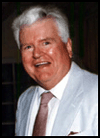
Paul R. Lohnes, a professor in the Department of Counseling, School and Educational Psychology for 30 years, died Feb. 16 in Dover, N.H., after a brief illness. He was 72.
| |
 |
| |
Lohnes |
Lohnes was noted for his many contributions to statistics and vocational psychology, as well as his interpersonal warmth, intellectual depth and sense of humor. Since his retirement from UB in 1993, he and his wife, Kathleen, had traveled extensively and enjoyed their waterfront home on Colony Cove, N.H.
Born in Lynn, Mass., Lohnes completed his undergraduate degree at Yale University and doctoral studies at Harvard. He served in the U.S. Army from 1952-54 and taught at Newton High School in Massachusetts from 1954-56.
In addition to his work at UB, Lohnes was IBM Research Associate at MIT from 1960-62, and served as a professor and director of guidance studies for Project Talent-the first large-scale, national study of American youth-at the University of Pittsburgh from 1965-67.
Lohnes was author or co-author of eight books, eight monographs and more than 50 journal articles, and gave numerous national presentations. In the years prior to his retirement, he had developed innovative procedures for the statistical analysis of causal models in education and psychology.
Lohnes enjoyed a longtime professional collaboration with William Cooley of the University of Pittsburgh, who he had met while they were graduate students at Harvard. The pair created many of the first computer programs for multivariate analysis, which they published in their first book, "Multivariate Procedures for the Behavioral Sciences" (1962), along with descriptions of the statistical procedures and computed examples from their research. It was the first such textbook in that field.
During the next 15 years, they published three more books on various aspects of educational research, building upon their early start in computer applications and data analysis. Lohnes joined Cooley at the University of Pittsburgh, where they worked on Project Talent and produced several monographs dealing with the career development of young adults.
To facilitate their work together, Cooley bought a summer home next to Lohnes' on Colony Cove.
"Since 1956, Paul was a central feature of my career," Cooley says. "It was a great collaboration, stimulated by a kind of mutual respect that few academics ever experience. Even in my retirement, he has had a great influence on my life. My entire family and I will miss him dearly."
Details of a memorial service to be held at UB will be announced.


