While the shortage of nurses in Western New York has diminished in recent years, other issues have revealed themselves as problematic in the field-such as a changing demographic in which fewer young people enter the nursing workforce while the aging population of nurses continues to grow, and the relative attractiveness of the profession to newcomers.
Carol Brewer, associate professor in the School of Nursing, has studied labor trends in nursing since the 1980s. Fascinated by the workforce dynamics at the time, Brewer began work on her doctorate at the University of Michigan in 1987-roughly the same time the country was facing a major nursing shortage-and with a clinical master's degree already under her belt, added a master's in applied economics in the midst of her doctoral work.
Since joining the UB faculty in 1994, Brewer has investigated nursing trends in Western New York and New York State, with a desire to push beyond statistical data and uncover why certain conditions exist.
Right now, the industry is in the midst of a "baby boom bulge," with fewer youth entering the workforce, resulting in a moderate shortage, Brewer said.
| |
 |
| |
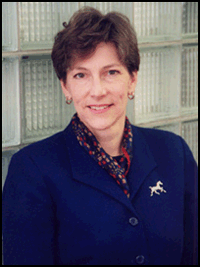
Carol Brewer says the emphasis on working conditions overshadows the great qualities of the nursing profession. |
| |
Photo: Stephanie Hamberger |
"We've got basically a smaller population looking to take care of an aging population, and a large population," she said. Given the relatively high average age in nursing, Brewer said that in terms of a shortage, there are two basic solutions.
"You can change the behavior of nurses who are participating, who are already licensed and in the workforce-you can try to get them to work more," she said. "Or you can educate more nurses so you have a higher volume entering the workforce."
Increasing the numbers, however, is a matter of enticing would-be nurses into a profession that's experiencing a "public-image problem," with its quality of work life on the downslide.
"People coming in.look at all the issues around nursing, and they say, 'Why would I want to work as a nurse when I could work as a teacher, or a social worker, or I could go into business or medicine?'" said Brewer, adding that nursing draws on both new- and second-career individuals.
"How do you say, 'We're having a terrible time in nursing right now...and nurses wouldn't want their own family members to go to the hospital because they don't think the care is good?" she asked. "How do you make those points...and not also give nursing a black eye?"
Brewer, whose commitment to her profession is unflagging, explains that these are legitimate gripes, but publicizing them can overshadow the benefits of the profession.
"Nursing remains a stimulating, exciting and fascinating profession, with many career options-and that is what gets lost when there is so much emphasis about working conditions," she said.
Health-care dollars drive the need for nurses, and when that money began to taper off in the early 1990s-the result of a surge in managed care-downsizing in hospitals occurred.
"The hospital market really drives the need for nursing," she explained, noting that in 1996, for example, 60 percent of nurses were working in hospitals. The decreased demand for nurses was the result of fewer dollars for health care-namely hospitals-and thus, less money to pay for nurses.
The demand for nurses is expanding, she said, but the growth rate for supply has slowed-with no increase in sight. To combat further loss, employers have increased wages. Still, she said, the wages being offered may not be enough to draw in nurses-nor may the kinds of jobs being offered at those wages.
To illustrate: In late 1999, a nursing executive told Brewer the number of part-time positions at a local hospital had doubled, from 30 to 60, and she couldn't fill them. What may seem like a shortage in this case, isn't, Brewer said, noting that changing expectations in the workforce have seen fewer nurses wanting part-time work. Once a strength in terms of flexibility for the majority of the workforce-women-part-time work has become more of a liability, Brewer said.
"(Nurses) expect to be in the workforce their whole lifetime; they expect to be able to work full time," she said.
Brewer herself illustrates the current demographic of second careers in nursing. Now 50-roughly the average age for nursing faculty members, with the average age for nurses at 44-Brewer was 43 when she completed her doctorate and she never considered not working. "When I got out of college, I said, 'I'm not going to be a stay-at-home mom,'" she said. "And I actually made a deliberate choice to go back to nursing after getting my first undergraduate degree in biology."
Since joining the UB faculty, Brewer consistently has examined labor trends. Between 1996 and 1998, she looked at the differences between hospital-employee nurses versus non-hospital-employee nurses in Western New York. And in 1999, she and a colleague at New York University conducted an analysis of state labor statistics for nurses, the results of which were published in the January/February issue of Nursing Outlook. Her latest effort, for which she is seeking funding, will look at labor issues on a national scale.
Building on a model used in turnover research, Brewer plans to investigate retention in the profession and its effects on the work force. The data will be gathered in two parts-once at the beginning of the year, and again at the close of the year-in order to monitor changes. "What is it that makes nurses dissatisfied?" she said. "Or if they're dissatisfied about something, or satisfied, do they act on it?"
What has become apparent to her over the years is the way nursing has become increasingly decentralized-an overloading of tasks outside the primary responsibility of patient care-which, in turn, has led to a devaluing of nurses in the profession.
"There's a message coming out of professional nursing organizations that quality care is a real concern," she said, noting, however, that "we have been a little shrill" in airing that message. Changing the mindset on how to solve problems, she added, won't be easy, given the complexity of issues in nursing.
"I think we have contributed to our own problems in terms of the perceptions of the profession. And it's really too bad because nursing is a great profession."


