Lives of street urchins
UB study finds homeless urban kids healthier than expected
By PATRICIA DONOVAN
Contributing Editor
The
rapid increase in the number of homeless children in cities in the developing
world is a matter of grave concern, particularly with regard to their
physical well-being.
| |
 |
| |
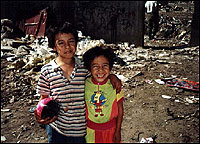
Anthropologist
Timothy Sullivan found that Guatemalan street children like these
two boys were healthier than expected, even though their lives are
fraught with poverty and danger. |
| |
|
A
study by a UB researcher, however, supports earlier findings that although
fraught with danger and poverty, the conditions under which these children
live are more optimal for survival than originally thought.
The
study of the health of urban Guatemalan street children by Timothy Sullivan,
a doctoral candidate in anthropology, was presented yesterday in an
abstract at the annual meeting of the American Association of Physical
Anthropologists being held in Buffalo.
Sullivan's
findings support the contention by other researchers that in developing
countries, these children are in better health and have a better chance
of survival than do their peers who reside in intact homes in agricultural
villages.
He
found that his subjects' average body mass index (BMI), a measure related
to a variety of health risks throughout life, was very similar to that
of American children whose BMI values, as reported by the National Center
for Health Statistics (NCHS), are the standards by which general child
health is judged worldwide.
BMI,
or relative weight to height ratio, correlates with mortality and morbidity
from a variety of causes. The BMI is used worldwide as an index of Chronic
Energy Deficiency (CED), a serious health problem in developing countries.
In addition, it predicts impaired maternal health and lactation, impaired
fetal growth, decreased work capacity and economic productivity, high
rates of chronic disease and mortality.
Sullivan's
study involved 51 street children ages 5-15 who were associated with
a street school in a highland city in Guatemala.
The
children were found to be shorter and weigh less than American children
in their age cohort. However, their BMI was found to be similar to mean
NCHS values. Sullivan said this indicates that although the children's
growth is stunted, the amount of weight carried on that height is about
the same as that of U.S. children of that height whose scores provide
the NCHS values.
The
z-scores used by Sullivan are based on the NCHS standard deviations.
The boys' z-scores for weight averaged 0.90 and for height, 2.6. The
girls' z-score for weight was 0.9 and that for height was 2.0. This
means, for example, that the boy's heights were 1 to 2.6 standard deviations
from the NCHS mean scores.
Although
the z-scores indicate that the children are shorter than the average
American child of the same age, the boys' BMI z-scores were 0.5 above
NCHS values and the girls' z-scores measured 0.0.
A
1996 research study by behavioral biologist Catherine Panter-Brick cited
by Sullivan looked at growth and biochemical markers for physical and
psychosocial well-being among street children of Katmandu. It contrasted
these with those of urban middle-class and rural-village children living
in intact families.
Sullivan's
findings, like Panter-Brick's, confirm that the lives of homeless urban
children are complex, yet less desperate in some ways than previously
thought. He said the research suggests, as Panter-Brick wrote, that
"homelessness may be an appropriate response to circumstances of poverty."
A.G.
Steegman, UB professor of anthropology, concurred.
"The
business of being a street urchin, of making a living on the street,
seems to work better for these children than we might anticipate," Steegman
said. "Their health as measured by their BMIs doesn't prove that they
live a fine life—it is fraught with great danger, including murder
and sexual exploitation, especially for the girls—but it does confound
our expectations," he says.
Whatever
the long-term psychosocial costs of urban homelessness, Steegman said
street boys like those in Sullivan's study appear to trade them off
against short-term survival benefits.
"These
kids are resilient and self-reliant and adapt physically to the difficult
conditions of homelessness," Steegman says. "Although middle-class urban
kids certainly fare better, homeless urban children seem to be doing
better health-wise than they would if they lived in intact families
in poor agricultural communities."


