| VOLUME 31, NUMBER 9 | THURSDAY, October 21, 1999 |


By LOIS BAKER
Baby walkers-the wheeled devices designed to offer babies support while they learn to walk-can be considered a form of early sensory-motor deprivation, slowing both mental and physical development, a study conducted at UB has found.
Roger V. Burton, professor of psychology, and Andrea C. Siegel of Case Western Reserve University, report in the October issue of the Journal of Developmental and Behavioral Pediatrics that because babies in most walkers can't see their feet when they propel themselves, they don't make the connection between the movements they initiate and the results, an important aspect of early development known as visual-motor coupling.
"The idea is that being able to experience the environment unhampered, especially in the six-to-nine month period, is very important to a baby's mental development," said Siegel, who was Burton's doctoral student when the study was conducted. "Being strapped into a walker limits free exploration.
"If you think of all the time a baby spends strapped in-to a car seat, changing table, stroller-and add to that two hours in a walker, which was accumulated in 15-minute segments throughout the day, that doesn't leave a lot of time for babies to practice their motor skills and act on their curiosity," Siegel added.
The study involved 109 babies who were between the ages of 6 and 12 months at initial testing, 56 of whom had used walkers and 53 who had not. The researchers tested the babies in their homes when they were entered into the study and three months later. Psychomotor-development tests measured body control, coordination and manipulation skills, while mental-development tests assessed perception, memory, language-learning, problem-solving and abstract-thinking.
The walker-users fell into two groups: occluding type, with narrow leg openings and a wide opaque tray; or "see-feet" type, outdated walkers with wide-leg openings and a small tray or no tray, which allowed babies to pick up objects at their feet and watch their leg movements.
Results showed that no-walker babies sat, crawled and walked earlier than babies who were placed in occluding-type walkers. The developmental onset of sitting in see-feet-walker babies resembled that of infants who used the occluding-type, Siegel said, while the onset of crawling and walking resembled infants who had never used a walker.
Mental-development scores showed similar associations. Babies in occluding-type walkers had the lowest mental scores, with infants in the see-feet walkers falling in the middle, and the no-walker babies scoring highest.
The researchers also found that, regardless of walker type, early and frequent walker use had the greatest effect on mental development. "Frequent use of a walker at 5 months, which was the age when infants tended to begin using their walkers, continued to predict comparatively lower mental scores in some infants for as long as 10 months," Siegel said.
Will these findings convince parents not to use walkers? Probably not, Siegel conceded. "Maybe they will convince parents to at least start thinking about whether or not the benefits of walker use outweigh the risks."
The study was funded in part by grants from the Diamond Research Fund and the Center for Children and Youth in the Baldy Center for Law and Social Policy at UB.
UB study finds device affects babies' motor, mental progress

News Services Editor
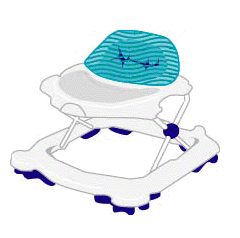 In addition, they found that a walker's characteristic wide tray prevents babies from reaching or examining the very objects they scoot around to inspect. In comparison, babies allowed to crawl have free access to objects that interest them.
Front Page |
Top Stories |
Briefly |
Q&A |
Electronic Highways |
Sports |
Kudos
Exhibits, Jobs, Notices |
Events |
Current Issue |
Comments? |
Archives |
Search
UB Home |
UB News Services | UB Today