| VOLUME 29, NUMBER 2 | THURSDAY, SEPTEMBER 4, 1997 |


Zap go the designs!
New computer tool developed at UB morphs designs of auto, aircraft parts
By ELLEN GOLDBAUM
Like the cartoon kids who zap themselves into Mighty Morphin' Power Rangers, engineers designing complex systems like cars and airplanes can now morph their design representations, thanks to graph morphing-a powerful, new computer visualization method developed at UB.
The researchers also have developed a way to apply virtual reality to this new tool, allowing different individuals to access and modify the same three-dimensional design across a computer network or the World Wide Web.
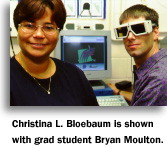
Christina L. Bloebaum, associate professor of mechanical and aerospace engineering and principal investigator, said graph morphing will significantly improve the design process in any industry that produces a complex product, particularly the aircraft and automotive industries. It also will help improve the design and layout of industrial plants, where it will help planners to decide how changes in specific configurations would impact the function of the plant.
Bloebaum, who developed graph morphing with doctoral candidate Eliot Winer, described it at the Second World Congress of Structural and Multidisciplinary Design Optimization in Zakopane, Poland.
She also described the first known application of Virtual Reality and Virtual Reality Modeling Language (VRML) to multidiciplinary design optimization, the field of engineering concerned with making complex, large-scale design more efficient and less costly.
Graph morphing allows designers to transcend the limits of two-dimensional computer screens by demonstrating how changing a variable in a multidimensional design space will affect the constraints and objectives that comprise the design representation of a complex system.
Until now, according to the UB researchers, designers working on such large-scale, complex design projects typically would be restricted to a very scaled-down visualization method that would address only two or three variables out of the entire problem.
"Before we developed this capability, it was virtually impossible to visually judge the impact of a change in a design variable in a complex, multidimensional design problem," said Bloebaum.
"The purpose of graph morphing is to capture in a two- or three-dimensional space on a computer screen both the objectives that are being designed for, such as minimizing cost, as well as the design constraints, such as maximum stresses or displacements or any of the other physical and performance limitations typically imposed in complex design," she said.
Working in the Multidisciplinary Optimization and Design Engineering Laboratory (MODEL) at UB, the researchers first developed graph morphing to apply to two-dimensional designs and then extended it to three-dimensional designs.
The objective is to examine potential trade-offs, situations where a change in one design parameter significantly affects one or more design objectives, constraints or disciplines-such as structures or aerodynamics-in a multidis-ciplinary environment.
"In a complex design environment, you have all these different subsystems that relate to each other in different ways, so when you change a variable over here, it changes what's happening elsewhere," Bloebaum explained. "It can be very difficult to understand those relationships without some sort of visualization capability."
In two-dimensional graph morphing, only two design variables may be plotted on the "x" and "y" axes; the others are assigned to, and controlled by, switches, which function like scroll bars on a screen. A designer can change one of these variables by using a computer mouse to grab the switch that controls that variable.
The image will respond by almost immediately morphing to a visual representation of that change, as well as of the subsequent design changes that modification will cause, as the switch is moved again to new design variable values.
Bloebaum explained that virtual reality takes the power of graph morphing one step further.
She cited the example of a designer working on an aircraft wing who is not sure whether or not the span of the wing should be longer.
"With virtual reality, you can actually reach out and pull that wing longer and then see a representation of what will happen to the design space in three dimensions so that you can move around it and examine it from all angles," Bloebaum said.
News Services Editor
 The new method allows engineers to visualize how changes in their designs will affect design requirements.
Current Issue | Comments? | Archives | Search
UB Home | UB News Services | UB Today