Lani Burkman is changing the way couples in Western New York think about reproduction.
As head of the Andrology Laboratory in the Department of Gynecology and Obstetrics at Children's Hospital of Buffalo, established by Burkman in 1995 under the auspices of the UB School of Medicine and Biomedical Sciences, the reproductive physiologist has devoted her research career to helping couples capitalize on their chance for conception-specifically, by setting her sights on sperm.
Simply put, Burkman is in the business of maximizing semen quality.
| |
 |
| |
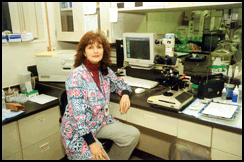
Lani Burkman, shown in the Andrology Laboratory at Children’s Hospital, focuses her work on maximizing semen quality. |
photo: Stephanie Hamberger |
But unlike the goal, the research conducted by the assistant professor of gynecology and obstetrics is anything but simple. Decades of dedication to the field of reproduction and discovery upon remarkable discovery have provided Burkman with unique insight into the workings of those male cells whose foremost mission can be thwarted by any number of factors.
Her most recent research with collaborator Herbert Schuel, professor of anatomy and cell biology, has focused on the effects of anandamidea naturally occurring cannabinoid-like substance in both men and women-as well as THC, one active substance found in marijuana, and how each affects human sperm function. The latest recipient of UB's Moir P. Tanner Award, Burkman-working with Schuel and Alexandros Makryannis of the University of Connecticut and Daniele Piomelli of the University of California at Irvine-plans to use the $9,000 grant to continue her research, which has shown that anandamide may have regulatory effects on the sperm's potential for fertilization.
The Tanner award, granted through the Office of the Vice President for Research, provides research funding for projects related to health-sciences issues.
Burkman also just received a $700,000 grant from the Philip Morris Research Foundation to focus on the effects of nicotine on sperm fertilizing ability.
"We have just shown that anandamide is found in semen and in female reproductive fluid," she says. "We're the first to show that it's right there (in humans) where it counts for fertilization." Burkman has had other firsts as well. She was first in the world to show that human sperm have hyperactivated swimming-something thought previously to exist only in animals-which is required for fertilization.
In short: It's all in the swimming. Sperm that demonstrate a vigorous swimming pattern, required to achieve capacitation-the ability to fertilize-have a greater success rate than those with weaker tendencies. In her laboratory, Burkman focuses on those factors that inhibit or stimulate hyperactivation, and has developed several assays-or tests-to recognize and remedy the shortcomings of the sperm.
For example, Burkman will look at the morphology of a patient's sperm sample to deduce how many have a normal shape. Sperm with an abnormal head or tail shape usually can't fertilize an egg. And a swollen sperm cap, which contains enzymes-the acrosome-may prevent the sperm from successfully penetrating the egg membrane. Sperm may undergo a wash-and-incubation procedure to see what percentage maintain hyperactivized motility after the process. Burkman also may conduct a split-ejaculate test-noting that the first third of the semen usually contains all the sperm, while the last two-thirds is fluid only-to gauge potency.
Burkman is a pioneer in motility software usage as well, employing computer-automated sperm analysis to most accurately measure the sperm's motility and velocity.
"There are no other labs in the region that employ the gamut of tests that we do," Burkman notes proudly. "Standard sperm-testing laboratories, by limiting themselves to just sperm counts-what percentage are moving-cannot predict whether the husband is fertile.
"We have a good handle on predicting what the future is for those sperm," she says of the techniques, which range from basic to complex. "It's awfully nice that we can try little things to stimulate sperm, to maximize the semen quality so that (couples) can best have a chance to achieve pregnancy."
As a doctoral student at the University of California in the late 1970s, Burkman became hooked on reproductive research, and in 1982, went to Norfolk, Va., where the country's first in vitro clinic was started. She spent the next eight years studying human sperm in that context.
While in Virginia, she developed a new assay in the field-one she uses in her laboratory work today-called the hemizona-binding assay. Using a non-living human egg, researchers split the egg cover in half and compared the number of sperm that bound to the outside of the zona-or egg's surface coat-from a fertile man versus that of a man believed to be infertile. Exciting as it was, Burkman says federal funding of sperm in vitro work was not supported by the Reagan Administration, which essentially banned grants for any kind of fertility work having to do with embryos.
Left without a research grant, Burkman shifted her course and ended up as a corporate scientist at a Grand Island research company, where she spent four years developing products for fertility laboratories. In 1995, Burkman joined forces with Frank Gonzalez and Kent Crickard, reproductive endocrinologists who ran an in vitro fertilization clinic at Children's Hospital. Shortly thereafter, Burkman opened the Andrology Laboratory, with a secondary interest in toxcity testing.
"The timing over the last 20 years has been very important," she says of the developments resulting from in vitro work. "We are able, in our laboratory, to answer specific questions about how the husband's sperm are functioning, and to give specific feedback to the physician as to what to expect.
"We're a fairly new laboratory, and we want Western New York physicians and couples to know that there are tests available to give real answers."


