When Sidney Poitier was born prematurely on Feb. 20, 1927, in a clapboard house in Miami, everyone-save his mother and a stranger-believed his chances for survival were slim. Even his own father, who had lost several children previously, brought home a shoebox to serve as the tiny boy's casket. His mother, more indignant than despairing, found hope for 50 cents in a last resort-a palm reader.
Poitier, holding captive an audience of nearly 3,000 in Alumni Arena on March 14, described the moment after which a long, uncomfortable silence had passed between his mother and the woman.
"And then all at once, her eyes flew open again, and she said: 'Don't worry about your son. He will survive and he will not be a sickly child. He will travel to most of the corners of the earth. He will walk with kings. He will be rich and famous. Your name will be carried all over the world.'"
| |
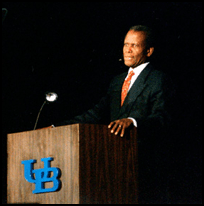 |
| |
Oscar winner Sidney Poitier told a UB audience on March 14 that he went to Hollywood "on his terms." |
| |
Photo: Frank Miller |
One could say that despite the odds stacked against him, Poitier-the first African-American male to win an Oscar-came into this world on his own terms.
Truly stranger than fiction, and perhaps more outrageous than anything Poitier experienced in the cinematic world of make-believe, is his life-according to Poitier himself, whose lecture to commemorate Martin Luther King Jr. was included, for the first time in its 25-year history at UB, in the Distinguished Speakers Series. For 51 of his 74 years, Poitier has been defined by his celebrity, but the stories he told his UB audience had more to do with the man behind the scenes.
"Unlike Dr. King, most famous people are not known outside the frame of their celebrity," he said. "What, then, were they before celebrity happened by?"
A relaxed Poitier, eyes welling up with the memory of his youth, revisited the journey from childhood to manhood-one influenced largely by his mother, Evelyn.
"She was instinctual in her nurturing, her discipline, her molding," he said. "I was a restless boy with a fair amount of imagination and no common sense. But she never gave up. It was in her nature, her personality, to work on me.
"The proof is in the living, the lessons were in the journey, paid for each day, each hour of those 74 years, while the man that I am was being built from being inside the restless boy," he said.
From the moment he was born, and including the exceptional circumstances of that occasion, Poitier's life has been what he said he can describe only as "weird."
Poitier, the youngest of eight children, nearly drowned-said tongue-in-cheek-at his mother's hands when he was just a baby. The "method to her madness," he later understood, was teaching him to swim-to survive, essentially-given their proximity to the ocean. And the beloved actor who starred in the timeless favorites "A Raisin in the Sun," "To Sir, With Love," "Guess Who's Coming to Dinner" and "Lilies of the Field"-for which he won the Oscar for best actor in 1963-was jailed three times; once each in New York City, Florida and the Caribbean. Left for a later discussion at which he never arrived, Poitier intimated, however, that details could be uncovered in his memoir, "The Measure of a Man."
But perhaps the most endearing story told by Poitier was how he was acquainted with what became his livelihood. Having just moved with his family from the semi-primitive Cat Island in the Bahamas to Nassau, Poitier said he found himself overwhelmed by a host of luxuries he had never known: electricity, running water, cars, radio, ice cream-and the matinee.
When his new friends invited the 11-year-old to a "matinee," Poitier admittedly was stumped.
"I had no idea what it meant," he said. "But I wasn't about to show them my ignorance."
His first picture, a cowboy film, put Poitier in fits.
"I (had) no idea how they got all those people and those cows in (that) little building," he said laughingly of his first impression.
Those boyhood years, Poitier said, served as the foundation on which his life was built. And while he may have been without a clue, he explained, his mother's rearing encouraged him to get a handle on the big picture.
"Stars are what I saw," he said. "And lots of them, too. I was in my teens before I got the big picture."
That big picture brought Poitier to Hollywood for a career that would span nearly 60 films. His accomplishments in film speak to a consciousness of, and attention to, issues of race and social conflict. And in being selective about the roles in which he was cast, Poitier raised the bar for other actors who followed. Poitier said he clung not only to his parents' value system, but also to the hope that one day he might command the respect and exude the dignity of his two biggest film influences-Canada Lee and Paul Robeson.
A lack of power within the industry, however, did not detract from Poitier's acting convictions. "I would say no to anything that was not favorably reflected on my values," he said.
And like the day he was born-Poitier endured.
"I went to Hollywood," he said. "This might sound, and it isn't, immodest. I had nothing. But I went to Hollywood on my terms."


