"Usonianism" to be topic of art history talk
Roland Reisley, a founder of community designed by Frank Lloyd Wright, to speak
By PATRICIA DONOVAN
Contributing Editor
"Usonianism,"
an architectural style that articulated Frank Lloyd Wright's social
and economic principles of "usonian democracy," is well-known to Wright
aficionados but far less familiar to the general public.
| |
 |
| |
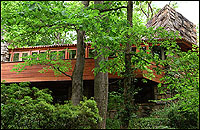
Roland
and Ronnie Reisley built the Reisley House in the usonian community
of Pleasentville, N.Y., with their honeymoon money in 1951. They
still live in the house. |
| |
|
The
small, pleasant and unique community of "Usonia," designed by Wright
and constructed more than 50 years ago in Westchester County, is likewise
not well-known, but demonstrates Wright's profound influence on middle-class
residential architecture and architectural thought over the past 70
years.
One
of the founders of Usonia is physicist Roland Reisley, the author of
a recent book, "Usonia, New York: Building a Community with Frank Lloyd
Wright," and a founding secretary and director of the Frank Lloyd Wright
Building Conservancy.
In
the book, Reisley tells the story of a cooperative of idealistic young
couples which, following World War II, enlisted Wright to plan "Usonia,"
an organically designed utopian community near the Westchester town
of Pleasantville.
The
Department of Art History in the College of Arts and Sciences will present
a lecture by Reisley at 7:30 p.m. Tuesday in the Buffalo and Erie County
Historical Society, 25 Nottingham Road, Buffalo. The talk will be free
and open to the public.
Usonia
has 47 homes, three of which were designed by Wright. He approved the
plans for the other 44, however, so that all reflect the close association
of naturalism and functionalism common to Wright's work.
The
community represents the strong anti-urban attitudes espoused by Wright
throughout most of his life.
"Wright
claimed to hate cities and said they should be abandoned," explains
Wright scholar and author Jack Quinan, professor of art history.
"He
proposed that rampant urbanization be halted through the development
of well-designed, low-density, efficient, semi-agrarian communities,"
Quinan says. "Wright coined the term 'usonian' to describe these communities
and proposed they be governed by the social, political and economic
system he referred to as 'usonian democracy.'"
Usonian
residences were designed to be economically and energy efficient within
their individual climate zones. Wright perceived the architectural "problem"
posed by each project as one with a "natural" solution derived from
the function of the building and nature of the site.
The
influence of traditional Japanese architecture commonly found in Wright's
designs prevails in usonian structures as well, and can be seen in the
open floor plans, flowing interiors with movable screen partitions,
emphasis on natural light, overhanging eaves and shallow-pitch roofs.
"Most
of the residences have one story or maybe a split-level floor plan,"
Quinan says. "They originally were conceptualized as middle-class houses
for middle-class clients, but since Wright was well-known for his cost
overruns, some were more expensive than originally planned."
Although
the houses have changed hands over the years, Quinan says Usonia remains
a very attractive cooperative community where neighbors have property
in common—a swimming pool and tennis courts, for instance. They
also make certain decisions together.
In
1951, when Reisley and his wife, Ronnie, decided to spend their wedding
money on a hillside home designed by Wright, they took a chance on the
latest wave of the radical ideal of cooperative living.
Their
decision was well taken. The Reisleys still live in Reisley House, which
they helped put on the architectural map, along with the social experiment
that gave rise to its creation.


