Providing
insight into physics of combustion
Simulations are closest to turbulent flows that
occur in hydrocarbon combustion
By
ELLEN GOLDBAUM
Contributing Editor
The incredible
complexity of turbulent combustion has made modeling it and systems
in which it is important a goal that researchers know probably won't
be reached in their lifetimes.
| |
 |
| |
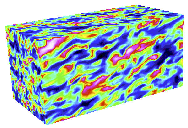
Researchers
in UB's Computational Fluid Dynamics Laboratory have simulated turbulent
reacting flows that will provide insights into the physics of internal
combustion. |
| |
|
The reason
is that in turbulent combustion, the difficulties of modeling turbulence—by
itself one of the most challenging problems in physics—are further
compounded by the complexities of strong, non-linear interactions between
turbulence and the chemical reactions that occur during combustion.
Using a
computational method called direct numerical simulation, Cyrus K. Madnia,
associate professor of mechanical and aerospace engineering, and his
colleagues in UB's Computational Fluid Dynamics Laboratory have performed
simulations that are the closest to date to a true model of the physics
of chemically reacting turbulent flows.
The work,
published in the current issue of the Journal of Fluid Mechanics,
comes closest to mimicking the turbulent reacting flows that occur in
hydrocarbon combustion without taking into account complex chemistry.
Knowledge of how these turbulent flows affect internal combustion could
improve greatly the efficiency and environmental impact of all kinds
of engines.
"In reacting
turbulent flows, this will be the benchmark," said Madnia, lead author
on the paper.
The simulations
by the UB researchers come the closest to mimicking hydrocarbon combustion
since they demonstrate a defining feature of combustion: how the heat
of reaction affects the exchange of energy in a turbulent system.
In every
engine or furnace, combustion causes the release of heat, which results
in an increase in internal energy. At the same time, the turbulence
in the engine is producing kinetic energy.
"Between
internal and turbulent kinetic energy, there is a continual exchange,"
said Madnia. "How these two fields exchange energy with each other constitutes
the basic physics of turbulent reacting flows."
Madnia
cautioned that the flows that he and colleagues have simulated do not
account for the incredibly complex chemistry of combustion, which involves
hundreds of chemical reactions.
"Several
decades from now, we still will not be able to simulate internal combustion,"
he noted.
"But with
this research, we are pushing the limit of direct numerical simulations
for simulating turbulent combustion."
Unlike
the group's previous work with nonreacting flows, where the researchers
could "check" their results against those of laboratory experiments,
these simulations cannot be compared with laboratory experiments because
none exist.
According
to Madnia, the goal of the research is to gain a better understanding
of the two-way interaction between chemistry and turbulence in order
to develop more realistic models of the fluid mechanics and chemistry
involved in combustion.
"With this
work, we have helped push that frontier a bit further," he said.
Co-authors
on the paper are Daniel Livescu, formerly a doctoral candidate in the
Department of Mechanical and Aerospace Engineering who now is at Los
Alamos National Laboratory, and Farhad A. Jaberi, formerly a post-doctoral
researcher at UB who is an associate professor of mechanical engineering
at Michigan State University.
This work
is sponsored by the National Science Foundation and by donors to the
Petroleum Research Fund administrated by the American Chemical Society.


