research news
UB receives NSF grant aimed at making scientists more relatable to students

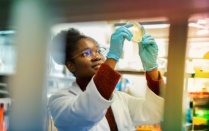
Portrayals of scientists — like this photo of a student working in a UB chemistry lab — can make scientists more relatable. Robin Costello, assistant professor in the Department of Biological Sciences, has received a grant to study how portrayals of scientists affect student engagement in STEM. Photo: Douglas Levere
By TOM DINKI
Published October 7, 2026

How do you make a scientist more relatable?
They can often seem like brilliant but distant figures who understand the world in ways most of us can’t. But research suggests that helping students relate to scientists can increase their interest and engagement in science and help them envision themselves pursuing a career in science, technology, engineering or math (STEM).
That’s why UB researcher Robin Costello is developing ways to better measure how students perceive scientists. A principal investigator on a new four-year, $1.16 million collaborative grant from the National Science Foundation, Costello aims to create the first validated instrument for measuring how undergraduate STEM students perceive scientists and use it to determine which portrayals of scientists are most effective.
“The goal is to help guide the design of instructional materials that can make a career in science feel more attainable to students and, ultimately, increase participation in the nation's scientific workforce,” says Costello, assistant professor in the Department of Biological Sciences in the UB College of Arts and Sciences.
The project is in collaboration with Cissy Ballen, associate professor of biological sciences at Auburn University. The grant will bring $473,489 to UB.
The project builds on Costello and Ballen’s earlier work looking at how students perceive scientists. In a study published last year, they found that photos alone weren’t enough to make scientists relatable to students. Instead, humanizing information about the scientists’ backgrounds was needed to help students relate to them and better engage with the class material.
Still, researchers don’t know exactly what makes some portrayals of scientists more effective than others.
To find out, this new project will create a validated measurement instrument and provide empirical evidence about what makes scientists relatable. Costello, Ballen and their collaborators will do this through large-scale experiments with undergraduate biology, chemistry and physics students across the country.
They will develop a survey instrument to measure how these students perceive scientists, including how competent and relatable they find them and whether they view the scientists’ success as attainable.
Next, they’ll provide students with different portrayals of scientists in the widely used textbook “Biological Science” and use the survey instrument to examine whether these portrayals affect students’ interest in pursuing a STEM career.
“We want students to feel as if a career in STEM is attainable,” Costello says. “Understanding how to portray scientists as relatable people with careers that are attainable could go a long way toward achieving that.”