Department of Communication Newsletter 2025
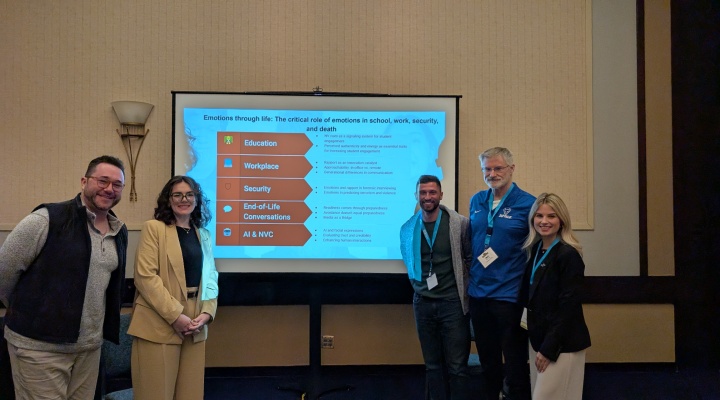
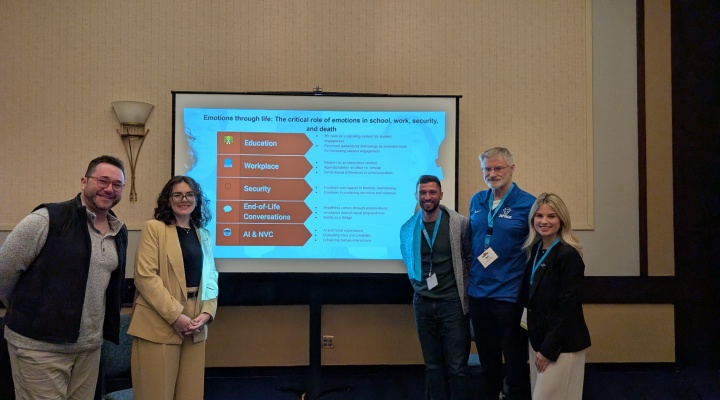
Scholars coming together for a weekend of panels, networking, and research on AI, education, politics, health and workplace dynamics at the Eastern Communication Association Convention.
In this Issue:
Give to the Department of Communication
You can support your department and help to provide for our students by making a gift online.
As we begin the new academic year, we are celebrating the recent accomplishments in the department and looking toward another great year. Our students and faculty have been busy, not just learning and teaching but also winning awards, recording podcasts, leading research and shaping conversations about communication in the digital age.
Our graduate and undergraduate students recently shared their outstanding work in the Celebration of Student Excellence, and doctoral student Tahleen Lattimer won the 3-Minute Thesis competition, showcasing both her research and communication skills!
Last spring, we hosted the Moral Media Conference, which featured keynote speakers from around the globe. From neuroscience to film studies, scholars explored how media shapes our sense of morality. Our students and faculty also made a strong showing at the Eastern Communication Association Conference, also right here in Buffalo.
We're also thrilled to be part of UB’s new Department of AI and Society. Our new degree program, AI and Responsible Communication, will teach students how to use AI thoughtfully and ethically. New courses, including "Media Literacy in the Age of AI" and "AI as Medium & Communicator," are launching this fall, with more to come in the spring.
For undergraduate students, we welcome you to get involved in the Communication Undergraduate Student Association (CUSA) or internships (see Dr. Lance Rintamaki or Undergraduate Advisor Azita Safaie for details). If you’re interested in research experience, connect with your professors or check out opportunities through the Experiential Learning Network.
Best wishes for a wonderful year!
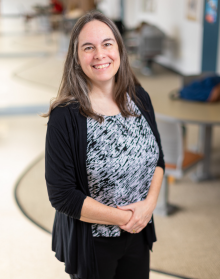
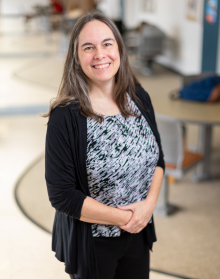
Melanie Green, PhD
Professor and Department Chair
Department of Communication
Moral Media Conference
We were proud to host the eighth annual Moral Media Conference, welcoming scholars from around the globe to explore how media influences morality. The event featured keynotes from thought leaders in communication, psychology and media studies, with discussions that tackled the intersection of media, values and decision-making.
Why media and morality?


The event brought together 23 institutions across six countries and continues to grow as an international hub for scholarship. Co-sponsored by the Office of International Education and the Media Psychology and Morality Lab, the conference is quickly becoming a global fixture in the field.
Two new AI undergraduate courses
The department is pleased to announce two new AI courses this fall:
Media Literacy in the Age of AI
This course examines how AI, like algorithms and generative tech, is changing the way we create and consume media. Students explore core communication theories, tackle real-world ethical challenges and build the critical skills needed to spot misinformation and produce responsible content in a digital-first world.
AI as Medium & Communicator
This course explores how AI shapes our world and how we communicate with it. Through lectures, skill labs, and a capstone, students will study AI’s evolution, ethical challenges, human-AI interaction, and practical tools for success in school and beyond.
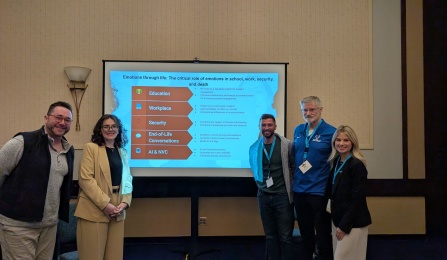
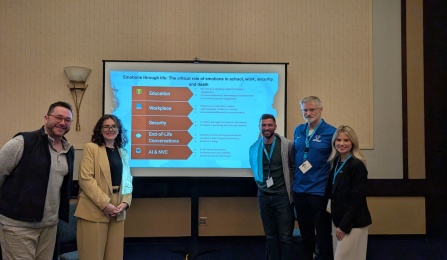
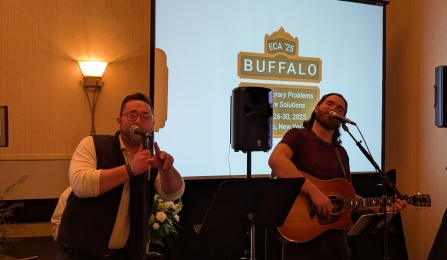
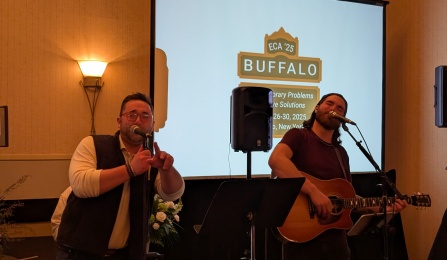
Eastern Communication Association Convention Comes to Buffalo
Buffalo hosted this year’s Eastern Communication Association (ECA) convention, bringing together scholars for a weekend of panels, networking, and research. Founded in 1910, ECA is the nation’s oldest professional communication association. The 2025 theme—Contemporary Problems, Creative Solutions—challenged scholars to tackle today’s issues using communication tools. Topics included AI, education, politics, health, and workplace dynamics.


Zach Carr hosts the “Conversations about Communication” podcast, exploring how communication shapes our world. From human interaction to media tech, each episode features scholars, professionals, and students.


Janet Yang received the Chancellor’s Award for Scholarship and Creative Activities—an honor well-earned for her groundbreaking work in risk and science communication.


Hua (Helen) Wang has been named a Fulbright Scholar and will spend the spring in Norway doing innovative work on technological advances that promote storytelling for social impact. Her work continues to make waves globally.


Yotam Ophir has been awarded the inaugural Chancellor’s Horizon Award for Faculty Research and Scholarship—recognizing early career faculty making significant impacts with long-term promise.


Christine Tinnesz and McKenzie Vorpahl were selected as 2025 SUNY Online Teaching Ambassadors, honoring excellence in virtual education and leadership in SUNY’s teaching community.


Alison Zhou brings fresh energy to our department. A health and interpersonal communication researcher, she joins us from Penn State and is already making an impact. She’s teaching Persuasion and Research Methods and is eager to offer a grad-level course in Structural Equation Modeling. Her research focuses on persuasive messaging and decision-making in health contexts. When she’s not in the classroom or the lab, she’s likely exploring Buffalo’s coffee scene or walking through Delaware Park.
Can you tell me a little more about yourself?
I'm a social scientist studying health and interpersonal communication, with a focus on social influence and social support. I received my PhD from Penn State. Before moving to The U.S., I got my MPhil from the Chinese University of Hong Kong and my BA from Shanghai International Studies University. I grew up in Rugao, a small city along the Yangtze River in Jiangsu Province, China.
What drew you to Buffalo and to UB for this position?
The fantastic faculty and the opportunity to collaborate with such brilliant minds. The research community here is top-notch, and I was really excited about contributing to it.
What has your transition to Buffalo and UB been like?
It's been awesome. Everyone here has been super welcoming and supportive, which made settling in easy. Plus, my years in State College (where Penn State is) prepared me well for Buffalo's winters - I'm no stranger to snow:)
What courses are you teaching or would like to teach in the future?
Right now, I'm teaching Persuasion, and I have also taught Research Methods here. In the future, I'd love to teach a grad course on Structural Equation Modeling.
Can you tell us about your previous and current research?
My research primarily focuses on persuasive messages and how they can (or fail to) change attitudes and behaviors, especially in health and risk contexts. Recently, I've been looking into the impact of conflicting information (especially in the form of advice) on health decision-making and exploring ways to help people make better choices despite all the noise.
What motivated you to become a professor?
I've always loved doing research and sharing knowledge and ideas, and being a professor lets me do both.
What are some fun hobbies or activities you enjoy outside of your professional responsibilities?
I love watching movies, traveling cooking, and spending time with my two cats.
What are your favorite Buffalo 'hot spots', restaurants, parks, art, etc.?
I'm still getting to know the city, but I definitely enjoy a good walk around Delaware Park and spending some quiet time reading/writing in the cafes along Elmwood.


Message from the Director of Graduate Studies
Greetings from Buffalo, New York, the home of breathtaking natural beauty, stunning mid-century architecture, world-class museums and theaters, and the #5 ranked1 department of communication in the United States!
At UB, we study communication as a science. We investigate a variety of communication phenomena through empirical, social-scientific research methods and advanced analytic techniques. Our graduate faculty members are internationally recognized experts in:
- Narrative communication and social influence (e.g., media processes and effects, narrative persuasion, entertainment-education)
- Science, health, environmental, and risk communication (e.g., risk perception, risk analysis, innovative interventions, campaign/program evaluation)
- Digital and social media (e.g., technology and well-being, social networks, computational research)
- Political communication (e.g., mediated public discourse)
- Misinformation and society (e.g., mass and social media, morality, and extremism)
- Nonverbal communication (e.g., facial expressions and deception)
- Interpersonal communication (e.g., social support, and end-of-life communication, close relationships)
- Media psychology of entertainment (e.g., media entertainment and morality, positive media psychology)
But our faculty members are not only great researchers, they are also great mentors. As a testament to the collaborative environment that we have built in our department, our students routinely present at (inter)national conferences, publish in high-impact journals, and pursue meaningful careers in academia, business, and government. Our graduate students are also incredibly supportive of one another through personal networks, various research groups and labs, and our Communication Graduate Student Association.
If all of this sounds good to you, we encourage you to apply. We admit new students once a year. The deadlines to apply for our graduate programs are:
- PhD applicants: December 1
- International MA applicants: April 1
- Domestic MA applicants: August 1
Please browse our website for tips on completing your application, frequently asked questions (FAQs) for MA and PhD applicants, and detail on our graduate faculty and student-led research. If you have any further questions about our graduate programs, do not hesitate to contact me at any time.
Wishing you only the best,
Arthur A. Raney, PhD
Professor and Director of Graduate Studies
1 In 2024, UB’s Department of Communication was ranked #5 of 144 (or 97th percentile) communication departments in the United States by Academic Analytics’ Scholarly Research Index, which combines metrics of faculty publications, grants, awards, and citations.
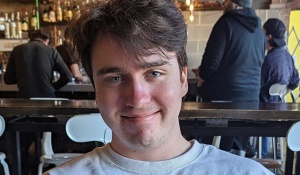
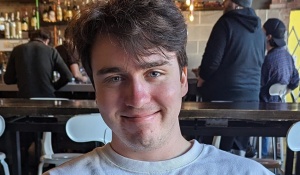
Kyle Heneveld has been at UB for nearly a decade—and he’s just getting started. A strong voice in health communication, Kyle’s research digs into how people seek and manage information in moments of uncertainty. He’s also leading work on how humor shapes responses to hate speech.
Tell me a little about yourself and your academic journey so far.
My name is Kyle Heneveld and I’m a second-year PhD student in the Department of Communication at the University at Buffalo. Though, I’ve been a student at UB for about 8 years now. I completed both my undergraduate and master’s degrees as a communication student here.
When I was a master’s student, I spent my first year working part-time as a grill chef at Chipotle to pay for rent and sustain my studies. During Mondays in my first semester, I remember working 8am-3pm at the grill, showering quickly at the gym where I had a membership, and then rushing to campus where I had two back-to-back classes from 4-9:30pm. Thankfully, during my second year, I was able to work as a graduate assistant in the Tutoring and Academic Support Services center. That meant more time on campus and more availability for other projects while assisting in UB programs which benefitted disadvantaged students. I also worked part-time as a graduate ambassador, answering questions about the College of Arts and Sciences to prospective graduate students.
As a PhD student, I’m the current president of the Communication Graduate Student Association and I’m still working as a graduate ambassador. Over the summer of 2024, I was a member of the Social Impact Fellowship program, where I worked with students from other disciplines to leave an impact on the greater Buffalo community. Particularly, we worked with the Erie County Department of Senior Services (ECDSS) to assist them with their Needs Assessment of older adults in the county. Now, I spend much of my time learning and applying models of how individuals manage their uncertainty in a range of contexts.
Why did you want to pursue graduate study in Communication?
When I was an undergraduate student, I became a teaching assistant for an interpersonal communication course with Dr. Vorpahl during my junior year. I found that I thoroughly enjoyed topics surrounding disclosure decisions and uncertainty management in health communication. After some time, I spoke with Dr. Rintamaki to discuss my options as a student who thoroughly enjoyed difficult conversations in health communication.
Thankfully, Dr. Rintamaki was eager to assist me in discussing the potential for graduate school as an opportunity to learn more about health communication. I then applied for a master’s degree in communication at UB and thoroughly enjoyed learning about the research process. After continuing to learn about health communication at the graduate level, I was certain I wanted to pursue a PhD and have a career in research.
What made you choose UB’s program?
When I applied to the master’s program, my decision to stay was mostly guided by my familiarity with the faculty and the location. However, when I chose to stay for my PhD, I think the biggest contribution to my decision was the engaging collaborative environment with faculty and other students. When I traveled to conferences during my master’s program, I learned first-hand from students of other research institutions that the intensity and competitiveness of their programs could be a negative influence on their mental health and personal lives. While a PhD program at any school is certainly rigorous, I took comfort in that I felt as though other students in my program weren’t my competitors, but friends and collaborators. Ultimately, that comfort is what guided my decision to stay at UB for my PhD.
What do you like most about the program? Favorite classes/subjects/professors
My favorite classes have certainly been Dr. Yang’s Risk and Science Communication courses. Investigating factors which influence how individuals process information pertaining to health, risk, and science is an incredibly fascinating area of research.
What are your goals/career objectives?
My goal is to be a professor at a research institution. For my research objectives, I’m really interested in the role that efficacy and emotions have in managing health information. So, I’d like to make a strong contribution to information management research on that front.
Are you involved in any research?
Yes! Most of the projects that I lead involve applications of the theory of motivated information management (TMIM), which examines varied responses to uncertainty within interpersonal contexts. However, I also have interests in the role that humor plays in the processing of hateful messages.
Do you have a focus in Communication that you would like to specialize in?
Overall, most of my research is in health and risk communication. Particularly on how individuals seek, avoid, and process health or risk information. In the future, I want to be an expert in how individuals manage their information in interpersonal contexts (e.g., with their care providers or family members).
What projects/research are you currently working on?
Right now, most of my research applies the theory of motivated information management (TMIM) in health contexts. In assistance with the Erie County Department of Senior Services, I’m interviewing caregivers of individual’s with Alzheimer’s to examine their information management behaviors as they pertain to their caregiving journey. I am also working on an independent study to apply the TMIM to examine a potential moderating effect of age on the relationships proposed in the model. Outside of the TMIM, I have recently submitted a paper which applies the risk information seeking and processing model to examine variables which influence the information seeking and avoidance process regarding mental health in young adults.
In a separate context, I am also leading a project to examine the role that humor plays in the processing of hate-based extremist messaging. There’s been some really cool research which suggests that humor can delay perceptions of hostility within messages and we want to further examine the role that humor plays in this context.
What are your favorite parts of Buffalo? Buffalo ‘hot spots’, restaurants, on campus, hidden gems in the Buffalo community.
I am fortunate enough to live very close to some of the best cafés Buffalo has to offer. On days when I work off-campus, I often go to Remedy House or 5 Points Bakery. 5 Points Bakery has free refills on a standard cup of coffee, which is quite the life hack for a graduate student.
What advice would you give someone considering a master’s or PhD?
Reach out to graduate students in the program. One of the best ways to understand the culture of the department is to speak to the students which participate it in. If you know the professor you’d like to work with as your advisor, meet with them before the program starts so you can hit the ground running.


Yi Yin Leong is researching health communication in minority populations, with a focus on how online discussions shape sexual health narratives. She’s driven by the goal of influencing policy and community health.
Tell me a little about yourself and your academic journey so far.
My name is Yi Yin and I am from Singapore. I got my BA, MA, and now PhD in Communication from UB and my research interests are in health and risk communication, specifically among minority populations,
Why did you want to pursue graduate study in Communication?
I wanted a career in research so that I can better inform health policies in the future.
What made you choose UB's program?
I was from the UB-SIM program in Singapore where I got to meet the professors during my summer semesters. I realized that there was so much more that I can do with my degree and I wanted to work with these renowned professors. The graduate students in our department are also really close which made my experience so much more enjoyable.
What do you like most about the program? Favorite classes/subjects/professors
I like that there is a lot of flexibility when it comes to picking my classes and research topics. I get to learn theories and methods that are tailored to my own educational needs. For example, although I mainly do qualitative research, I wanted to have strong statistical knowledge as well and took classes in the psychology department. However, my favorite classes and professors are still ones from the Communication department. I really enjoyed Science and Risk Communication by Dr. Janet Yang, and Grounded Theory by Dr. Kelly Tenzek. These are the classes that really shaped my research trajectory.
What are your goals/career objectives?
I would like to work in a thinktank or research company in the future, and hopefully closely with community members as well.
Are you involved in any research?
I am currently finishing up a manuscript for a follow up study that was just published this year that examined how users discuss sexually transmitted infections on lesbian subreddits. The second study is a focus group with lesbian and bisexual women, so that we can have richer insights on their sexual health experiences and further develop theory. I am also involved in other studies that look at TikTok videos among different communities (tradwives and caregivers of people living with dementia).
What are your favorite parts of Buffalo? Buffalo ‘hot spots’, restaurants, on campus, hidden gems in the Buffalo community.
I really enjoy North Tonawanda, Elmwood, and East Aurora. I enjoy trying different coffee shops and bakeries around Buffalo.
What advice would you give someone considering a master’s or PhD?
Furthering your education is an investment in your future. While it may sound daunting now as your peers start and grow their careers, remember that everyone has their own path to take. Be tenacious and steadfast, but remember to take breaks along the way and connect with people who matter.


Hao Chen pivoted from psychology to communication after discovering Dr. Hahn’s research. Now she's exploring how media messages influence moral judgments and social behavior. Her tip: take time to step back and reflect—it’s where some of the best ideas come from.
Tell me a little about yourself and your academic journey so far.
Hi! I’m a first-year Master’s student in Communication, and both the field and Buffalo, NY, are new to me. My curiosity about human behavior—how people think, feel, act, and interact with the external world—led me to pursue an undergraduate degree with a major in Psychology and a minor in Anthropology. That same curiosity continues to guide me as I explore different dimensions of human interactions.
Why did you want to pursue graduate study in Communication?
I originally planned to pursue a graduate degree in psychology, but as I explored different programs, I came across Dr. Lindsay Hahn’s work in the Media Psychology and Morality Lab. I was surprised by how well her research aligned with my interests, and I soon realized that the field of Communication offered a broader and more interdisciplinary approach to studying human behavior, making it the perfect fit for my academic goals.
What made you choose UB’s program?
After discovering Dr. Hahn’s work, I took a closer look at UB’s program and was excited by how well the curriculum aligned with my interests. The faculty’s diverse research expertise and the program’s strong emphasis on both theory and methodology made it a compelling choice. Additionally, the location was a personal attraction. I might be in the minority, but I prefer the cold over Florida’s humid heat, and being close to Niagara Falls was a bonus!
What do you like most about the program? Favorite classes/subjects/professors
The best part about the program is how approachable the professors are and how they curate their courses to prepare students for the competitive world of academia. I’m still getting to know most of the faculty, but so far, I’ve really appreciated Dr. Hahn’s structured yet collaborative work style and Dr. Yotam Ophir’s much-needed humor in tackling the serious topics he studies.
What are your goals/career objectives?
My current goal is to prepare for a PhD and, ultimately, a career in academia. I’m particularly interested in research and hope to contribute to the field by exploring topics that deepen our understanding of human behavior and communication. Beyond theoretical work, I am also interested in research that informs real-world interventions.
Are you involved in any research?
I am involved in several collaborative projects that have allowed me to gain hands-on research experience. Meanwhile, my coursework has helped me develop the skills to initiate and design my own research projects as well.
Do you have a focus in Communication that you would like to specialize in?
My primary research interest lies in morality, specifically how media messages shape moral responses, which can influence prosocial or antisocial behaviors. I’m particularly interested in the cognitive mechanisms behind information processing and how we can leverage these insights to design effective interventions in real-world settings.
What projects/research are you currently working on?
My current projects include one that examines moral responses to media portrayals of immigrants and another that explores how co-viewing contexts influence moral judgments of a media character.
What are your favorite parts of Buffalo? Buffalo ‘hot spots’, restaurants, on campus, hidden gems in the Buffalo community.
As someone new to Buffalo and admittedly a bit of a homebody, I’m still exploring! But I’ve enjoyed visiting Niagara Falls and trying out some of the city’s famous wing spots. I’d love to hear recommendations from more seasoned Buffalonians!
What advice would you give someone considering a master’s or PhD?
People consider graduate school for varied reasons, from academic curiosity to career development. I’d say tailor the experience to your long-term goals, and no matter the path, don’t underestimate the value of balance. Some of the best insights, whether in research or life, come from unexpected conversations, casual moments, or simply stepping back to think in a different perspective. Building relationships and making space for creative thinking can be just as important as hitting deadlines.


Raymond Chen has one of the most compelling academic turnarounds we’ve seen. From academic probation to a funded master’s student and department leader, he’s now pursuing crisis communication and marketing in sports. His energy is infectious, and his story is a testament to persistence and passion.
Tell me a little about yourself and your academic journey so far.
I am an avid traveler and credit card guru. I enjoy playing volleyball, watching the NBA, swimming, playing games and watching anime. On my free time I enjoy spending time with friends and occasionally dabble in playing violin. I love fashion and am very interested in and currently am in the process of getting a Bernese mountain dog. My academic journey has been a wild ride! Believe it or not, I was once a business administration student who believed C’s and D’s get degrees. Back then, my GPA did not matter to me. Boy, was I wrong! In my mind, that all that mattered was the expensive piece of paper that you received after walking across the glorious stage in May. I had no care for how I got there, as long as received my degree in the end.
My mental health was at an all-time high, I lost a lot of weight, I was making many friends and even exercising on a consistent basis. However, it was at the cost of my grades. My grades dropped from a 2.7 GPA all the way to a 1.6. I was at my lowest when I received an email stating that I was placed in academic probation. After receiving this devastating news, I took some time to reconstrue the opportunities that I was given growing up. Not everyone was delt the same fair cards. I was fortunate enough to be able to attend college while others may not even get the chance to. I took some time to reflect and realize that my parents worked so hard to provide for me and came to America to give me the best possibility to make something of myself! At this point, I knew what I had to do to honor their efforts. I did not want their hard work to succumb to nothing, and so I had some meaningful conversations with some soon-to-graduate seniors and they informed me that GPA matters. They stated that "no one is going to hire a doctor or engineer that barely passed their classes, they want the best of the best." That sentence of wisdom really stuck with me moving forward. After having my worst semester of my undergraduate education, I finished my second semester as a sophomore taking four classes that resulted in two F's an R and a D.
From there on I spoke to an advisor about my situation, and she recommended that I give COM 101 a try. I instantly fell in love with my professor Zach Carr's teaching style and the topics that I had learned in the class. So much so that I decided to switch my major from Business administration to Communication. From there on, I grew an intrinsic motivation to keep on learning and doing my work because I was genuinely interested and curious. I started studying on my free time, asking questions in class, staying after class, attending office hours to get clarity on certain topics, and most importantly, treating all professors as human beings - asking about their interests, how their day's going, and overall fostering these incredible relationships! Your professors are the closest thing to experts in your field of research and most likely have connections to industry professionals with their vast network of prior students and peers.
As I took more COM classes, my grades started increasing and my GPA started to raise higher and higher, as a tradeoff, I ended up devoting more time towards my studies and less towards exercising. I gained some weight, but my grades went from C's and D's to B's and B+'s. I started taking summer classes to catch up and graduate on time. At this point everything seemed like a game to me, and I thought to myself "what can I do to get A's and perfect scores moving forward." Although a 93 is the threshold for an A, I did everything I could including all extra credit assignments to hit the 100 mark. I ended up completing a summer course with a final grade of 102 and felt so proud of myself.
From there on, every class I took resulted in A's and I was placed on the Dean's list for three consecutive semesters with multiple 4.0 GPA semesters. I made personal goals for myself including studying abroad, graduating Cum Laude and making use of my first two years of business class credits. Ultimately, I hit every goal! I studied abroad in Korea University which is one of the "SKY" top 3 universities of South Korea in the same sense that there are Ivy league schools categorized in the US. I graduated Cum Laude with a GPA of 3.2 from only getting A's/A-'s and retaking any previously failed course to update my grade. I also ended up focusing my whole final semester on just business classes to complete my Business management Minor.
I was proud to double my GPA in a matter of 2 years while studying what I loved. I am now in my second semester as a Graduate student in the Department of Communication with a 3.8 out of 4.0 GPA. I have also taken on a graduate assistantship role for student employment and operations at the UB Career Design Center where I supervise 15 peer coaches and experience ambassadors. Additionally, I am also simultaneously a marketing intern for our UB Athletics division. Back then, I never fathomed that I’d ever pursue a master's degree. My only goal was to finish school, skate out with a bachelor's degree and enter the job market. Now I am almost halfway through my master's all while having my Undergraduate and Graduate education fully funded! If there is an overarching moral of the story - It's that there is always hope no matter how deep of a hole you dig yourself into, as long as you're willing to put in the effort.
Why did you want to pursue graduate study in Communication?
I pursued graduate study in communication because of a combination of two reasons. Firstly, I fell in love with the topics and how applicable Communication theories were to everyday life. I would argue that our communication department has some of the most understanding professors. There are tons of great people that are actively open to building relationships and connections, rather than just teaching a subject.
My second reason as to why I continued my education is due to the notion of degree inflation. At this point in time, everybody is starting to attain college degrees left and right to where it’s not as unique anymore. To better prepare myself for the job market, I wanted something that would set me apart from the many. I felt that a graduate degree in Communication would be the best move to propel my career. I loved what I was learning, and it gave me more time to gain experience, while hammering my professional/academic writing to perfection!
What made you choose UB’s program?
While I definitely should've done more research on the numerous master's programs provided across the nation. I chose UB's program because I wanted to sustain my connections with all the COM professors that I had met in my undergraduate years at UB. University at Buffalo is widely renowned for being an R1 research institute with a Division 1 presence in sports. After my amazing undergraduate experience studying at UB, I decided to continue and further my education at this university.
What do you like most about the program? Favorite classes/subjects/professors?
What I love most about UB's communication master's program is the relational dynamic within the department. All the professors and students are very accepting and understanding! It doesn't feel like I'm competing with anyone, but rather everyone in my department and cohort are supportive, lifting each other up along the way! My favorite course that I have taken is Pro-seminar with David Lee Ph.D. In this course, you can learn about all the other COM department faculty and their research interests and are given the opportunity to read the work that they have published. You get to ask questions and hear about their academic journeys as well, which is what I found most relatable and interesting.
What are your goals/career objectives?
My career goals are to eventually work for the communications or marketing department of a professional sports organization! My passion for the sports industry stems from growing up playing sports, my love for the interpersonal interactions surrounding fan engagement, and the industry's ever-changing nature keep me excited to pursue a career in sports. I have taken multiple steps that can propel me into the right direction from connecting with industry leaders, taking an internship with our UB Athletics marketing division, conducting research on the history of sports communication, and attending numerous major sport organization's job fairs including (I.e., the Buffalo Bills, Buffalo Sabres, Buffalo Bandits).
Are you involved in any research?
As a 1st year master's student, I have not produced or been a part of any published research yet. However, during my undergrad, I did conduct a content analysis on the super/sub qualities of 10 professional musicians that led to success in their professional careers.
What are your goals/career objectives?
My career goals are to eventually work for the communications or marketing department of a professional sports organization! My passion for the sports industry stems from growing up playing sports, my love for the interpersonal interactions surrounding fan engagement, and the industry's ever-changing nature keep me excited to pursue a career in sports. I have taken multiple steps that can propel me into the right direction from connecting with industry leaders, taking an internship with our UB Athletics marketing division, conducting research on the history of sports communication, and attending numerous major sport organization's job fairs including (I.e., the Buffalo Bills, Buffalo Sabres, Buffalo Bandits).
Are you involved in any research?
As a 1st year master's student, I have not produced or been a part of any published research yet. However, during my undergrad, I did conduct a content analysis on the super/sub qualities of 10 professional musicians that led to success in their professional careers.
Do you have a focus in Communication that you would like to specialize in?
My field of interests and research lies within the intersection of narrative persuasion and crisis communication. My research focuses on the effectiveness of storytelling approaches vs traditional crisis communication methods in mitigating reputational damage. Specifically I am interested in investigating areas in how to alleviate brand damage, narratives, and proper message tailoring to strategically communicate in the sports industry.
What projects/research are you currently working on?
I am currently working on a research project with a fellow Ph.D. student Byeong-Hyeon Lee investigating how to reduce the gender disparity in sports (specifically the WNBA) by using virtual reality as a low-stakes gateway to experience exemplars through Exemplification theory, Transportation theory, and the concept of flow.
What are your favorite parts of Buffalo? Buffalo ‘hot spots’, restaurants, on campus, hidden gems in the Buffalo community.
Undoubtedly, my favorite spot for wings is Bar-Bill Tavern! The service is always exceptional, and their Cajun honey butter BBQ wings alongside their signature blue cheese are phenomenal! Britesmith brewery is another great location to grab some food and have a nice glass of Octoberfest! If you are an avid coffee lover, The Bean on Hertel is a very cute and cozy cafe with amazing seasonal coffee flavors and deliciously fluffy bagels!
What advice would you give someone considering a master’s or PhD?
A piece of advice I’d give to those considering pursuing a master's would be to definitely research school faculty beforehand to find areas where your research interests may align. It definitely helps to learn under someone who has experience studying the topics that you may wish to investigate.
Additionally, don’t let the cost of graduate education deter you from pursuing a masters. There are tons of ways to fund your college tuition. I didn’t initially get funded when starting my master's but was fortunate enough to find graduate assistantships available throughout the year that have fully covered my tuition costs. While it was definitely difficult on the fact that it took multiple round interviews and professional references to achieve this GA-ship, never count yourself out for these opportunities! You may be more qualified than you think!
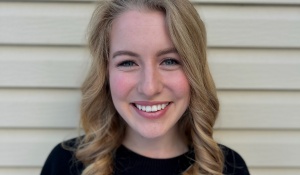
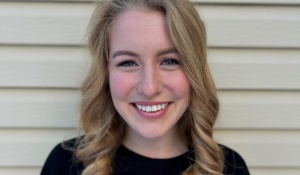
Jenna Wahl, a self-described newcomer to the field, is already shaping children's media narratives in the Media Psychology and Morality Lab. Her advice? Don’t worry if your path feels unclear—curiosity is your greatest asset.
Tell me a little about yourself and your academic journey so far.
I grew up in La Crosse, Wisconsin, which is right on the Mississippi River. I attended a liberal arts college in Mankato, Minnesota, where I received my bachelor's degree in psychology and communication with a minor in English. My academic journey has been very involved; I was a student-athlete, participated in theatre productions, served on student government, and worked as managing editor for our literary magazine.
Why did you want to pursue graduate study in Communication?
Communication as a field of study is still pretty new to me! I added it as a major in the spring of my junior year. What really drew me to it was the way it applies psychology in a real-world environment. I attribute my decision to pursue graduate study to my professors who pushed me to dive deeper into the research and what can be done with it.
What made you choose UB’s program?
I chose UB's program because my undergraduate advisor, Dr. Brian Klebig, recommended it to me. He went to Michigan State with Dr. Lindsay Hahn and had nothing but great things to say about her. We had read some of her work on children's morality in our classes, and I was really excited to continue working in that area!
What do you like most about the program? Favorite classes/subjects/professors
One of my favorite things about the program is the labs that I sit in on. I joke and call it "listening to smart people talk," but I truly believe there is so much to learn from observing the ways scholars discuss and puzzle over their research. I took Media Psychology in the Fall, which was also discussion-based, and it was great to participate in academic conversations.
What are your goals/career objectives?
My goals and objectives are a bit unrefined at the moment. I'm thrilled by the numerous opportunities I have access to with an advanced degree in communication, but narrowing down is hard! Broadly speaking, I am interested in the dissemination and application of research findings, so I can see myself being a professor someday.
Are you involved in any research?
I am currently a part of a number of projects in the Media Psychology and Morality Lab, which is co-directed by Dr. Lindsay Hahn and Dr. Art Raney. These projects all consider the moral implications that various forms of media may have on particular groups.
Do you have a focus in Communication that you would like to specialize in?
My psychology background was focused on children's development, and I would like my communication studies to continue in that. I am very interested in the messages we send to children in their entertainment and educational contexts, and children's media is a great specialty in which to study that.
What projects/research are you currently working on?
I'm currently working on a children's media study in which we are testing the ways characters and their decisions affect moral judgment and character liking. I was able to write the children's story that we plan to use for our stimulus, and let me tell you, I never thought that my communication master's program would require me to write an underwater superhero story, but here we are!
What are your favorite parts of Buffalo? Buffalo ‘hot spots’, restaurants, on campus, hidden gems in the Buffalo community.
Wow, I feel like just about the least qualified person to give recommendations about the Buffalo area. During my short time here, I've discovered coffee shops like Coffee and Stone in North Tonawanda and Tipico in Elmwood. I also love going to Tifft Nature Preserve on the Outer Harbor!
What advice would you give someone considering a master’s or PhD?
My advice to someone considering a master's degree is that your mind is allowed to change! I came into this program feeling like I was floundering on what my interests were and how I would pursue them, and that feeling hasn't completely gone away. Even in responding to these questions, I don't feel entirely confident that what I'm saying perfectly reflects me, but that's okay. The most exciting thing I've discovered in academia is that multiple interests are a good thing. There are always new concepts to learn and theories to investigate. While I started my academic career as someone whose activities were broad spanning, my choice in a specific field doesn't mean that I am now limited. Now, more than ever, I can continue asking questions and exploring the vast expanse that is communication.


Angela Lee (BA)
Angela Lee is now a paralegal in Connecticut, working with elderly and disabled clients where communication is not just helpful—it’s essential. She credits her time as a TA and her coursework, particularly in nonverbal communication, for shaping her ability to connect with others in meaningful ways.
Angela's advice to students? Use every resource available. Take advantage of the Career Design Center, connect with professors, and don’t overextend yourself. Growth comes not from doing everything, but from doing the right things with intention.
Which course in the Department of Communication did you find the most interesting, and why?
Nonverbal Communication (COM 438) was my favorite course. The subjects covered are applicable in everyday life, and are especially useful for upcoming graduates. For example, being able to walk into an interview with confidence seems like an impossible task for most students.
However, by your attendance and note-taking in this course, you'll learn to better your interpersonal skills, ultimately becoming more efficient in creating and maintaining meaningful relationships even during difficult situations. As I reflect on my academic experience at UB, I'm incredibly grateful to my past self for enrolling in this course!
Can you share an interaction with a professor that impacted your growth?
I was a Teaching Assistant to Professor Brian Reynolds for his Interpersonal Communication and Public Speaking courses, which I had taken with him in earlier semesters. It was really fun to be a TA! I loved assisting students with various topics and bringing my dog, Neo, to class. One day, Professor Reynolds and I were talking about my plans after graduation, to which I had absolutely no idea what I was going to do at the time. He encouraged me to slow down and understand that no one knows what they're doing in their early twenties. I felt like there was nothing out there for me but he reassured me that I will do great regardless of which field I land in. His sincerity resonated with me and truly contributed to my ability to continue my job search.
What clubs, internships, or hands-on projects did you participate in?
I was involved in quite a lot as a student! Most of the time, I worked two jobs. In all, I was a member of a professional business fraternity, Alpha Kappa Psi; I worked night shifts as a child caretaker; I was a TA; I compiled a report for the Department of Communication titled "AI-Powered Pedagogy: Enhancing University Public Speaking Curricula"; I was a Career Coach and hosted professional development skillshops for the Career Design Center; I worked part-time as a graphic designer; and I was a Front Office Assistant at the Clinical Legal Education Office at the School of Law. It was extremely tiring and I do not recommend exhausting yourself AT ALL. While I maintained a high GPA and financial independence, the burnout was not worth it. I definitely could have managed my time better and given myself more breaks. Being active in social, academic, and professional affairs is how you make the most out of being a student, but only if you allocate your time reasonably!
How did the program prepare you for your current role or further education?
Holding a Bachelor of Arts degree in Communication was something I was worried about when I considered post-grad employment. At the same time, I knew that majoring in Communication would allow me to fully indulge in my interests. It's such a broad field that even if you don't know what your interests are, you are sure to come across topics you'll forever apply to each interaction you have with yourself and others. Currently, I work as a Probate and Estate Planning Paralegal at Cipparone & Zaccaro, P.C. in New London, Connecticut. My job heavily involves client correspondence, research, document preparation and execution, and diving deep into not numbers on a case list, but individual stories. As I work mainly with elderly and disabled populations, problems do arise in communication. For instance, a client may come off as cold, but in actuality, they’re focused on planning for their death. Or, they might have difficulty hearing. In either case, I need to diagnose the issue in communication and find a solution -- we need accurate information, and as much of it as possible.
What career resources (e.g., networking events, alumni panels) were most helpful?
I recommend booking an appointment to speak with a Career Design Consultant or Career Coach. You can log into Handshake and book 30-minute time slots to go over anything and everything career related: resumes, cover letters, LinkedIn profiles, wondering if your major is right for you, interview preparation, and so many more. Luckily, your student tuition includes all services provided by the Career Design Center. Please take advantage of it! The Career Design Center also hosts job fairs that each student should attend. You can speak directly to recruiters face-to-face and ask them specialized questions about the position they are looking to fill. If no companies interest you at the job fair, a Career Design Center staff member would be more than happy to help you search through online platforms.
How would you describe the department’s culture (collaborative, competitive, etc.)?
The culture of the Department of Communication is astoundingly collaborative. If you need help, it is always there for you. Being that it is the Department of Communication, you'll never see heavy conflicts, at least, not any that can't be solved. Their website states, "Our faculty are committed to teaching and mentoring in a collaborative environment that provides you practical training in state-of-the art social scientific techniques." It's true! Their website also states that they seek "to educate the next generation of information professionals, knowledge workers and communication and information researchers. The shared principle that information serves the purposes of human communication and is enhanced by technological systems is at the core of our curriculum." Once upon a time, it was a requirement to complete a Computer Science course as part of the Communication curriculum. I was so peeved at the time because of my lack of talent in STEM, but I came to enjoy seeing computer codes as their own language, something to understand and find reason in. I appreciate that the Communication curriculum is not only extremely interesting, but also mentally stimulating.
Support that speaks volumes.
When you give to the Department of Communication, you're doing more than funding scholarships or events—you’re investing in future leaders, researchers and change-makers. Your support helps us offer students the opportunities, mentorship and tools they need to thrive.
Together, we build futures.