An NSF & IES AI Institute for Transforming Education for Children with Speech and Language Processing Challenges
AI for Early Detection of Dyslexia and Dysgraphia
Dyslexia and dysgraphia can significantly affect a child’s ability to read and write, making early detection essential. Yet, evidence-based screening tools that do this efficiently are currently lacking and manual assessments are often time-consuming and costly.


Research led by the University at Buffalo is demonstrating how AI-powered handwriting analysis can change that. The project responds directly to priorities outlined in the New York State Dyslexia and Dysgraphia Task Force report, including the need to:
- Identify effective, evidence-based screening methods for dyslexia and dysgraphia.
- Strengthen reading interventions.
- Improve educational supports for students in kindergarten through grade five.
“Our ultimate goal is to streamline and improve early screening for dyslexia and dysgraphia, and make these tools more widely available, especially in underserved areas,” said Venu Govindaraju, PhD, PI and director, National AI Institiute for Exceptional Education.
Related News
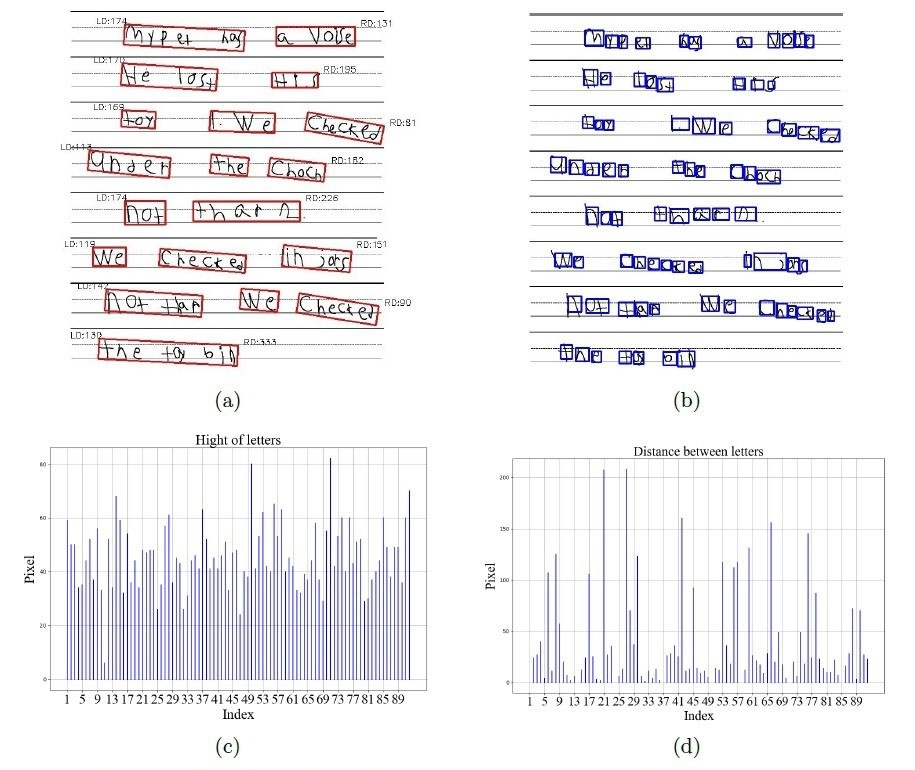
Structural analysis of handwriting samples (a) Atypical margin use, (b) Inconsistent letter sizing (c) Histogram representing height of characters (d) Histogram representing distance between characters.
Dyslexia varies in severity. Children with mild forms may show no spoken language difficulties but often struggle with academic writing as language demands increase. Because handwriting evaluation is already part of classroom routines, it provides a practical way to identify students who may be missed by spoken-language screenings.
The UB team’s models can:
- Analyze visual aspects of handwriting, such as letter size and spacing.
- Convert handwriting to text, identifying misspellings, reversals and other orthographic errors.
- Detect fine motor challenges by examining writing speed, pressure and pen movement.
- Assess cognitive-linguistic factors such as grammar, vocabulary and content complexity.
The research team partnered with Abbie Olszewski, a speech-language pathologist and associate professor of literacy studies at the University of Nevada, Reno, whose deep expertise in dyslexia and dysgraphia strengthened the project’s focus on early identification and intervention.
“It is critically important to examine these issues and build AI-enhanced tools from the end users’ standpoint,” says Sahana Rangasrinivasan, a PhD student in the Department of Computer Science and Engineering at the University at Buffalo.

Venu Govindaraju, PI
Institute Director
University at Buffalo

Srirangaraj (Ranga) Setlur
Managing Director
University at Buffalo


Abbie Olszewski
Faculty
University of Nevada, Reno
The study is part of AI4ExceptionalEd’s broader mission to create AI-driven tools that support earlier, more personalized screening and intervention for speech, language, reading and writing challenges. By enabling screening that is accessible, scalable, and data-informed, these innovations can help identify learning differences earlier, guide effective support and advance educational equity. This project exemplifies AI for public good in action.
The team has also developed an integrated tool that combines all the models, synthesizing their outputs into a comprehensive assessment.
Co-authors include Bharat Jayaraman, director of the Amrita Institute of Advanced Research and professor emeritus in UB’s Department of Computer Science and Engineering, and Srirangaraj Setlur, managing director of AI4ExceptionalEd and principal research scientist at the UB Center for Unified Biometrics and Sensors.
From pioneering handwriting recognition for the U.S. Postal Service, over three decades ago—one of AI’s first major success stories—to advancing handwriting analysis for early detection of dyslexia and dysgraphia, the University at Buffalo continues to harness AI for lasting societal impact.