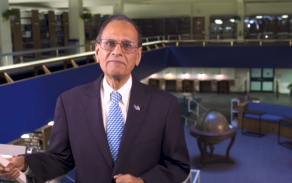

UB 2020 IT Transformation Town Hall Meeting

August 25, 2009

  • UB’s senior leadership charges Elias Eldayrie with developing a structured plan to be implemented within 12 months.
  • Budget reductions have added a sense of urgency to identify efficiencies and savings.
  • Five major divisions named that reflect new IT service strategies.

Part One: Background and Vision

Elias Eldayrie, Chief Information Officer, made opening remarks to an audience of more than 200 participants, and thanked everyone for taking the time to attend, as well as submitting high quality questions in advance.

Over five pages of questions submitted from the UB 2020 IT Transformation Web site were subsequently divided into themes that drove the presentation’s outline, plus time for follow-up Q&A from the participants. “The questions proved that the people in the UB IT community care very much about what we do,” remarked Eldayrie.

“We can’t find any other university that has taken on this kind of portfolio”, Eldayrie said. UB’s IT portfolio is unique in its breadth and depth when compared nationally with peer institutions. “IT professionals across the campus can take pride in the volume of work successfully accomplished. It reflects a strong work ethic.”

Background for the UB 2020 IT Transformation Phase II process is available on the UB 2020 Information Technology Strategic Transformation Web site. Eldayrie briefly described how the reorganization plan was data-driven and vetted through the Executive Technology Advisory Group (ETAG) in June 2009, and then through deans and vice presidents. UB’s senior leadership charged Eldayrie with developing a structured plan to be implemented within 12 months.

Other schools currently engaged in IT restructuring plans include: University of Florida, UCLA, Arizona State University, University of Arizona and UC Berkeley. The University of Florida has completed its reorganization plan with activities similar to those being considered at UB.

Eldayrie described the significant drivers behind the transformation:

  • Improving support for core business. “We are not in the business of technology—we’re here to support teaching, learning and research. This is the focus when moving forward with investment planning and decision making, articulated through UB 2020 strategic goals”, he said.
  • Reducing costs as much as possible. “IT is not getting cheaper, and financial budgets are not getting better.”

A second table indicated reduction of state funding to UB over time. See slide presentation.

Many institutions have countered budget reductions through overall layoffs and attrition. (University of Minnesota 1,200, ASU 750, Harvard 275). Eldayrie credited President Simpson and Provost Tripathi for adopting a plan that did not entertain layoffs from the earliest stages of troubling budget realities. “We can be smarter, we can be more efficient. We stepped up to the plate and showed how we can do that,” Eldayrie added.

The guiding principles and goals for restructuring IT are in alignment with strategic goals of individual schools and divisions. Eldayrie encouraged the audience to keep these guiding principles in the forefront.

  • Organize IT around the service portfolio as defined by UB needs, priorities and technology maturity.
  • Leverage UB 2020 ITST initiatives and investments.
  • Design a model that supports diverse campus needs and innovations.
  • Ensure that the process is transparent, inclusive and addresses local IT support concerns.
  • UB’s current IT organizational structure is 15 years old. Technology has evolved over time; much of IT has become a commodity, with more power available at the desktop.

Memorandums of Understanding (MOUs) and Service Level Agreements (SLAs) will be used to benchmark and create accountability. “As we move together through this process, work will not be defined through hearsay. We will work together to define what those agreements will be,” Eldayrie said.

This plan is about creating an integrated IT organization that meets the high level of demand for campus IT needs:

  • The creation of a single organization with 4 major components in addition to IT management and administration (See slide presentation):
    • Security
    • Infrastructure Support
    • Application Development
    • Client Services

Eldayrie focused on the Client Services component, which will be divided into five major divisions: Common Services, and four major services areas: Professional Schools, Academic Health and Center of Excellence, College of Arts and Sciences/Engineering, and Academic Support (which encompasses non-instructional academic support units). See slide presentation.

Common services across campus will include:

  • Integrated services help desk
  • Client desktop and classroom support
  • Training and professional development
  • Instructional support
  • Web services
  • Other services to be determined

Eldayrie then outlined next steps:

Develop and roll out in a staged implementation:

  • Communication plan
  • Service catalog
  • MOU/SLA documentation

“We will work together to identify service improvements and savings, then determine how to best provide fluid and timely status updates to our senior leadership,” said Eldayrie. “Meaningful assessment and benchmarking are critical to this process, and several deans have indicated they are ready to move forward, while others are waiting to see how the plans evolve.”

This concluded the formal presentation of the transformation plan.

Part Two: Responses to Pre-submitted Questions

Eldayrie began addressing questions that had been submitted in advance and presented thematically:

Q: Why restructure IT?
A: To build an integrated organization that provides consistent services and addresses financial realities. Deans and vice presidents have already been assigned budget reductions and will be facing mid-year cuts. The cost of IT contracts alone rise about 9 percent each year, so we need to contain future costs.

Q: How will restructuring be implemented?
A: Cautiously, and in stages, by talking with faculty and leadership. Remember that this is a “we” project, and as one of my professors said, "nobody is smart enough to have all the answers or dumb enough to make all the mistakes."

Q: Will IT requests go into a “lost queue” and never get addressed, or take 2-3 years to realize?
A: If that happens, we failed. There is already a long list of unmet needs in IT, and we need to prioritize how to best address them.

Q: What about our jobs?
A: There are no plans for layoffs. We will strategically align staff skills with the IT divisions and university needs. Staff preferences for job assignments will be considered and honored where possible. Many staff will continue to serve the people they currently serve. Many will remain in the same location.

In-house titles and compensations will be mapped using external market data. Being a “happy” employee is not the same as being a “satisfied” employee. We want to ensure that all staff feel productive and assured that they are contributing to UB’s strategic goals.

In-house titles and compensations need to be mapped to industry titles and adjusted to the Buffalo market. This is how we have proceeded in the past in order to create equity across roles in IT.

Q: How will IT services continue to be supported?
A: I share your commitment and concern to not break any current IT services. A major priority is to improve support for teaching and learning, and develop metrics to assess how we’re doing. If distributed units have processes in place to measure success, please share them—we’re happy to take a look and adopt where possible.

The user will continue to contact local staff for help with departmental application and support issues until a better alternative is identified. Priorities for local needs will be established by each division.

Q: How will professional development be supported?
A: We’ll continue to train and equip staff to perform their jobs, which is a very important aspect of restructuring. Staff will receive training for skills development.

Q: Will there be career opportunities and opportunities for promotion?
A: Some jobs have opportunities, some are dead-ended, and so there will be greater opportunities in a broader organization.

Q: Please listen to me!
A: (Eldayrie remarked this was a compilation of several questions submitted that reflected concern about ideas and suggestions being considered as part of the transformation). In the past two years, the record reflects that we’ve had more communication, conducted more focus groups, more Town Halls and engaged in more dialogue than at any time in the past. I will be personally involved, and managers will be strongly encouraged to listen to staff needs and desires. Any questions should be directed to IT leadership.

Q: Will I get to choose how I work?
A: Yes, if it meets UB’s needs. No, if it doesn’t. We want the right people in the right spots.

Q: How will all this be communicated?
A: We are developing a communication plan and will provide regular status updates; this is a work in progress. When changes are made that affect service delivery, they will be communicated directly with customers and staff. We will continue to utilize forums like today’s to move forward as well.

Part Three: Live Question & Answer Session

At this time, approximately 40 minutes remained for Q&A from those present. A microphone was circulated throughout the room.

Q: I would like to understand more about the MOUs and SLAs— what level of detail is being addressed in the current meetings?
A: We’re gathering data from distributed IT leaders and business managers to make sure there is a clear understanding. Service Level Agreements typically include details on who is contacted for support when issues arise, what the expected turnaround time is for service requests, and how to escalate issues if a problem is not resolved. We’re currently reviewing best practices to help inform the process, and we’ll make sure all parties agree to criteria before the implementation moves forward.

Q: How will SLAs be updated and modified to address future faculty needs—particularly for departments moving into new buildings and for research faculty as their needs evolve?
A: This is why the MOU is the first document to be considered, in order to better understand needs within a unit, prior to creating a detailed SLA. We understand, and are sensitive to, how these agreements must reflect faculty needs and be applied in a practical manner.

Q: There’s a difference between the statements, “we have no plans for layoffs” vs. “a commitment to no layoffs.” Can you address this difference?
A: It’s not possible to “commit” to a no-layoffs policy in light of not knowing where New York State will be in the next 5 years. If the economy totally imploded, the picture could change. What I can do today is commit to being completely honest with you and sharing knowledge the best I can as it evolves. Today, there are no conversations at UB about layoffs.

Q: Can salaries be adjusted downward?
A: We have a good relationship/partnership with the UUP—we enjoy honest conversations. First, you need to know that salary data, in comparison with other institutions, is either on par, or below market averages, with very few outliers; and to directly answer the question: No, salaries will not be adjusted downward. It would be a contractual violation to reduce salaries.

Q: As people retire or move to other positions, what will happen to the vacant lines? Will they go to IT or go elsewhere at UB?
A: We need to minimize negative impact on IT service delivery. At this time, university policy is to reserve state salary lines internally in HR for a period of time in case they are needed to address a university priority. After a period of time—90 days—they are released back to the unit, as long as the position is justified.

Q: Can you elaborate on the process for decision making regarding resources and how unique services within schools will be addressed?
A: To be perfectly honest, we don’t yet know. We understand, and are trying to address, the unique features of the units, but there are also a lot of similarities within units. That’s why the SLA data collection is so important as part of this process.

Q: To follow up on a previous question, when an IT salary line returns to the unit after 90 days, does the title and IT position go to you, or back to the school?
A: The restructuring calls for all PSR to be consolidated into the new IT organization—but to be clear, it’s not “me” as the CIO, it’s “us” as a newly formed and consolidated unit.

Q: Schools like pharmacy are still located on the North Campus. How will schools that are eventually split between campuses be supported?
A: It is not clear yet, and we’ll work with pharmacy to determine the best model.

Q: How will this affect people hired to support IT on “soft” money—hired for specific applications or services?
A: Usually grants are temporary in nature, typically for people not involved in the IT restructuring, unless they were hired specifically for IT support within a unit. We’ll need to look at those specific cases.

Q; SLAs data is due this Fri, and given the time of the year, it may be difficult to get this information vetted through our school’s internal leadership. We may need to evolve and modify agreements.
A: If we need a little more time, we’ll give it. It’s important to do it right and not “fast.” The current process is a starting point.

Q: If cost containment is a major driver, and assuming that PSR consumes the majority of the overall IT budget, how will cost containment be realized?
A: You’re correct that 60-70 cents of each IT dollar is spent on people. We need to look for opportunities that are presented through retirements (filled with lower paying positions), and examine ways to leverage existing IT staff rather than hiring to fill a position.

Q: (Follow up) But the units can manage many of those costs today with the exception of assignment to a broader organization—so where’s the savings?
A: Some people’s work has changed over time. We’ll leverage wherever we can.

Q: Will there be exceptions or exemptions from this plan?
A: The deans and vice presidents will have every opportunity to make a case to the provost for exemption, but there are no known exemptions as of today.

Q: Is there a goal to have one SLA over broad areas? For example, if one unit serves several customers with different needs, how will this work?
A: That will be addressed through the conversations within the units and the MOUs. It’s based on mutual expectations—what we’re looking to have submitted by the end of this week is the start of the process. One size will not fit all.

Q: You mentioned a goal was to “flatten” the IT organization – what’s that mean?
A: Narrow organizations, by design, are more expensive to operate (Eldayrie gestured a hierarchical organization). Flatter organizations lower costs when you search for common opportunities over a broader organization.

Q: (Follow up to the exemptions question) The School of Dental Medicine has been attempting to make the case for an exemption—are there fresh opportunities to become exempt? We’ve already been told “no”.
A: As recently as yesterday it was re-articulated that the deans can make the case, and it’s possible that some of the issues of concern can be resolved through future meetings and dialogue.

Q: How and when will the faculty be informed as to what’s going on? There are currently lots of rumors out there.
A: Communication has been going out through several avenues. The provost’s letter went out six months ago, and it’s expected that the leadership is sharing this information throughout their organizations. I’ve been talking about this in general terms for a while now, but we’re still in the infancy of this process. I’ve been invited to talk with the Faculty Senate Executive Committee about these plans, and have done that— and I will continue to explore every opportunity to make sure that communication is clean and robust. We are in the process of developing a robust communication plan. It will also be incrementally rolled out.

Q: Within the School of Dental Medicine we’re looking to build on an IT system that was developed in-house and works well. Will we be forced to give it up in place of a commercial solution?
A: If the system is serving the needs of the School of Dental Medicine, we’ll take a careful look. The tool you refer to is 15 years old, so it’s possible that a commercial application is superior at this point in time as a commodity solution, but it’s not our intention to destroy something that works.

Q: Do we have a new organizational name?
A: UBIT for now, but we can have a conversation on that—maybe even a naming contest.

Q: Following the research, do you have a sense of where investments will be made?
A: Instructional technology is very uneven across campus—we want to improve classrooms, access to intellectual property, etc. There are also deficits on the administrative side of the house. We’re trying to address teaching and learning deficits first.

Q: Some people have hybrid skill sets. For example, in my area, we hired a Ph.D. instructional designer, who technically is not an IT person, but performs many IT functions in support of teaching and learning. How will this plan address these people?
A: There are 34 FTE’s across the campus that perform non-IT work. It’s not our core competency to manage non-IT people, but we need to sort through those issues.

Q: If an area is made up primarily of research-funded support people, doesn’t that by default make them exempt?
A: It depends on the support that’s being provided and how it may be best provided, either through grants or non-state lines.

Q: Part of what makes me a satisfied IT worker is the diversity of work I provide;. Will I be able to continue to enjoy this diversity?
A: We’ll sit down with employees to best understand how they do their work. My job is to make sure the institution gets the job done, and with your help we’ll get there.

Q: Those of us in distributed IT areas are concerned about space. If schools want space that currently houses IT people, how will space be identified for proper IT staff support?
A: It is known that some IT staff are being moved to unacceptable space as the result of the announcement of this reorganization. If units are abandoning IT staff as the result of this announcement—just because they don’t directly report to the unit—we will do our best to make the case when the space is not acceptable.

Q: What about instructional designers who use technologies to support online learning, etc.? Will you be expanding your definition of IT work to cover these tasks?
A: That will be examined carefully.

Q: In terms of priority setting—academic research needs are not a “service” or “utility”—but rather a part of science, and intimately linked to IT support. How can these needs be served centrally?
A: We need to examine what you are trying to do, and how we can help you get there. The academic units and faculty stakeholders determine priorities. Specialized services are very likely to remain in place. This phenomena or delineation of “us” in central services vs. “distributed” IT will end, because it’s all “us” as a consolidated unit providing support.

Q: Will people be able to apply for jobs through some kind of “job catalog” to receive new opportunities?
A: The goal is to provide people the opportunity to apply for some of these jobs. I like the idea of a catalog, and maybe that’s something we should be doing.

Check the UB 2020 IT Strategic Transformation website for information on the next IT Town Hall, scheduled for a date to be determined.

We hope you found this UB 2020 IT Town Hall brief useful and informative. We are always interested in hearing from you.

UB 2020 IT Transformation Project Communication Team