
Archives
UB’s future considered at forum
Faculty, staff, students, community offer feedback on campus concepts
By KEVIN FRYLING
Reporter Staff Writer
About 650 UB faculty, staff, students, planning professionals and members of the local community came to the Center for the Arts on the North Campus on Tuesday to participate in the second of four public forums on UB’s comprehensive physical planning process.
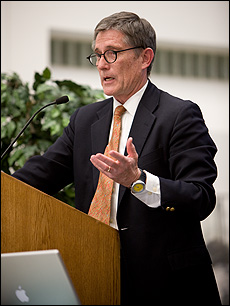
Frederick Bland, the consultant who is leading development of the comprehensive physical plan with the Building UB team, explains the three major growth scenarios that are being considered.
PHOTO: DOUGLAS LEVERE
The day-long event, in which members of the campus and local communities could provide feedback on specific concepts under consideration for development of the university’s North, South and Downtown campuses, was concluded with a “capstone session.”
Speaking at that session were President John B. Simpson; Satish K. Tripathi, provost and executive vice president for academic affairs; Robert G. Shibley, professor and director of the Urban Design Project in the School of Architecture and Planning, who, as senior advisor to Simpson, is overseeing UB's ongoing master-planning process; and others from the internationally known consulting team chosen to work with the Building UB team and lead development of the plan.
“The capital master planning process was set up to seek the input of our internal communities and our external communities,” said Simpson, whose comments opened the hour-long capstone session. “This is by plan and this is very much part of a listening process that we’re engaged in.”
In developing the comprehensive physical plan in conjunction with UB’s plans to grow by 40 percent by the year 2020, Simpson said UB is committed to reaching out “in unprecedented ways” to its neighbors in the local community.
Also integral to the process is the input from on-campus communities, added Tripathi, noting that UB’s plans are being greatly shaped by the “advice, experience and aspirations” of the faculty, students and “professionals whose work to make sure our students and faculty succeed.”
“We are listening to faculty about what kinds of facilities and places they need to succeed,” he said.
All of the plans under consideration remain “speculative proposals about how UB might achieve the academic excellence to which it aspires,” said Shibley, noting that the conversation with UB’s internal and external communities began during the first public forum last Dec. 4. “Our purpose throughout the process of the past year has been to ask the question, ‘What do you think?’”
He noted that a draft of the plan will be presented for comment in a public forum on Nov. 19 and that the final plan will be presented in a public forum in April 22, 2009.
In terms of UB’s physical expansion, Frederick A. Bland, managing partner for Beyer Blinder Belle Architects & Planners, the internationally known team chosen to work with the "Building UB" team and lead development of the plan, said three major growth scenarios are under consideration by planners. In the first scenario, referred to as “growth in place,” the university’s schools and major academic units remain on their current campuses, with the exception of the School of Pharmacy and Pharmaceutical Sciences, which already is scheduled to move to the South Campus. In a second scenario, the schools of Law, Social Work and the Graduate School of Education, along with the graduate plans of the School of Management, also move to the South Campus and the schools of Medicine and Biomedical Sciences, Nursing and Public Health and Health Professions move to the Downtown Campus. In the third scenario, the schools of Law, Social Work and the Graduate School of Education, along with the graduate plans of the School of Management, also move to the South Campus and all five health-sciences schools in UB’s Academic Health Center move to the Downtown Campus.
Increasing the student population from approximately to 40,000 in all three scenarios would require growing the North Campus from 6.7 million square feet to somewhere between 9.3 to 10 million square feet, Bland added.
“One prime issue that we think is critical is to ‘densify’ the campus,” he said. “That is, to grow ‘smarter’ rather than sprawl across the campus as has been done in the last decade or two.”
Plans under consideration on the North Campus include “thickening the academic spine,” as well as constructing a second “north-south” spine connecting the Ellicott Complex to the main academic corridor. The Commons would be razed and retail space would be located on the current spine, across, as well as in the ground floor of a block of new mixed-use buildings. A hotel/conference center would be built on Lake LaSalle and a major green space, “The Oval,” would be created where the Commons is now located
“A great campus is no longer just a collection of buildings for academics and a couple of dorms,” he said, pointing out that “complimentary use” buildings are an important aspect of a comprehensive physical plan. Other structures that might be created include a university museum and a recreation and wellness center on the North Campus; an executive education center and retirement community on the South Campus; and space for research and development, clinical facilities and “innovative housing” on the Downtown Campus.
Aesthetic improvements on the South Campus might include the demolition of Kimball Tower in order to construct a series of smaller academic buildings more in scale with the rest of the campus and the creation of a large “recreation quadrangle,” Bland added.
Consultants Shirley Dugdale of DEGW, an international design consultancy, and Kenneth Lin of STV Inc., a professional firm offering engineering, architectural, planning, environmental and construction management services, also were present to discuss creating innovative places for teaching and learning, and mitigating traffic and parking problems on campus, respectively. They reported receiving strong support from UB’s internal and external communities on such ideas as improving transit between all three campuses, providing safe and convenient paths and facilities for pedestrians and bicyclists, constructing facilities and design features encouraging “social learning” and improving on-campus dining.
The construction of “tiered parking,” or parking garages limited in height, on the North and South campuses also was discussed by planners.
Feedback from UB faculty members during their peer group workshop earlier in the afternoon was largely positive. Josephine Anstey, assistant professor of media study, supported an idea about creating space to showcase the arts on the Downtown Campus, but also expressed concern about UB contributing to problems related to “gentrification” in the neighborhoods adjacent to the Buffalo Niagara Medical Campus.
Gayle Brazeau, associate dean for academic affairs, School of Pharmacy and Pharmaceutical Sciences, endorsed the idea of creating faculty-only “hubs” for professional meetings and dining, noting that UB currently has no permanent on-campus “faculty club.”
William Baumer, professor of philosophy, asked planners to remain cautious about relocating UB’s health sciences schools, explaining that the original decision to locate the School of Medicine and Biomedical Sciences on the South Campus and not downtown came about because “they wanted to be closer to the rest of the university.”
“These are big bulky ideas still; they’re not fine-tuned architectural responses yet,” Bland said during the conclusion of the capstone session. “But…there’s not anything more important to me than being sure we’re providing the academic spaces necessariy for this university to achieve the level of excellence that we’ve heard about time and time again today. That’s the primary purpose. We want to be sure that the spaces that the faculty needs to create this environment are there.”