
Archives
Report outlines UB’s environmental impact
By ELLEN GOLDBAUM
Contributing Editor
The university’s first quantitative study on how its operations impact the physical environment will be formally presented at a reception from 5-8 p.m. tomorrow in the UB Art Galleries in the Center for the Arts, North Campus.
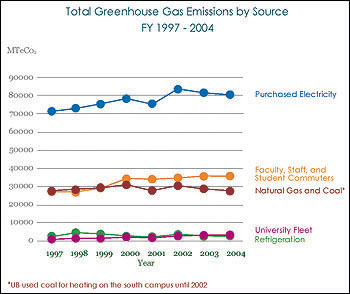
The result of two years of intensive data collection and analysis by UB Green, UB’s environmental stewardship office, the 160-page “UB Green Climate Action Report” is chock-full of statistics about how UB’s operations impact global warming, how that impact has changed during the past decade and how the university might harness resources on campus to dramatically reduce that impact.
The key finding is that electricity purchases and on-campus natural gas heating are the single greatest contributors to UB greenhouse gas emissions.
Already an energy-conservation and green power purchasing leader, the report states that UB will have to move more aggressively in both areas to approach and eventually achieve climate neutrality.
“This is the baseline,” James Simon, principal author of the report and an environmental educator at UB Green, said of the report, subtitled “An Opportunity for National Leadership and Environmental Excellence.” “We looked at our greenhouse gas emissions over a period of seven years to identify the main sources of those emissions and to develop strategies and recommendations for reducing or eliminating them.”
Walter Simpson, UB energy officer and the report’s editor, said that the report is timely and urgent.
“As scientists worldwide and esteemed international activists like Nobel Peace Prize winner Al Gore have made clear, we are facing a full-blown global climate crisis,” Simpson said. “We have just a few years to reverse a trajectory of ever-increasing greenhouse gas emissions.”
The user-friendly report was designed to appeal to UB students, faculty and staff, and the entire Western New York community, including outside institutions that want to reduce their own environmental impact.
“While our report focuses on UB, the report outlines a climate action ‘game plan’ that could be useful to nearly any building owner or facilities manager interested in addressing climate change,” Simpson said.
In addition to the general presentation tomorrow, UB Green encourages members of the UB community to attend a “town hall” meeting on the UB Green Climate Action Report. The meeting schedule:
Tuesday, noon, 210 Student Union, North Campus.
Wednesday, 3 p.m., 210 Student Union, and 7 p.m., Screening Room, CFA.
Feb. 4, 7 p.m., 105 Harriman Hall, South Campus.
Feb. 5, noon, 301 Crosby Hall, South Campus.
Feb. 20, 7 p.m., Unitarian-Universalist Church, 695 Elmwood Ave., Buffalo.
The purpose of the town hall meetings, according to Simpson, is to stimulate and maintain a vigorous dialogue, both on and off campus, about UB’s climate impact and how to dramatically reduce it.
“Only by having serious discussions based on well-demonstrated scientific data can we as a university make serious advances on climate action,” said Claude E. Welch, SUNY Distinguished Service Professor in the Department of Political Science and a member of the report’s advisory committee. “However, the information in the report is only a foundation for action. Our commitment will be shown by the steps that we take, not just by what we talk about.”
The information is critical, in light of President John B. Simpson’s signing last spring of the American College and University Presidents Climate Commitment, which requires the university to actively benchmark the progress it has made so far and then dramatically reduce greenhouse emissions to eventually become carbon-neutral—the point at which greenhouse emissions are completely offset by the use of renewable energy sources.
“We believe you can’t manage what you can’t measure,” said Robert G. Shibley, director of UB’s master planning process and chair of the Committee on Environmental Stewardship, which is charged with helping the university meet the requirements of the Presidents Climate Commitment. “The Climate Action Report and other reporting being developed by the committee are itemizing a whole range of institutional behaviors that we need to benchmark and monitor, such as how we design our buildings for energy efficiency, how we get to and from campus and curricular opportunities, and research and scholarship that will advance the state of the art in environmental stewardship.
“It won’t be easy to achieve carbon neutrality,” Shibley continued, “but we have constructed a process that will involve every element of the institution in devising a solution, implementing the plan and monitoring progress. The work on the Climate Action Report is a giant leap forward in the discipline of the process.”
The report provides readers with a brief introduction to global warming, how scientists perceive the crisis and how they say it will affect Western New York in particular.
It then provides a detailed picture of how UB, which is the size of a small city, contributes to climate change primarily through fossil fuel use, which produces emissions of carbon dioxide, the principal greenhouse gas.
The report notes that the university’s plans to grow by 40 percent between now and 2020 will further heighten the challenge.
UB added more than 890,000 square feet of new building space between 1997 and 2004—a key contributor to greenhouse gas emissions since buildings have the greatest emissions—even more than transportation, according to national sources cited by the report.
That means new buildings will have to be even more efficient, said Simpson, and serve as national models of energy efficiency that receive the highest possible green building design ratings.
Many of the numbers are sure to give readers pause. For example, the report states that in the period studied:
UB’s annual average greenhouse gas emissions were equivalent to those that would be produced each year by more than 25,000 cars.
To get to and from campus, UB students, faculty and staff drive more than 79 million miles every year—the equivalent of circling the globe at the equator more than 3,000 times.
Solid waste production increased around 900 tons to a level of 3,148 tons in 2004 from the 1997 level.
Recommendations range from dramatically boosting renewable energy purchases, such as wind power; maximizing energy efficiency in new buildings and renovations; advocating for better mass transit and boosting carpooling; and conducting educational and outreach activities in the community, with support for local businesses that address climate change.
Data were gathered from numerous stakeholders on campus, including Utilities Management, Operations and Planning and Design, all in University Facilities; Financial Services; the Office of Institutional Analysis and Campus Parking and Transportation Services.
The data compilation and analysis was conducted with the use of the Campus Greenhouse Gas Emissions Inventory Calculator provided by Clean Air Cool Planet, a nonprofit organization that helps colleges and corporations reduce their environmental impact.
The report will be available on CD at tomorrow’s presentation and at all the town meetings. It eventually will be available on the UB Green Web site.