
Archives
Lights, cameras, quake
Full-scale wooden townhouse to undergo landmark seismic testing at UB
By ELLEN GOLDBAUM
Contributing Editor
Build house. Shake vigorously. Repair damage. Repeat.
That's the recipe UB earthquake engineers are following as they launch a series of unprecedented seismic tests on a full-scale, wood-frame townhouse over the next nine months.
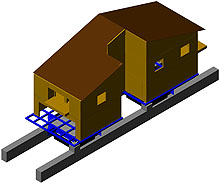
This graphic depicts how the townhouse will be set upon the shake table for seismic testing.
The 73,000-pound, 1,800-square-foot townhouse will be the largest wooden structure to undergo seismic testing on a shake table in the United States.
The landmark testing at UB is part of a $1.4 million international project called NEESWood, funded by the National Science Foundation's George E. Brown Jr. Network for Earthquake Engineering Simulation (NEES).
Beginning on Wednesday and continuing through the fall, selected NEESWood tests and construction milestones at UB will be open to the media, as well as broadcast live on the Web at http://nees.buffalo.edu/projects/NEESWood/video.asp.
In November, the full-scale, furnished, three-bedroom, two-bathroom townhouse will be subjected to the most violent shaking possible in a laboratory—mimicking what an earthquake that occurs only once every 2,500 years would generate.
In that final test, the townhouse is expected to suffer massive damage, according to computer simulations performed by the UB researchers and colleagues at other NEESWood institutions.
To gather the data, the UB researchers are equipping the townhouse with 250 sensors that will provide detailed information about how each nook and cranny behaves during each simulated earthquake.
A dozen videocameras—eight indoors and four outdoors—will record the damage as it happens.
The NEESWood research is based on the premise that if more were known about how wood structures react to earthquakes, then larger and taller structures could be built in seismic regions worldwide, providing economic, engineering and societal benefits.
"We want to revolutionize the building of wood structures for seismic performance," said Andre Filiatrault, professor of civil, structural and environmental engineering in the School of Engineering and Applied Sciences, a co-investigator on NEESWood and the lead investigator on the UB tests.
The experiments will be performed in UB's Structural Engineering and Earthquake Simulation Laboratory (SEESL), the only laboratory in the nation large enough and sophisticated enough to conduct the tests. Details about SEESL are available at http://nees.buffalo.edu/.
Between now and November, several dozen professors, students, contractors and local companies will be constructing, testing, repairing and testing again the two-story townhouse. It is being constructed on top of twin, movable shake tables in UB's SEESL that will be set to deliver the exact same earthquake payload with precise simultaneous synchronization.
During each of the six testing phases being planned, the townhouse structure will be subjected to five increasing levels of shaking in three dimensions-the most authentic ground motions that can be produced in a U.S. laboratory. The ground motions will simulate increasing intensities that were recorded during the 1994 Northridge earthquake in the Los Angeles region.
Earthquake engineers say such testing is long overdue.
While wood-frame construction accounts for an estimated 80-90 percent of all structures in the United States and 99 percent of all residences in California, fewer than 10 percent of civil-engineering students are required to study wood design.
One hundred years after countless wooden buildings collapsed in the devastating 1906 earthquake in San Francisco, little is known about how they behave in earthquakes.
"Wood has always been the poor cousin of other design materials," said Filiatrault. "Wood structures have been seen as uninteresting and not very sexy. Engineers have traditionally been more attracted to the design of commercial structures, like the TransAmerica building in San Francisco," he said. "But the 1994 Northridge quake and the 1995 Kobe quake in Japan were eye-openers."
In Northridge alone, he said, half of the $40 billion in property losses was due to damage to wood construction. Of the 25 fatalities that resulted from building damage in the quake, all but one occurred in wood-frame structures.
"Suddenly, wood-frame construction has become more interesting to engineers and now there are funds to study it," said Filiatrault, who also is deputy director of UB's Multidisciplinary Center for Earthquake Engineering Research.
The UB tests will be among the first to provide realistic data to engineers about how a typical, full-scale, two-story wood-frame townhouse built to current standards in California will behave in an earthquake.
One of the tests will examine how well dampers installed inside the townhouse can protect the structure against damage during seismic activity; it is the first time that such dampers will be tested in a wood-frame construction.
The ultimate goal of the four-year NEESWood project is to develop a design philosophy for wooden structures in seismic regions so that taller and larger wooden structures can be built, up to six stories in height.
In some states, Filiatrault explained, wood structures of up to four and five stories tall are being built, but no data are available on how such structures will perform in an earthquake.
Right now, he said, structures are designed to meet codes that were not developed based on seismic testing of full-scale wood structures.
"The problem is, property owners and engineers are not on the same wavelength," he said. "For engineers, designing to code means life safety for occupants, but you can do that and still sustain major damage to a property. Owners, on the other hand, believe that designing to code means they will have an intact building right after the quake. Performance-based design gives both parties a chance to balance the issue of how much an owner is willing to pay to mitigate damage in an earthquake versus how much damage he or she is willing to sustain."
The UB tests are the first step in moving toward performance-based design for wood-frame structures. NEESWood will culminate with the validation of new design processes using a six-story, wood-frame structure that will be tested on the world's largest shake table in Miki City, Japan, early in 2009.
NEESWood is a consortium of researchers led by John W. van de Lindt, professor of civil engineering at Colorado State University; co-principal investigators are Rachel Davidson, assistant professor of civil and environmental engineering at Cornell University; Filiatrault of UB; David V. Rosowsky, professor and head of the department of civil engineering at Texas A&M University, and Michael Symans, associate professor of civil and environmental engineering at Rensselaer Polytechnic Institute.
Led by Filiatrault, the UB testing also will be conducted by Assawin Wanitkorkul, a postdoctoral associate in the Department of Civil, Structural and Environmental Engineering, and Jianis Christovasilis, a graduate student in the department, as well as several undergraduate students.
This summer, Hirochi Isoda of Shinshu University in Japan and Bryan Folz of Canada's British Columbia Institute of Technology also will be joining the research at UB.
In addition to NSF funding, the UB testing would not be possible without the generous donations of time, resources and expertise from private companies and educational institutions both in Western New York and across the U.S.