All-female team to live under the sea
Researchers
led by UB biologist Mary Alice Coffroth to study changes on coral reefs
By ELLEN
GOLDBAUM
Contributing Editor
A
UB scientist is leading an all-female research team that will be living
and working deep under the surface of the ocean and studying the parentage
of a coral reef off the coast of Key Largo, Fla.
| |
 |
| |
Tonya
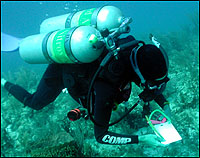
Shearer, a UB doctoral candidate in biological sciences, is part
of an all-female research team studying coral deep under the ocean. |
| |
|
Mary
Alice Coffroth, associate professor of biological sciences, and the
other three members of her team will call the Aquarius, the world's
only undersea laboratory, their home for 10 days, from Monday through
April 24.
Their
goal is to gather detailed data and tiny coral samples that will help
determine how coral populations grow, providing an important tool for
marine managers so that ultimately, the reef—known as the Conch
Reef—can be properly managed and preserved.
The
work, practically speaking, would be impossible to do from a typical
surface-based diving operation.
That's
because when ecologists go on dives, they can work at depths of 90 feet
for just 25 minutes; then they have to come back to the surface and
rest for 2 1/2 hours before their next dive to avoid decompression sickness—"the
bends"—a condition that can cause pain, paralysis and, in some
cases, death.
Since
the Aquarius allows the scientists an opportunity to live at ocean depths
continuously without having to surface, they can greatly increase their
"bottom time."
"This
is a really good application for Aquarius because it provides a huge
amount of 'bottom time' and that's what these scientists need to be
able to make such detailed observations about the coral," said Steven
Miller, director of the National Undersea Research Center at the University
of North Carolina at Wilmington, which manages Aquarius.
"What
they're looking at on this mission is the next generation of corals
and we know that the existing population, especially in Florida, is
in significant decline," he added. "It's critical that we find out where
the next generation is coming from."
For
the duration of the mission, the Aquarius will be anchored about 4 1/2
miles off the coast of Key Largo. The scientists will be doing their
research on the Conch Reef at ocean depths that vary between about 60
and 100 feet.
Throughout
the mission, the main lock, or living quarters, of the Aquarius will
be visible through a 24-hour live Webcam at http://www.uncwil.edu/nurc/aquarius.
Journal updates by the scientists also will be available at the site.
"We
are asking is, 'What will this coral look like in the future?'" explained
Tonya Shearer, a doctoral candidate in the Department of Biological
Sciences in the College of Arts and Sciences and one of the scientists
making the trip.
In
order to see into the future, the researchers are looking at the youngest
corals, the tiny new colonies called recruits. Corals reproduce in one
of two ways: Either larvae are released in the water and then settle
nearby to mature, or egg and sperm are released into the water where
they combine and then travel, sometimes as many as tens or even hundreds
of miles, before settling onto a reef to mature.
"We
are trying to determine if the new corals originate from the local adult
population or if they were carried there by ocean currents from other
coral reefs, possibly from a great distance away," said Shearer.
The
answer could have a major impact on the steps that managers of marine
resources take to protect future generations of coral.
"If
the local population of adult corals is contributing the majority of
juveniles, a decline in those adults resulting from a natural event
like a hurricane or a manmade event, such as a ship running aground,
ultimately will lead to a reduction in new corals for the next generation,"
Shearer explained.
"However,
if a consistent supply of larvae from other adult populations is repopulating
the reef, a significant decline in local adults may have little impact
on the future generation of corals. In order for us to understand which
adult populations should be managed and protected, it is important to
know the source of the recruits."
Coffroth,
Shearer and fellow "aquanauts" Dione Swanson and Leanna Rutten are taking
a novel approach to determining changes occurring on reefs such as the
Conch Reef, where their study will take place.
Theirs
is one of the first studies to combine demographic and genetic studies
of coral in a systematic way.
Swanson,
a doctoral candidate at the University of Miami, will be studying the
demographics of the coral by documenting the coral growth, death and
recruitment through observations and extensive photographing, so that
when the team returns next year she can record how the reef has changed.
Rutten, a graduate student at Florida International University, will
assist Swanson with reef surveys and marking, measuring and photographing
hundreds of coral colonies.
Shearer
and Coffroth will gather samples that will be subjected to months of
state-of-the-art genetic testing when Shearer returns to the laboratory
at UB to determine the relationship between different age classes of
coral to identify potential larval sources.
"We
are hoping to be able to identify the source of new coral recruits to
Conch Reef through the use of extremely specific genetic markers," said
Shearer.
For
Coffroth and Shearer, the sheer luxury of so much "bottom time" is the
main attraction of the mission.
"When
you do a dive from the surface, the whole day is wasted," said Coffroth.
"Here, we will stay down for 10 days and we can spend as long as six
hours in the water at a time."
While
the environment of the Aquarius often is compared to outer space, scientists
refer to the submerged feeling as more akin to a type of "inner space."
In fact, NASA uses the Aquarius to train astronauts.
"The
coolest thing is, for 10 whole days, you're in a whole different world,"
said Coffroth, whose last foray into an undersea laboratory was in 1980.
"You become so comfortable down there, you start to feel like 'this
is where I belong.'"
The
UB scientists are being funded by the National Oceanic and Atmospheric
Administration (NOAA), the same agency that owns the Aquarius.


