Bringing
rarely performed opera to UB
Visiting professor Dora Ohrenstein brings to
music concerns and culture of current day
By DONNA
LONGENECKER
Reporter Assistant Editor
Animated,
passionate, intense—as any classically trained soprano should be—Dora
Ohrenstein moves easily between the worlds of classical music, new music
and the American art song.
| |
 |
| |
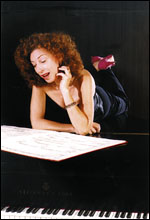
Visiting
assistant professor Dora Ohrenstein will direct the rarely performed
"Dido and Aeneas" next month, giving the opera, composed in 1689,
a contemporary spin. |
| |
Photo:
Frank Miller |
| |
|
Her classical
training, combined with a deep, experiential knowledge of past and present
American composers like Charles Ives and Ben Johnston, has inspired
Ohrenstein to continually risk exploring new vocal terrain and experimenting
with a wide variety of musical styles.
As a performer
and teacher—she directs UB's Opera Workshop and teaches voice as
a visiting assistant professor in the Department of Music—she brings
audiences and students into a heightened awareness of the historical
context of her performances by making it relevant to the concerns and
culture of the present day.
Next month,
Ohrenstein will direct Henry Purcell's "Dido and Aeneas," a rarely performed
opera—the first opera in English—composed in 1689 and based
on a section of Virgil's "Aeneid." Ohrenstein's production, while remaining
faithful to the original work, will illuminate the conflict between
public and private duty by placing the story within a context audiences
are familiar with: Dido is a movie queen and the opera's chorus is a
group of paparazzi who relentlessly invade her privacy.
The story
is a tale of disappointed love between Dido, Queen of Carthage, and
Aeneas, hero of the Trojan wars. The struggle between public and private
duty, a theme present in the original work's setting, is a concept supported
in Ohrenstein's interpretation with a live video camera on stage shooting
selected scenes that will be projected from video monitors placed all
around the theater. The audience will experience the stage production
and its video counterpart simultaneously, allowing for a multi-faceted
portrayal of Dido, the central character.
"It's very
important to me to not make any (directorial) decisions that defy the
essence of the work—to remain true to the work's conception," says
Ohrenstein, whose association with music theater includes her own critically
acclaimed, one-woman production entitled "Urban Diva" and the landmark
Philip Glass/Robert Wilson production of "Einstein on the Beach," a
five-hour opera that she calls "very visionary, avant-garde and completely
plotless."
In fact,
it was her decade-long stint as solo vocalist for the world-renowned
Philip Glass Ensemble that Ohrenstein credits with launching her career.
"Being in the ensemble professionally was a great blessing, it put me
on the map as an artist," she says. With the ensemble, Ohrenstein performed
throughout Europe, North and South America, Australia and Japan.
"When I
got into the ensemble, he (Glass) had just signed with CBS. It was a
huge breakthrough for any classical composer to sign with a major label—a
lot of people in the business resented that and put down Philip's music
as too accessible and not really art," she says.
A New York
City native, Ohrenstein originally started out as a pianist, having
played since the age of 9. "But," she confesses, "I was never that great.
I was very musical, but didn't have great chops." So, she learned to
sight-read music and by her early 20s knew that she wanted to be a singer
and has since performed everything from chamber music to Gregorian chants.
She has been called a singer of "limitless range" with a "liquid voice,"
and an "exhilarating" performer who "breaks with the expectations of
her vocal genre (to) explore uncharted territories."
However,
it is the American art song, represented by such diverse and critically
praised works as her four-disc recording of "The Complete Songs of Charles
Ives" (1994, Albany Records), her work with the group Bermuda Triangle
and their widely hailed program entitled "The Political Songbook," and
"Urban Diva" (1994, CRI) that perhaps defines Ohrenstein's career and
gives voice to the political and universal themes present in much of
her work: feminism, sexual identity, racism, heartbreak, longing and
loss.
"I realize
almost everything I do ends up having a strong feminist angle to it.
When I say 'feminist' I mean issues like women's sexual identity and
the roles they are made to play or are forbidden to play end up always
being a perspective I bring to the opera world," says Ohrenstein. Themes
of sexual identity and repression, as well as the media's invasion into
private life, she notes, are present in the updated production of "Dido
and Aeneas."
In May,
she will make her professional directorial debut in a Buffalo production
of "Pagliacci" with the Buffalo Opera Theatre. In fact, she gained valuable
experience in coordinating large productions when she commissioned five
American composers (Ben Johnston, Scott Johnson, Linda Bouchard, Anne
LeBaron and Anthony Davis) to write songs for "Urban Diva" and was able
to obtain a grant from the National Endowment for the Arts to pay the
composers and fund the musicians, costumers and other aspects of the
show.
Ohrenstein,
in the last year of a two-year contract with the Department of Music,
hopes to remain at UB and says she has enjoyed working with a "very
good body of accomplished students."
"Dido and
Aeneas," a multidisciplinary collaboration featuring student artists
from the departments of Media Study and Theatre and Dance, as well as
Music, will be performed at 8 p.m. March 8 and 2:30 p.m. March 9 in
the Drama Theatre in the Center for the Arts, North Campus. (For the
Department of Music's full concert schedule for March, go to Music
announces March concerts.)


