Krupski's
work focuses on wellness
Director
of Living Well Center offers students a holistic approach to life
By DONNA
LONGENECKER
Reporter Assistant Editor
As director
of the Living Well Center, Laurie Krupski, says she has the best of
both worlds—with work and play so deeply interwoven into her everyday
life, it's often hard to distinguish between the two.
| |
 |
| |
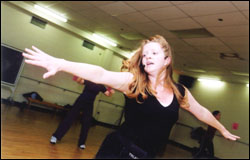
The
Neuromuscular Integrative Action class led by Laurie Krupski is
one of several mind-body activities students attending Krupski's
alcohol and drug awareness workshop must participate in. |
| |
Photo:
Nancy J. Parisi |
| |
|
That's
not to say she doesn't work and play hard—attending graduate school
and working at the center full time, as well as teaching evening classes
in ballroom dancing and an expressive fitness-and-awareness class called
Neuromuscular Integrative Action (NIA) designed to reduce stress and
stimulate awareness of the mind-body connection.
She also
spends many weekends practicing what she preaches—teaching students
on campus the value of embracing a holistic lifestyle as an alternative
to punishing their bodies with alcohol and drugs.
Students'
emotional, academic and social needs are the Living Well Center's primary
concern, she says. And the result is an increasing focus on incorporating
holistic wellness and the importance of life-long learning into students'
daily lives through a variety of programs.
Krupski
and staff at the center have integrated what they define as the "eight
dimensions of wellness," (social, occupational, spiritual, physical,
intellectual, emotional, cultural and environmental) into a philosophy
of wellness that strives to help students realize proactive goals of
personal development that in turn lead to more positive lifestyle choices.
Workshops on relationships, stress and time management, nutrition, fitness,
smoking cessation and alcohol and drugs are a part of the peer-education
activities hosted by the center.
The center's
workshops and much of Krupski's teaching style engage creative learning
strategies that appeal to all types of learners, from visual, tactile
and kinesthetic learners to the student who prefers listening or lecture
as a way to absorb information—with a primary goal of reducing
stress and helping students bond with their peers, says Krupski.
Part of
the education and outreach work undertaken in Krupski's "free time"
involves helping students find a more balanced approach to socializing
and getting to know their classmates without relying on alcohol and
substance abuse—a rite of passage for many students before they
even reach their freshman year at UB.
Even Krupski's
dissertation proposal as a student in the Graduate School of Education
is geared toward understanding and utilizing teaching strategies that
will most effectively reach students who have violated the university's
alcohol-and-drug policies—students who are mandated to attend a
two-weekend workshop with Krupski called the Student Educational Program
for Alcohol and Drugs (SEPAD). During that time, she teaches them to
recognize the signs of alcohol poisoning and discusses other options
to a lifestyle that for many revolves around weekend binge drinking
and substance abuse.
"The passion
for me is teaching and understanding what strategies are most effective
in engaging students. This is a challenge—to reach students who
are mandated, who don't want to be here and feel punished," she says.
Before
students attend the last of the weekend sessions, they must participate
in one of the center's mind-body activities, which includes classes
in meditation, mind-body awareness, self-defense, ballroom dance and
drumming.
"We're
giving them creative avenues to participate in activities that don't
involve alcohol and drugs, and that will help them really embody the
understanding of respecting their bodies," says Krupski. "Drinking and
partying are not just accepted, but promoted. It really is a challenge
for them to say 'no.' There is so much pressure to be accepted and fit
in."
Most of
the 26 students in a recent weekend session chose meditation as their
activity for the week, said Krupski. "They're interested in learning
how they can achieve a similar altered state of mind where, if they
need a release, they can do it on their own without turning to alcohol
and drugs," she adds.
Unfortunately,
she says, there are students who have become alcoholics by the age of
21. "Those students tend to come to me—they tend to recognize it
themselves," she says. In fact, a couple of students who have recovered
from drug and alcohol abuse now talk to students about their experiences,
hoping to bring more awareness to the consequences of substance abuse.
Krupski makes it clear that students don't have to be alcoholics to
have a problem.
She says
that when she asks students how many of them have hugged the toilet,
missed class or felt hungover the next day after a night of drinking,
all or most routinely raise their hands. When she asks those same students
if they feel they have a problem with drinking, invariably, no one raises
a hand. But, she adds, if a student admits to even one of the negative
effects of drinking, the consequences clearly have outweighed the benefits.
Krupski points to the case of Scott Krueger, an MIT student and Orchard
Park resident who died in the fall of 1997 of alcohol poisoning after
a night of binge drinking at a fraternity party.
"Scott
Krueger was not an alcoholic. He was not a seasoned drinker. He was
a student who went out to have fun and made some poor choices one night
that cost him his life. That night, he had a problem with alcohol,"
she said.
The results
of a survey given to incoming freshmen at UB last fall revealed that,
by and large, students overestimate the amount of alcohol consumption
engaged in by their peers, and consequently, try to live up to those
misperceptions. The end results of excessive drinking, Krupski says,
are lower grade-point averages, an increased likelihood of engaging
in unprotected sex, driving while intoxicated and dropping out.
Krupski
is trying to increase retention by emphasizing to students that "there
is nothing wrong with your need to feel de-stressed and to have fun,
but we're offering you healthy activities four evenings out of the week
in which you can meet those needs without alcohol and drugs."


