Quattrin
studies diabetesÐbone link
UB pediatrician
urges education about osteoporosis begin at earlier age
By
DONNA LONGENECKER
Reporter Assistant Editor
Diabetes
and brittle bones may go hand in hand, according to preliminary data
obtained in an ongoing UB research study. Thus, educating women who
have type 1 diabetes about osteoporosis must begin at a much earlier
age, according to Teresa Quattrin, associate professor of pediatrics
in the School of Medicine and Biomedical Sciences and director of the
Diabetes Center at Children's Hospital.
| |
 |
| |
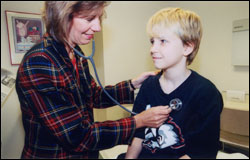
Teresa
Quattrin listens to 10-year-old Mike Witherell's heart during an
examination at Children's Hospital |
| |
Photo:
Jessica Kourkounis |
| |
|
Quattrin
is the lead investigator on a study that seeks to establish a possible
link between women diagnosed with type 1 diabetes and the early onset
of osteoporosis, a disease that affects nearly 10 million Americans,
about 8 million of whom are women, according to Diabetes Forecast.
With funding
from an American Diabetes Association Clinical Research Award, Quattrin
four years ago began a cross-sectional, bone-mineral density study—that
since has expanded into a much larger, longitudinal study—to try
and pinpoint when and why bone loss begins occurring in young women.
"We wanted
to see how women ages 13 to 19 were doing and wanted to see women in
their 20s and 30s, because one of the issues is that it (bone loss)
seems to strike women before the classic symptoms of osteoporosis would.
Ordinarily, you think of women getting this during the menopause years,"
says Quattrin. The study may prove to be groundbreaking, she adds, because
of the lack of definitive research on bone density loss in young people
with type 1 diabetes.
As part
of the cross-sectional study, bone-density scans were obtained from
two groups of females between the ages of 13 to 18 and 19 to 30 who
had type 1 diabetes. Each group also had a matched-age control group.
The scans showed that although type 1 study participants' bone density
was within normal limits, it was lower than the bone density of those
in the control group. Quattrin hopes that the data obtained from both
studies, along with a two-year follow-up, will give researchers the
tools to develop preventative measures relative to the needs of young
women with type 1 diabetes.
The second
component of the study examined blood and urine levels of such hormones
as osteocalcin, estrogen and insulin—all of which play an important
role in the formation of healthy bone—and N-telopeptides, a marker
of bone resorption. Quattrin says that although preliminary data hasn't
yet established a relationship between key hormones related to bone-mineral
density, it is well-established that obese people who produce excessive
insulin tend to have higher bone-mineral density, while the opposite
is true for people with lower insulin levels. This, she says, provides
the conceptual link between insulin and bone density.
One thing
is certain: Young girls need to reach peak bone-mineral density quickly,
before maturity if possible. There is only about a two-year window of
opportunity after the onset of menstruation in which most young women
experience increases in bone density, says Quattrin.
"If you
are 25 and have a low bone-mineral density, it's not likely that you're
going to increase it," she adds.
Moreover,
there is power in knowing one's family history because bone-mineral
density is "highly genetically determined," according to Quattrin. "Many
women would know exactly if their mothers had something bad like cancer
of the uterus, but they may not pay any attention to the fact that their
moms might have been having bone loss in earlier years."
Other important
factors determining healthy bone formation are such lifestyle issues
as diet, weight, smoking and exercise, and the use of hormonal preparations
like estrogen, which actually may increase bone-mineral density. Quattrin
also emphasized that the patient's relationship with her team of physicians
and caregivers is vital to making any treatment protocol a success.
"This kind
of education should happen in a young woman's life, (in) the school
and in the pediatrician's office because those are very critical years
to form lifestyle habits that will help you preserve your bones down
the road," says Quattrin.
While the
public at large is much more educated about the importance of bone strength,
the focus remains on middle-aged and pre-menopausal women, she adds.
"It's a funny joke when people tell you 'I shrunk; I used to be 5' 4"
and now I'm 5'3",' but it's not a joke," Quattrin says, pointing out
that spinal measurements of middle-aged people show significant decreases
in bone density that often go undetected until a problem occurs, such
as a fracture from a fall.
Quattrin
generously praises her colleagues at Children's Hospital, and looks
forward to expanding her research into other issues related to diabetes.
Key researchers on the study include Jean Wactawski-Wende, assistant
professor of gynecology and obstetrics; Richard P. Donahue, professor
of social and preventative medicine, and Jacek Dmochowski, assistant
professor of statistics, and their participation underscores what Quattrin
calls "exciting (cross-disciplinary) collaboration."
"Ultimately,
my philosophy and my hope is that we may be able to continue our interdisciplinary
research within clinical research," she says. "I am hoping that we also
will get other colleagues involved in the basic research to collaborate
with us so that it (the work) will be across-the-board and looking at
other systems and other pathologies as well. We don't want to forget
the basic science aspect of it, and I hope to have a larger team working
at UB on all aspects related to bone-mineral density and diabetes in
general," she added.


